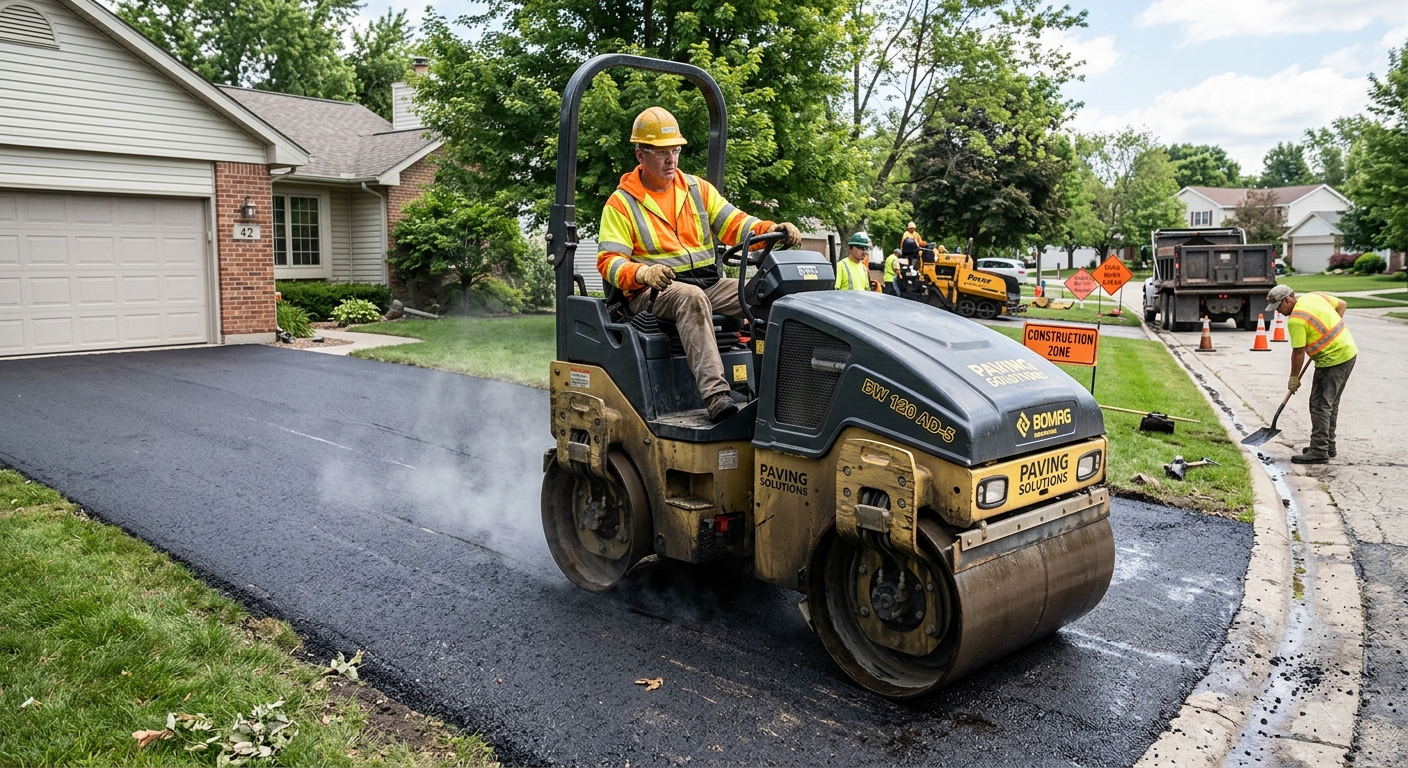
What a new driveway costs in Limerick
Limerick is a mostly owner-occupied, single-family community—57.9% of homes are detached, and 83.7% are owner-occupied (U.S. Census Bureau, ACS 2024). That means driveways aren’t just cosmetic; they’re a real property expense that most residents will face sooner or later. Where most homeowners get tripped up, especially in places with our Montgomery County conditions, is not the visible pavement but what’s underneath. Prices swing wildly quote-to-quote because the most expensive part—the stone base, the prep work, and the drainage—is buried and invisible before the first truck pulls up. A pretty top layer means nothing if there’s soft clay underneath or the base isn’t thick enough.
Limerick’s climate—moderate freeze-thaw cycles and humid summers—complicates matters. Water in the base, trapped by heavy silty clay (common in this part of Montgomery County), expands and contracts, breaking up thin or weak spots. It’s why replacing a driveway here isn’t just a matter of “how thick the blacktop is,” but how well it fights water from below as seasons shift. That is what drives cost: labor and materials you won’t see, but that determine whether your new drive lasts decades or needs redoing in five years.
| Service |
Best for |
Lifespan |
Price range |
| Asphalt — full replacement with new base |
failed base, structural cracking |
20–30 yrs |
$3,900–$10,000 |
| Asphalt overlay / resurfacing |
sound base, surface cracking only |
8–15 yrs |
$1,650–$5,000 |
| Sealcoating — single application |
preventive maintenance on sound asphalt |
2–4 yrs |
$225–$750 |
| Concrete — new installation |
long service life, low maintenance |
30–50 yrs |
$5,500–$13,500 |
| Crack filling and patching |
isolated cracks under a quarter inch |
1–3 yrs |
$200–$800 |
| Gravel driveway |
rural, budget, long runs |
5–10 yrs with upkeep |
$900–$3,500 |
Estimates for a typical Limerick driveway. Square footage and base condition drive these figures more than material choice.
Grading and water management on a Limerick driveway
Montgomery County driveways fail from the bottom up, and water is the main culprit, especially in Limerick where moderate freeze-thaw cycles wreak havoc. Proper grading is not just a finishing detail—it’s what keeps your drive from rapid deterioration. Every driveway should be pitched at least 2% away from structures; that means a minimum slope of a quarter inch per foot, enough to shed water so it can’t pond or soak in. For center-running driveways, a crowned shape sends water to both sides; a side-to-side cross-slope does the same when width and layout allow.
In Limerick, many properties have silty clay beneath—a soil that holds water and drains poorly. That makes grading even more crucial: trapped water sitting in the base will freeze, expand, and heave the pavement above. If your lot or topo sends water toward the garage or house, you need more than a pitch; trench or channel drains at the right spots collect and redirect flow, while dry wells or daylighted outlets handle what the natural grade can’t move. Never shortcut here—compromising on under-surface drainage is the surest way to a short-lived drive.
One more hard boundary: you can’t simply push runoff onto a neighbor’s property. Drainage liability survives even if permits are silent; sending your stormwater into another yard makes for a lasting problem under Pennsylvania law. Good grading and water management keep the peace as well as the pavement.
How to vet a paving contractor in Limerick
In Limerick, a good paving job does not start with a fast talker and a cell phone—it starts with accountability. Montgomery County’s market is saturated, so you’ll see trucks everywhere, but only a portion are truly local firms equipped for proper work. Ask where their asphalt or aggregate comes from. Local supply—plants along the I‑276 and US 202 corridors—should be their answer. If they hesitate, they may not do their own paving at all. Insist on seeing their Home Improvement Contractor (HIC) registration at hic.attorneygeneral.gov for any job over $500, and check Workers’ Compensation compliance through the state’s WCAIS system (wcais.pa.gov).
Equipment matters: owned gear on site and a local, verifiable address show roots in Limerick, not just a name on a truck. Get references from jobs three or more years back—driveways age slowly, so fresh reviews are next to meaningless. If the contractor cannot supply specifics, walk away.
- PA Home Improvement Contractor registration check
- Proof of Workers’ Compensation from WCAIS
- Local, physical business address—not a PO box or just a cell number
- Owned (not rented) equipment
- References from 3+ years ago, not just new jobs
- Ability to name their asphalt or aggregate supplier (I‑276/US 202 corridor for Limerick jobs)
- Written contract per state law (HICPA) for jobs over $500
- Clear start and completion timeline in writing
- Description of full scope, not just “blacktop” or “sealcoat”
- Reasonable deposit terms—avoid full prepayment
- Specific warranty in writing, not just “guaranteed”
- Vehicle and crew branded with the company name
Red flags: anyone who pressures you for a cash deposit, gives only a cell number, cannot show registration or insurance, or offers no supplier or local references is counting on being gone before the first frost.
Maintenance that actually works
If you want a Limerick driveway to outlast the average, start with the basics: filling cracks before water gets in. That is the cheapest and most effective protection—left open, even hairline cracks let moisture reach the base, freeze, and force up the top. Next is edge support: the thinnest, weakest point of any drive is its open side. Backfill the edges with soil or aggregate to prevent unraveling and crumbling. Keep downspouts and all surface water moving off the pavement. Idle dumpsters, jack stands under tires, and repeated spot loads create divots—use proper pads or avoid these stresses whenever possible.
New asphalt in Limerick’s seasonal swings needs 3-7 days minimum before parking vehicles, longer in humid summer. Wait at least a year before applying the first sealcoat. Spinning tires or turning while stationary risks scuffs in soft, still-curing pavement.
For de-icing, know this: never use salt or any chloride on concrete—spalling and premature flaking are guaranteed. On asphalt, salt isn’t a direct chemical threat, but meltwater seeps in, refreezes, and expands, speeding up cracking. Sand works, as do pet-safe, calcium-based blends, but they cost more—somewhere between $15 and $35 per bag compared to common salt. For most Limerick drives, mechanical snow removal and judicious spot treatment beats any chemical overload in our freeze-thaw climate.
Reading a driveway proposal
The best defense against overpaying for a driveway in Limerick is an apples-to-apples quote—and most “estimates” aren’t even close. Every serious bid should spell out the measured square footage (not just length/width guesses), the depth to be excavated, what’s happening with the old pavement, and exactly what type and depth of new stone base is going in. Compaction—in lifts, not just a roller over the top—needs to be included. Asphalt is best done in two layers: binder then surface, each with a compacted depth stated. Edge restraint, site grading for water, lawn restoration and cleanup, and the payment schedule (modest deposit, not most up front) round it out.
Warranties should be in writing (don’t expect coverage for future cracks—most exclude them outright). And if the proposal just reads “Asphalt overlay: $4,000,” skip it—you cannot compare specs that aren’t there. This is, hands down, how most subpar work gets sold: an empty piece of paper with a big number at the bottom.
| Line item |
What to look for |
Red flag if… |
| Area |
measured square footage stated |
eyeballed or absent |
| Excavation |
depth and disposal included |
'we'll pave over it' |
| Base |
aggregate type and depth in inches |
'proper base' |
| Compaction |
method, and done in lifts |
not mentioned |
| Asphalt |
courses and compacted depth |
'3 inches' unqualified |
| Drainage |
slope and water direction stated |
silent |
| Warranty |
what is covered and what is excluded |
verbal only |
| Payment |
modest deposit, balance on completion |
full cash up front |
Driveway permits, approaches and stormwater rules
In most of Montgomery County, including Limerick, repaving your existing driveway does not typically require a building permit if you’re keeping the same footprint. That saves you time (and a call to the township) for routine work like overlays or sealcoating. The exception is where the driveway meets the public road: the driveway approach. For properties on township roads in places like Montgomery Township, the Public Works Department handles “road occupancy” permits, not the building code office. If you’re widening the drive, cutting curbs, or working near a sidewalk or apron, a permit is nearly always required—especially in denser areas.
Pennsylvania’s climate brings enough runoff issues that adding or expanding impervious driveways can create headaches. Some properties will need to address stormwater management, such as swales, drains, or dry wells, particularly if more water is being sent to the street or a neighbor. Regardless of what the permit says, you are still liable if your runoff damages an adjacent lot.
Every contract over $500 must be written, and every contractor should show HIC registration at hic.attorneygeneral.gov. Workers’ compensation is mandatory for all employers and verified via WCAIS. Don’t move forward without proof in writing—Limerick homeowners have real protection under Pennsylvania law.
Why you can't pave in February
Paving season in Limerick is not a matter of preference—it’s a hard limit set by the climate. Asphalt must be delivered and installed hot; once air temperatures in southeastern Pennsylvania dip below about 45°F, mix cools so quickly that it cannot be compacted properly. This is not theory—the region’s winter design temperature is 14°F, and local asphalt plants along I‑276 and US 202 flat-out close from late November into March. That means if someone promises to “get your drive in before spring,” you’re either getting cold-mix (which doesn’t last), or a shortcut job with no chance of proper bonding or compaction.
Concrete has its own window—if overnight lows hit freezing, the surface can’t cure, and surface scaling or permanent damage is likely. For that reason, the concrete season here starts in the spring when nights are safely above freezing and runs only to early fall. Even then, pours should happen in dry, mild weather.
The shoulder seasons—April/May and September/October—are best for getting both crews and pricing, as summer is peak season and books earliest. If a Limerick contractor offers to pave after Thanksgiving or before March, take it as the warning it is: no credible supplier or contractor in this area operates in those conditions. For real driveway durability, trust the seasonal rhythm—it’s determined by the weather, not the calendar.
Frequently asked questions — driveway paving in Limerick
What is the difference between binder and surface course?
In Limerick, as in all of Montgomery County, proper asphalt driveways are built with at least two layers. The binder course is the first layer—it's thicker, coarser, and makes up most of the structural support. The surface course is finer, uses smaller aggregate, and forms the smooth, finished layer you see and drive on. You need both: binder for strength, and surface for finish and durability. Many cheap bids skip the two-layer build, laying all the thickness in one go, which consistently results in early cracking from freeze-thaw cycles. If you're paying for a full replacement in the $3,900–$10,000 range, make sure both courses are specified on your proposal. This detail in the quote tells you the contractor plans for longevity, not just a quick overlay.
Can I pave over my existing driveway?
In Limerick, you can sometimes pave over an old driveway, known as an asphalt overlay, if the existing base is still sound and there are only surface-level cracks without dips or structural heaving. Overlays are popular in Montgomery County’s post-1945 subdivisions, where the original construction was decent but the surface is aged. They typically cost $1,650–$5,000, a lot less than tearing everything out. The key is what’s under the old pavement—if you pave over failing or soft spots, you just hide the problem and buy a few extra years (at best). Ask for a proper inspection before deciding. If the base is failing or there’s deep cracking and movement, a full replacement is money better spent.
Are there stormwater rules on paving in Limerick?
Yes, stormwater is not just a formal concern—it’s a practical and legal issue for Limerick homeowners. Expanding a driveway or increasing impervious surface may trigger township or county requirements for managing runoff, especially if the water flows toward the street or a neighbor. Even if no specific permit is required for resurfacing, you are liable if your new hard surface causes drainage problems next door. Professional paving contractors in Montgomery County should address drainage in their proposals and may recommend grading, swales, or dry wells. Expect this additional work to add anywhere from $200–$800 for minor improvements to much more for substantial site changes. Ignoring it risks neighbor disputes and expensive rework.
How much does it cost to widen a driveway?
The cost to widen a driveway in Limerick depends mainly on whether you are expanding into undisturbed yard or adding onto an old drive edge. If you’re adding asphalt on a new stone base, expect pricing between $3,900–$10,000 for a new-width install, though smaller bump-outs can be less expensive. Beware that any work touching the driveway approach—where your drive meets the road or sidewalk—almost always requires a local permit. If stormwater drainage or soil conditions need addressing, that adds to both complexity and cost. Always get a detailed, itemized proposal so you know exactly what’s included and what’s extra.
What causes concrete to spall or flake in Limerick?
Concrete spalling or flaking is a familiar issue in Limerick, and the main causes are freeze-thaw cycles and de-icing chemicals. When water enters the surface and cycles between freezing and thawing, it expands inside the concrete and causes pieces to pop off. Using salt or other ice-melting chemicals accelerates this process, especially in southeastern Pennsylvania's humid winter swings. Poor finishing practices—like over-troweling or not allowing a proper cure—make it worse. Even the best concrete needs protection: keep salt away, seal joints as needed, and try sand for traction during icy spells instead. Neglected maintenance can turn a new $5,500–$13,500 driveway into a patch job in just a few winters.
How much does a concrete driveway cost in Limerick?
A concrete driveway in Limerick generally costs between $5,500–$13,500 for a new installation, with most falling near $8,800 for an average-size, single-family home. Concrete is popular here for its longevity and low maintenance, typically lasting 30–50 years if installed properly and not abused by salt in the winter. Expect the price to vary based on square footage, site prep, soil conditions (heavier subgrade prep for clay soils), and any added details like decorative finishes or drainage work. If you see a quote dramatically below this range, scrutinize the proposal—it may skip essential base depth or finishing steps that prevent future frost damage.
Does sealcoating fix cracks?
Sealcoating does not fix cracks in a Limerick driveway. What it does is put a thin, protective layer over sound asphalt, helping block UV damage and minor surface wear for two to four years. Cracks must be cleaned out and filled before sealcoating; otherwise, water still gets into the base, and nothing stops freeze-thaw damage. For isolated cracks under a quarter inch wide, professional crack filling costs $200–$800 and is your first line of defense. For larger or connected cracks, sealcoating is at best a cosmetic mask—not a repair. Done right, both can buy you more years, but don’t let anyone sell you sealcoating as a structural fix.
What kind of soil is under Limerick driveways?
Most Limerick driveways are built on silty clay or glacial till—a subgrade that holds water and drains slowly. This soil is typical for eastern Montgomery County and underscores why a thick, well-compacted stone base is needed—otherwise ruts, settlement, and heaves form, especially after wet winters. A shallow or poorly prepped base in this soil type guarantees early failure, even if the surface looks great initially. That’s why a full-depth replacement (in the $3,900–$10,000 band) costs more but lasts much longer in these conditions. If your current driveway is alligator-cracked or uneven, the root cause is almost always in the base, not the visible surface.
Can asphalt be laid in cold weather?
Asphalt paving in Limerick and Montgomery County simply does not happen in cold weather, and for good reason. Hot-mix asphalt must stay at a set temperature to compact and bond; after air temps drop below 45°F, the mix cools too fast, resulting in weak, porous pavement liable to crack in the first winter. Local asphalt plants along the I‑276 and US 202 corridors close for the winter, so real paving work is paused from about Thanksgiving to March. Anyone offering to pave your drive in January is either using inferior cold-mix or taking shortcuts. For a project in the $3,900–$10,000 range, wait until spring for quality that lasts the full lifespan—and avoid wasted money on work that won’t hold up.