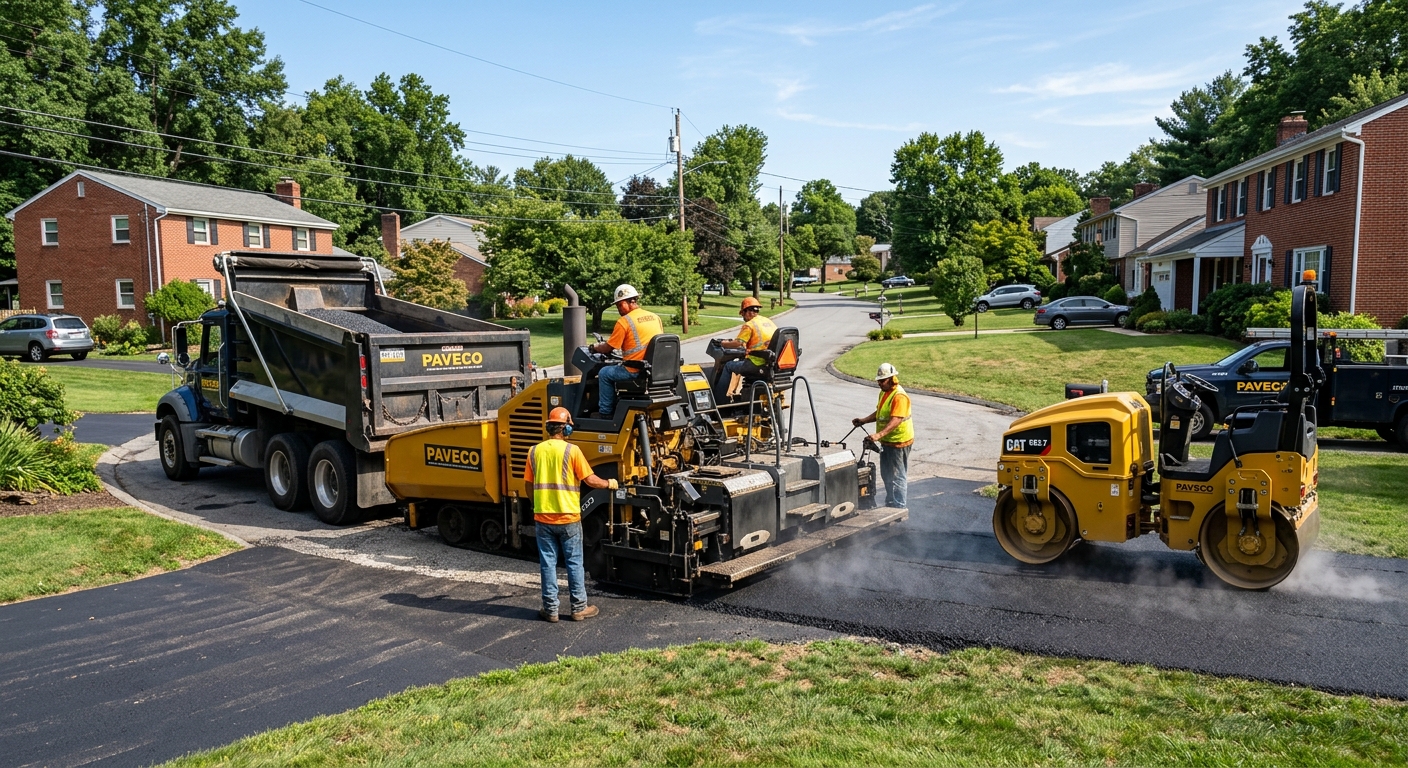
Center paving prices by scope — 2026
In Center, where 84.1% of homes are stand-alone houses and nearly 8 out of 10 are owner-occupied (U.S. Census Bureau, ACS 2024), driveways are a real part of home life and upkeep. The price to pave or replace a driveway here reflects not just the visible surface, but how thoroughly the contractor addresses hidden conditions under the asphalt or concrete. The area’s hilly lots and glacial till or shale subgrade drive most of the cost-to-value discussion; good prep below grade is what separates a driveway that lasts decades from one that fails within a few winters. This is especially true in Center, where heavy freeze-thaw cycles and clay-heavy soils mean water infiltration and expansion are constant threats.
Most of the dollar difference between two asphalt quotes will be buried, literally, in the base work. Homeowners rarely see base thickness, compaction, or subgrade treatment, yet those factors set future lifespan. Cutting corners here saves money only in the moment. Below is what to expect for the most common paving and repair jobs in Center:
| Service |
Best for |
Lifespan |
Price range |
| Asphalt — full replacement with new base |
failed base, structural cracking |
20–30 yrs |
$3,600–$9,400 |
| Asphalt overlay / resurfacing |
sound base, surface cracking only |
8–15 yrs |
$1,550–$4,700 |
| Sealcoating — single application |
preventive maintenance on sound asphalt |
2–4 yrs |
$200–$750 |
| Concrete — new installation |
long service life, low maintenance |
30–50 yrs |
$5,200–$12,500 |
| Crack filling and patching |
isolated cracks under a quarter inch |
1–3 yrs |
$200–$800 |
| Gravel driveway |
rural, budget, long runs |
5–10 yrs with upkeep |
$900–$3,500 |
Estimates for a typical Center driveway. Square footage and base condition drive these figures more than material choice.
How paving fraud actually operates
Driveway paving draws more than its share of fly-by-night operators and outright scams, especially in a mostly suburban–rural market like Beaver County. The combination of high homeownership and houses set apart from neighbors helps shady crews disappear before poor work is noticed. The plays are predictable, but still effective: “leftover materials from a job down the road,” “today-only special,” unmarked trucks with out-of-area tags, insisting on cash up front, giving you a handshake quote with nothing in writing, or spraying thin oil and calling it sealcoating. In sparsely-set communities, references are harder to check and neighbors are less likely to spot questionable activity, making homeowners even easier targets.
The key legal protections here were written for exactly these situations. Under the Pennsylvania Home Improvement Consumer Protection Act (HICPA), any paving work over $500 must come with a written contract—and you have a right to cancel that contract within three business days with no penalty. Do not waive this right, and never accept a “deal” that depends on giving up your legal protection. Crews offering these red-flag deals often demand the check be made out personally, price well below market, or vanish when you start asking for paperwork. If you do not see the business’s name (matching their registration card) on their truck and contract, walk away.
Spend five minutes: Verify their Home Improvement Contractor registration at hic.attorneygeneral.gov, ask for written workers’ compensation proof, check both their phone number and address, and don’t pay Cash. These steps defeat almost all the common scams.
When paving can actually be done in Center
Paving isn’t just a matter of scheduling in Center; our freeze-thaw and heavy winter climate set hard limits on when quality work is possible. Hot-mix asphalt only performs as designed if laid while the air and base are warm enough for proper compaction—once temperatures drop toward the region’s winter design temp of 8°F, asphalt cools too fast, and you end up with a brittle, porous surface guaranteed to fail. The concrete guys face a similar wall: concrete can’t set properly below freezing and will spall or crack if poured in cold snaps.
Local plants that supply hot-mix asphalt near Aliquippa and Ambridge shut down over the winter, cutting off the supply entirely after late fall. Trying to lay pavement when material plants are closed or temperatures are borderline is a sign the contractor is desperate for work, not that they have a secret technique. Plan driveway projects from April through early November for the best results. Mid-spring and mid-fall, crews usually have more flexibility and sometimes lower prices before summer’s rush. By July and August schedules are packed, but your finished product will last if done then. If anyone offers to pave your driveway after plant close or during deep cold, that’s the biggest red flag you’ll encounter.
Maintenance that actually works
If you want your driveway to last in Center’s climate and soil, there are a handful of maintenance steps that matter. First: address cracks quickly, before thaw and rain can get water into the base and start the freeze-expansion cycle that wrecks driveways below the surface. Keep the driveway edges supported—soft edges break down, letting water and soil undermine the whole structure. Maintain proper drainage so water flows away, not across or under, the drive. Don’t park heavy equipment, jack stands, or dumpsters directly on the pavement—they’ll leave permanent dents or cracks, especially in the heat of summer or during cold snaps when the material is brittle. New asphalt needs a minimum two–three days (after roller traffic) before you park on it, and no turning your wheels in place the first week.
Come winter, the de-icing question gets tricky. Salt is tough on concrete, causing early scaling and surface breakdown, especially with repeated freeze-thaw cycles. Asphalt handles salt better chemically but suffers from the freeze-melt-refreeze action. Sand or calcium magnesium acetate can fill in, but both cost more up front—and sand creates more spring cleanup. The best policy is to clear snow promptly and use the lowest effective dose of any de-icer, no matter your surface.
Which surface survives Center winters
Center’s winters, with frequent freeze-thaw cycles and clay-dominated soils, punish rigid surfaces and expose thin or poorly bonded layers. Asphalt is often the most forgiving option in Beaver County because it flexes with ground movements and recovers from small frost heaves, while concrete, rigid and unyielding, can develop deep cracks or catastrophic scaling if salt is used for ice and snow—something nearly every homeowner here finds hard to avoid. While a concrete surface can outlast asphalt if the owner avoids all salt, the reality is most people use de-icers during icy southwestern PA winters, making that promise hard to keep.
Asphalt’s main maintenance is sealcoating every few years and periodic crack filling—costs are ongoing but manageable. It doesn’t last as long as properly poured concrete, but it’s forgiving of some movement and cheaper to repair. Pavers perform well here if installed with a stable base and edge restraint, flexing individually without major cracks, though install cost is toward the top end. Gravel is the least sensitive to freeze-thaw; it requires top-dressing rather than structural patching and is sometimes the only answer for very long or steep drives where runoff would ruin a hard surface.
| Option |
Installed cost |
Maintenance |
Freeze-thaw performance |
Lifespan |
| Asphalt — new install |
$3,600–$9,400 |
sealcoat every 3–4 yrs |
excellent, flexes |
20–30 yrs |
| Asphalt — overlay |
$1,550–$4,700 |
same |
good if base is sound |
+8–15 yrs |
| Concrete |
$5,200–$12,500 |
low, avoid de-icing salt |
fair, spalls with salt |
30–50 yrs |
| Pavers |
$8,300–$12,500 |
individual units replaceable |
good, settles gradually |
25–50 yrs |
| Gravel |
$900–$3,500 |
top-dress every 2–3 yrs |
excellent drainage |
indefinite with upkeep |
What you need before paving in Center
If you’re repaving an existing driveway in Center Township and not expanding its footprint, you generally do not need a building permit according to most local rules in Beaver County. However, if you are creating a new driveway or widening your existing one, especially in Beaver Borough, a building or zoning permit is required before any work starts. The key spot where many homeowners get tripped up is the driveway approach—the part that connects your drive to the public road. For any work on or near state routes in Beaver County, a highway occupancy permit must be obtained from PennDOT District 11-0. This can add time and paperwork, so check early if your drive meets a major road.
Any expansion in impervious area (more pavement) can trigger stormwater requirements and even if not, you remain liable if your new driveway redirects water onto neighboring property. Municipal offices can clarify local rules but mind grading and drainage regardless of permit details.
Pennsylvania law also requires paving contractors to register as Home Improvement Contractors for projects over $500—check their number at hic.attorneygeneral.gov. ALL employers must carry workers’ compensation coverage; proof is verifiable through the WCAIS system. Insist on seeing these before signing any contract.
Drainage: the failure nobody plans for
Water is the single most destructive force acting on driveways in Center. Proper grading isn’t cosmetic—without it, water infiltrates the base, freezes, and turns a new drive into rubble in a few seasons. Aim for at least a 2% slope away from buildings, or about a quarter inch per foot. For flat or broad driveways, a slight crown (raised centerline) promotes runoff to the sides; otherwise, a cross-slope is needed to direct water away from garages and homes.
Problems arise when driveways slope back toward the house or level out just before the garage door—here, adding trench or channel drains can make the difference between a dry garage and chronic water incursions. If you can’t achieve daylight drainage (where water runs off to the curb or yard), a dry well or catch basin may be required, but these need special planning on Center’s clay subsoils, which drain poorly and can keep water pressed up against the driveway base. That adds future risk in our heavy freeze-thaw cycles; trapped water means expansion and heaving in winter.
Never redirect runoff onto your neighbor’s property—even with a permit, it’s a liability and often triggers complaints or even legal action. Good drainage design is the root of a long-lasting drive in Center’s soils and climate.
Frequently asked questions — driveway paving in Center
How deep should the aggregate base be here?
In Center, local glacial till and shale soils, plus heavy freeze-thaw cycles, mean you need a thicker base than in other regions. For asphalt, a proper base is 6–8 inches of compacted stone with fines, not the 4 inches some contractors propose. On slopes, dense clay, or where the soil holds water, it is wise to lean toward 8 inches for extra stability. For concrete, the sub-base is even more critical. Skimping on thickness may save upfront costs but guarantees problems—potholes, heaving, or cracks—down the line. For a full-depth asphalt replacement, a typical Center homeowner will pay $3,600–$9,400 depending on drive size and prep needs. Always insist on visible, compacted layers during installation.
Why does my driveway have depressions that hold water?
Depressions or “birdbaths” are common in older Center driveways because of settling in the base, especially after decades of freeze-thaw and clay soil shifting. Sometimes original installation skipped proper compaction, or later water infiltration eroded the underlying stone. A thin or soft base in this part of Beaver County is the start of most trouble. Surface repairs can help, but persistent low spots indicate base failure and mean you should budget for an overlay or full replacement at $1,550–$9,400 rather than patching endlessly.
How long before I can drive on a new asphalt driveway?
After a new asphalt driveway is laid in Center, wait at least 48–72 hours before driving or parking on it if you want to avoid tracks and ruts, especially during peak summer heat. The surface will continue to harden over weeks, but the major curing happens in those first few days. Turning wheels while stationary can easily gouge or scuff new pavement. For overlays on an existing base, the same wait applies. A proper install at $3,600–$9,400 deserves the little extra patience to ensure a clean, durable finish. For concrete, wait a week.
What does an asphalt overlay cost in Center?
An asphalt overlay—where new hot-mix is laid over an existing base that is still sound—runs from $1,550–$4,700 for most typical Center driveways. Base condition is the single biggest variable. If your existing drive is cracked but stable and has no soft areas, an overlay extends life about 8–15 years for much less than a full replacement. If the base is compromised, overlays won’t last. Always have the contractor inspect for soft spots, especially with Center’s clay subgrade and slopes.
What is the difference between crack filling and sealcoating?
Crack filling targets isolated cracks under a quarter inch wide, using specialized rubberized material to keep water from reaching the base—absolutely critical in Center’s freeze-thaw cycle. It’s a spot repair and can last 1–3 years. Sealcoating is a surface application for the entire driveway that restores color and adds minor protection against sun and water; it’s not meant to repair structural issues. Done every 2–4 years at $200–$750 in Center, sealcoating keeps the drive looking fresh but won’t fix root-level problems the way timely crack filling can.
Are there stormwater rules on paving in Center?
Expansion of any paved surface in Center typically brings stormwater rules into play. Even if local code enforcement doesn’t require a permit for a simple resurface, adding new pavement area often means showing your plans for runoff control. Directing stormwater onto someone else’s property is always the homeowner’s liability, with or without a permit. For projects over $500, you’ll need both a written contract and attention to drainage—cutting corners here is sure to cause neighbor complaints or worse.
Are pavers worth the cost in southwestern Pennsylvania?
Pavers are a premium choice in Center, with install costs from $8,300–$12,500 for a typical drive. They don’t crack like concrete, since each unit can flex independently, and if settling happens because of freeze-thaw or poor subgrade, you can lift and reset individual pavers rather than jackhammering a section. Their repairability and looks make them a great long-term investment for some, but only if installed with proper base prep (usually 8–10 inches deep here). If resale, low maintenance, and appearance matter, they’re worth considering.
Does Center have local asphalt plants?
Yes, Center is near several asphalt plants located in Aliquippa and Ambridge. This is important—shorter haul distances keep pricing reasonable and ensure the mix stays hot all the way to your driveway. For more rural jobs in Beaver County, longer trips add to costs and scheduling. Center homeowners benefit from having local supply, which means reliable material and better quality work within the price range of $3,600–$9,400 for a full install.
How much does it cost to widen a driveway?
Widening an existing driveway in Center typically falls between a resurface and a full replacement, depending how much new base and grading is involved. For straight add-on sections with minimal drainage changes, expect $1,550–$4,700 if just resurfacing, or $3,600–$9,400 for a full-depth extension. Permits can be needed in parts of Beaver County, especially when the work changes how water moves on your lot or the connection to a public road. Always confirm drainage and permitting before starting.