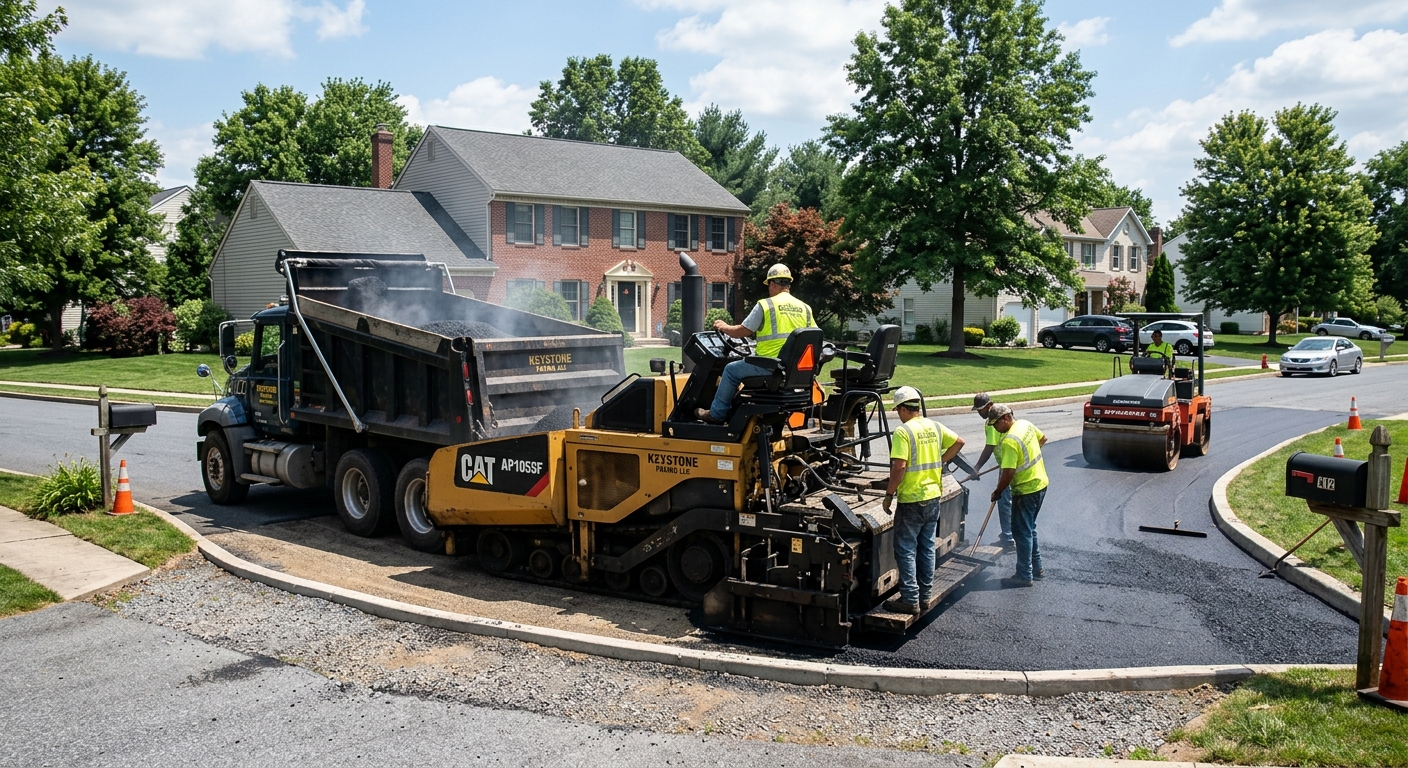
What a new driveway costs in Butler
In Butler, a driveway is one of the bigger investments that comes with owning a single-family home—which matters, since 84.8% of homes here fall in that category, and homeownership sits above 86% (U.S. Census Bureau, ACS 2024). If you’re pricing new paving, know that surface materials are just part of the equation. The real price difference between local quotes lies in what happens underneath: compaction, base thickness, drainage, and prep. You won’t see most of those choices after the job is done, but they make the difference between a driveway that survives Butler’s fierce freeze-thaw cycles (thanks to our 36-inch frost depth and ground prone to heaving) and one that falls apart early.
Butler sits on glacial till and shale—soft enough you need a good, thick, compacted stone base. Skimp here and you’ll see ruts, cracks, and drainage problems soon as winter sets in. Upfront, this means higher labor and some material cost, but it’s what keeps your new driveway from failing before its time. Here’s what you can expect to pay for typical driveways and maintenance services in Butler:
| Service |
Best for |
Lifespan |
Price range |
| Asphalt — full replacement with new base |
failed base, structural cracking |
20–30 yrs |
$3,600–$9,200 |
| Asphalt overlay / resurfacing |
sound base, surface cracking only |
8–15 yrs |
$1,550–$4,600 |
| Sealcoating — single application |
preventive maintenance on sound asphalt |
2–4 yrs |
$200–$700 |
| Concrete — new installation |
long service life, low maintenance |
30–50 yrs |
$5,100–$12,000 |
| Crack filling and patching |
isolated cracks under a quarter inch |
1–3 yrs |
$200–$800 |
| Gravel driveway |
rural, budget, long runs |
5–10 yrs with upkeep |
$900–$3,500 |
Estimates for a typical Butler driveway. Square footage and base condition drive these figures more than material choice.
Comparing paving estimates in Butler
Comparing estimates is tough because what matters most is buried. In Butler, the true cost drivers aren’t the asphalt or concrete you see—they’re the prep and base you don’t. You want a quote that states the measured square footage of your driveway, excavation depth, which stone is going down for the base, how thick (in inches), and how that stone is compacted in layers. Good estimates break out asphalt depth and number of courses and specify edge protection, grading for drainage, and what happens with the lawn edge. Cleanup and restoration around the driveway matter, too.
Always expect a clear payment schedule, usually with a small deposit and balance due after the work is complete. Reputable pavers in Butler also write out a warranty—but most exclude cracking, which surprises a lot of people. A strong warranty is backed by a business address, not just a phone number.
The number one way Butler homeowners get burned: accepting a quote that’s just a one-liner with a total and no detail. If a quote doesn’t spell out each step, you can’t compare it—it’s usually a sign you’ll get underbuilt work for premium money.
| Line item |
What to look for |
Red flag if… |
| Area |
measured square footage stated |
eyeballed or absent |
| Excavation |
depth and disposal included |
'we'll pave over it' |
| Base |
aggregate type and depth in inches |
'proper base' |
| Compaction |
method, and done in lifts |
not mentioned |
| Asphalt |
courses and compacted depth |
'3 inches' unqualified |
| Drainage |
slope and water direction stated |
silent |
| Warranty |
what is covered and what is excluded |
verbal only |
| Payment |
modest deposit, balance on completion |
full cash up front |
What you need before paving in Butler
In Butler, you generally do not need a building permit just to repave an existing driveway with the same footprint, which saves hassle and paperwork. But if you’re planning to enlarge your driveway or change how the water runs off the surface, you may be required to take out a permit—especially if you’re increasing impervious area. If your property is in Luzerne Borough and you’re tying into a state road, the driveway approach (where your driveway meets the street) needs a Highway Occupancy Permit from PennDOT District 4, not your local office. This surprises many homeowners who assume the municipality handles all permits.
Be aware that expanding or reshaping your drive can trigger stormwater management requirements. Even if you don’t need a permit to resurface, you’re still responsible for not sending runoff to your neighbor—liability travels faster than paperwork.
Before signing any contract over $500, Pennsylvania law requires your contractor to have Home Improvement Contractor (HIC) registration, which you can verify at hic.attorneygeneral.gov. Every employer is also required to carry workers’ compensation insurance in the state; you can check this at WCAIS (wcais.pa.gov) before work starts. Don’t skip these checks—if there’s an injury or property damage, the risk lands with you as the homeowner.
Choosing a paving company
The basics count most in Butler’s saturated paving market. Start by verifying your contractor’s Home Improvement Contractor (HIC) registration at the state registry, and their workers’ compensation insurance in WCAIS. A real paving contractor will list a local business address—not just a cell number—and own their paving machines. Ask for references from three or more years back; a driveway has to survive at least a few Butler winters for a reference to matter. You want to hear which Wilkes-Barre or Hazleton quarry they’re pulling their aggregate from, and the asphalt plant they buy from—the plants here are local, so if they can’t name one, they don’t have a real operation. Avoid anyone who is evasive or claims it’s “all the same.”
- Check HIC registration at hic.attorneygeneral.gov
- Verify workers’ comp at wcais.pa.gov
- Confirm a business address, not only a phone
- Ask for three-year-old and older references
- Demand owned (not just rented) paving equipment
- Ask who supplies their asphalt
- Ask which quarry they pull stone from
- Require a written contract with all specs
- Payment: a modest deposit only, not full cash
- Request warranty terms in writing
- Look for photos of similar jobs (not stock images)
- Get a timeline—start and finish dates matter in NEPA
Red flags: unverifiable registration, no real business address, answers that dodge specifics, or high-pressure tactics like deep discounts “today only.” If the price sounds too good for the work and weather in Butler, it usually is.
How to tell if the base is gone
The base is what makes or breaks a Butler driveway, and diagnosing problems yourself isn’t hard if you know what to look for. Run a visual check across the driveway after a rain. Alligator cracking—lots of tiny, interconnected cracks—shows the stone base has failed beneath the surface asphalt. No amount of overlay will cure this: the cracks will punch right through any new layer within a season or two.
If you see single, straight cracks with plenty of solid pavement around them, that’s usually surface aging, which can be filled and sealed. Depressions or “birdbaths” that hold water indicate subgrade movement below the base, often from our heavy Butler freeze-thaw cycles. Crumbling along the driveway’s edges is another warning—this shows the base was never wide or thick enough to support traffic, especially along tight side yards. Standalone potholes tell you water has already breached asphalt and stone, creating a spot that will widen if not fully rebuilt.
An overlay on a failed base is money thrown away. No honest paver in Butler will quote one without testing the base—usually with a probe or core sample. Here’s what the common symptoms mean and what the right repair looks like:
| What you see |
Likely cause |
Right fix |
Cost |
| Isolated cracks under 1/4 inch |
surface aging |
crack fill and seal |
$200–$700 |
| Alligator cracking over a wide area |
base failure |
full replacement |
$3,600–$9,200 |
| Depressions holding water |
subgrade movement |
excavate and rebuild that area |
$3,600–$5,600 |
| Crumbling edges |
no edge support |
edge repair, consider curbing |
$400–$1,500 |
| Potholes |
water into the base |
full-depth patch, then assess |
$250–$900 |
| Faded but sound surface |
oxidation only |
sealcoat |
$200–$700 |
The honest case for and against sealcoating
Sealcoating has its place in Butler driveway care, but the value is not what the ads say. Proper sealcoat slows oxidation of the asphalt binder and protects from oil and fuel spills. Done right, it also keeps a driveway looking fresh, which many see as the main benefit. What sealcoating will never do is add actual strength, repair a failed base, or fix cracks bigger than a hairline—it’s strictly a surface treatment.
What most folks never hear: sealcoating too often does more harm than good. In Butler, aggressive pavers may suggest yearly sealing, but this builds up layers that trap moisture and eventually peel and crack on their own. You only need to seal every two to four years, and never on new asphalt until the pavement has cured for at least six months—preferably a full year. Rushing to seal too soon traps volatiles and weakens the surface, especially in our freeze/thaw winters.
The bigger maintenance priority is filling cracks before sealcoating. Crack filling stops water from reaching the base and saves the structure. If price for a single sealcoat job is below $200, it’s likely thin spray-on emulsion that won't last one Butler winter. A real application means hand-edged borders, filling all cracks and joints first, and letting it cure in dry weather.
Spend your money on crack filling first. If the asphalt is still structurally sound, a sealcoat every few years at $200–$700 keeps it looking good and slows sun damage—but pushing for more or sooner is a waste.
Maintenance that actually works
The cheapest and most important thing for your Butler driveway is crack filling—do this before rain and melts drive water down to the base. Open cracks are the direct line for water to freeze, thaw, and destroy your subgrade, especially with our 36-inch frost depth winters. Keep the edges supported; most failures in Luzerne County happen where driveways narrow between houses and the base thins. Don’t let topsoil wash away, and skip rolling dumpsters or parking heavy vehicles right on the edge. After paving, wait at least three days (ideally longer in cool weather) before parking or turning wheels on new asphalt. Cure time cannot be skipped—impatience here leaves permanent scarring.
For de-icing, know that salt eats at concrete (causing spalling), while the main risk for asphalt is water seeping into cracks, then freezing and blowing apart the surface. Sand or calcium magnesium acetate are alternatives—more expensive, but less damaging long term. If you must use salt, go light, sweep up what’s left after a melt, and repair any damage in spring.
Winters here are rough; maintenance matters more than in lower-snow areas. Stop water, watch the edges, and let new pavement cure—it’s not complicated, but it’s non-negotiable if you want your driveway to last.
Frequently asked questions — driveway paving in Butler
Is gravel a cheaper option in Butler?
Gravel is nearly always the cheapest way to put in a driveway in Butler, especially for rural properties or longer runs. For a standard-length single-family drive, you’re looking at $900–$3,500, well under the cost of asphalt or concrete. Butler’s local stone quarries mean trucking fees are low, and for many outlying properties, permits aren’t required as long as you don’t change drainage. But you’ll face more annual upkeep: ruts, weeds, and regrading every few years. In neighborhoods with tight side yards or zoning requirements, gravel sometimes runs into restrictions—and for resale, a gravel drive isn’t as attractive as paved. Still, for budget and function over appearance, gravel is the straightforward choice here.
Does sealcoating fix cracks?
Sealcoating does not fix cracks in a Butler driveway—it’s just a top coat that protects against sun and spills. If your asphalt has open cracks, those need to be filled first, ideally with hot-applied crack filler. Sealcoating after crack filling helps slow further aging, but by itself sealant won’t fill or bond cracks shut. Neglecting this step lets water into the base, where it freezes and causes real damage. Honest pavers in the Butler market will make clear: sealcoating by itself is maintenance, not repair. A proper crack filling plus sealcoat runs $200–$700 for most driveways and is worth doing if the base is still solid. If you see spiderweb, alligator-style cracks everywhere, that’s a base issue—a sealcoat won’t help and you shouldn’t spend the money.
What does an asphalt overlay cost in Butler?
Asphalt overlay or resurfacing is a good option in Butler only if your existing driveway base is solid and you’re just dealing with surface wear or minor cracking. You can expect to pay between $1,550–$4,600 for a typical job, depending on driveway size and how much prep is involved. This is much more affordable than full replacement, but don’t let anyone sell you an overlay if you have deep cracks, dips, or major edge crumble—those problems will show right through in a season or two. Always ask your contractor to check the base, and don’t accept a one-line quote without details on prep and paving depth.
What slope does a driveway need for drainage?
In Butler and throughout Pennsylvania, standard driveway slope for drainage is at least 1% (about 1/8 inch per foot), but with our winters—6100 annual heating degree days and regular snow melt—a steeper pitch, closer to 2% (1/4 inch per foot), is safer. This keeps meltwater and rain flowing off, not sitting and freezing into birdbaths or running toward your foundation. Proper grading during installation is essential, especially with the glacial till and shale subgrade prevalent here. A well-paved, properly sloped asphalt or concrete drive in Butler will age better and keep repair costs closer to $200–$700 for maintenance, rather than facing high-cost base repairs.
How far ahead should I book a paver in Butler?
Because Butler sits in a metro with a saturated paving market and reliable local plants, you have more contractor options than most rural areas. Still, spring and summer fill up fast—aim to book three to six weeks in advance, especially for a full replacement or new installation. For smaller repairs or sealing (under $700), a week or two notice is often enough. Don’t rush: last-minute bookings sometimes mean you get whoever’s available, not the best outfit. Be wary of anyone promising to start “tomorrow” on a wandering schedule—a reputable paver will give a firm window and stick to it.
What causes concrete to spall or flake in Butler?
Concrete driveways in Butler are prone to spalling (flaking or chipping of the surface) mainly because of freeze-thaw cycles and de-icing salts. When water seeps into even hairline cracks and freezes, it expands and pops off small pieces of the surface. Spalling is also made worse by improper finishing or early sealing that traps moisture. The best way to keep a concrete drive looking good in Butler’s climate is to avoid salt, use air-entrained mixes, and keep up with crack filling. Repairs can cost as much as $5,100–$12,000 if you let it go long enough, but early intervention with crack sealant or a concrete resurfacer is much cheaper and extends life significantly.
Do I need an approach permit where my driveway meets the road?
In many parts of Luzerne County, including Butler, the driveway approach—where your drive connects to the public road—often requires a separate permit. If your property fronts a state-maintained route, PennDOT District 4 issues the required Highway Occupancy Permit. Homeowners expect the municipality to handle all permits, but this part is handled at the state level. Not pulling the right permit can mean having to redo the approach, or worse, fines. It’s less of a headache to confirm before starting, even if your repaving work inside the property lines is otherwise permit-free. Budget in the approach work if your quote includes any tie-in—these add $200–$900 typically for basic curb cuts and aprons.
Can I pave over my existing driveway?
You can pave over an existing asphalt driveway in Butler if the base is still solid, edges aren’t crumbling, and there’s no widespread alligator cracking. This process—called overlay or resurfacing—is more affordable, typically $1,550–$4,600 for most homes. Never do this if you see depressions, soft spots, or water coming up, as these issues will come right through the new layer. Any honest contractor in Butler will assess the base first, usually by coring or probing, before suggesting an overlay. It’s tempting to go the cheaper route, but if the base is gone, it’s money spent for a driveway that will fail in a season or two.
Are door-to-door pavers a problem in Butler?
Butler, like much of Luzerne County, sees its share of door-to-door paver crews, especially in the spring and fall. Some are legitimate, but many are fly-by-night outfits—from out of county or even out of state—who offer leftover asphalt at “cheap” rates. They rarely provide written contracts, proof of HIC registration, or insurance. They may offer a driveway for under $1,500 that looks acceptable when fresh, but with soft, thin asphalt and no real base. If you don’t see company branding on trucks, local address, or the ability to name the Wilkes-Barre or Hazleton plant they buy from, walk away. Your real protection is a clear contract, insurance proof, and references from jobs that have survived at least three Butler winters.