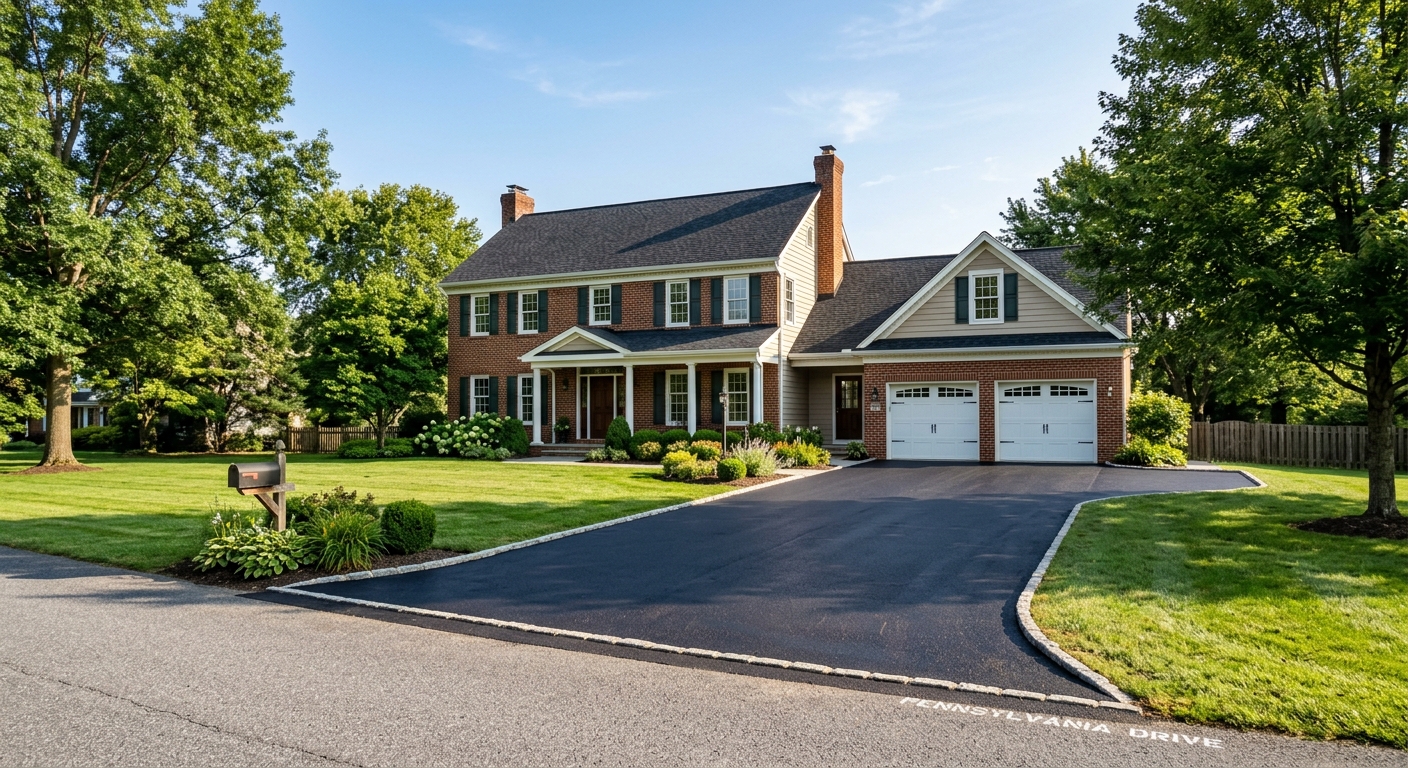
Canonsburg paving prices by scope — 2026
Canonsburg’s single-family homes make up 63.0% of its housing stock, and with a 59.1% homeownership rate (U.S. Census Bureau, ACS 2024), most driveways are private, visible, and a lasting point of value. Driveway paving prices here are shaped directly by two regional realities: frequent freeze-thaw cycles every winter and the local subgrade—thick layers of shale and clay as found throughout Washington County. Both factors force contractors to dig deeper and build a stronger base than you might see elsewhere.
What drives your cost isn’t just the surface you see but the groundwork you don’t. Most of the price difference between two bids hides under the surface—in excavation, base thickness, and proper drainage. A neatly rolled, jet-black driveway may look perfect on day one, but the real question is how deep the stone is, how well it drains, and how the edge ties into your lawn. Materials and square footage matter, but the lasting difference comes from what’s underneath.
| Service |
Best for |
Lifespan |
Price range |
| Asphalt — full replacement with new base |
failed base, structural cracking |
20–30 yrs |
$3,500–$8,900 |
| Asphalt overlay / resurfacing |
sound base, surface cracking only |
8–15 yrs |
$1,500–$4,500 |
| Sealcoating — single application |
preventive maintenance on sound asphalt |
2–4 yrs |
$200–$700 |
| Concrete — new installation |
long service life, low maintenance |
30–50 yrs |
$4,900–$12,000 |
| Crack filling and patching |
isolated cracks under a quarter inch |
1–3 yrs |
$200–$800 |
| Gravel driveway |
rural, budget, long runs |
5–10 yrs with upkeep |
$900–$3,500 |
Estimates for a typical Canonsburg driveway. Square footage and base condition drive these figures more than material choice.
Changing the footprint of a Canonsburg driveway
In Canonsburg, changing your driveway footprint—widening for a second car, extending to reach a detached garage, or adding a turnaround—means building on ground that’s likely never been paved before. New footprint work is more involved because contractors must excavate untouched shale and clay subgrade and install a new aggregate base. Even when blending new asphalt with old, the seam where they meet will always be a little weaker and more prone to separation or settlement over time.
There are also local rules to watch. Every square foot you pave adds impervious surface area, which can affect overall runoff. Expanding too close to a side or rear property line can violate municipal setbacks. As stated in the county facts, new or expanded driveways that connect to public streets can require a local paving or access permit—handled by the municipal office in your part of Washington County, or possibly by PennDOT if you front a state route. Always check before you build; stormwater runoff that crosses into your neighbor’s property can get you in trouble regardless of permits.
Replacing a gravel lane with asphalt isn’t just a surface upgrade—it typically means a full rebuild with base preparation. Expansion projects almost always cost more per square foot than a straight resurfacing, because the sitework is more intensive and permitting steps may apply.
Comparing paving estimates in Canonsburg
A good driveway estimate in Canonsburg spells out every major step: the measured square footage (not just “approximate”), depth of excavation, type and thickness of stone base, method of compaction (preferably in lifts), how many courses of asphalt go down and at what thickness, the way edges are finished, and details about grading and drainage. Cleanup and how your lawn edge will be restored should also appear. Your payment schedule matters—most reputable contractors ask for a small deposit, not the whole price up front. Finally, there should be a written warranty specifying exactly what is and isn’t covered. Most paving warranties do not cover cracking, and you should expect this in writing; if you want coverage against settlement or edge crumbling, ask to see it specified.
The single most common way homeowners in Canonsburg get less than they pay for is by accepting one-line bids: a single number, no breakdown, and no details. If you can’t see what’s included, you can’t compare or hold anyone to it—a real loss in a town where most driveways hide as much under the surface as they show.
| Line item |
What to look for |
Red flag if… |
| Area |
measured square footage stated |
eyeballed or absent |
| Excavation |
depth and disposal included |
'we'll pave over it' |
| Base |
aggregate type and depth in inches |
'proper base' |
| Compaction |
method, and done in lifts |
not mentioned |
| Asphalt |
courses and compacted depth |
'3 inches' unqualified |
| Drainage |
slope and water direction stated |
silent |
| Warranty |
what is covered and what is excluded |
verbal only |
| Payment |
modest deposit, balance on completion |
full cash up front |
Door-knocking crews and leftover material
Paving in Washington County, including Canonsburg, regularly attracts “drive-by” crews. These outfits show up unannounced, pitching asphalt from a “job down the street”—they’ll tell you there’s leftover material and offer a one-time deal if you pay cash today. The truck is often unmarked, the license plate might be from out of state, and there’s no paperwork. Others promise a wide, glossy drive, but only apply a thin coat of sprayed oil—leaving nothing but sticky residue that wears off after the first rain. Some may even skip the stone base entirely, leaving you with a surface that will crack and sink within a year or two. Market density is lower here than in central Pittsburgh, so these operators count on less word-of-mouth and weaker local checks.
Pennsylvania’s Home Improvement Consumer Protection Act requires a written contract for any job over $500, and you have the right to cancel that contract within three business days. Anyone who pushes for a verbal agreement or asks you to waive your rights is not above-board. Waiving your homeowners insurance deductible, which some may offer as a "perk," is also prohibited by law.
A five-minute check defeats nearly every scam: verify Home Improvement Contractor registration at hic.attorneygeneral.gov, and check workers' compensation coverage through WCAIS (wcais.pa.gov).
What you need before paving in Canonsburg
Most driveway resurfacing projects in Canonsburg—meaning a new coat over an existing, previously permitted driveway—generally don’t require a new building permit. This saves you a lot of run-around and paperwork if you're not expanding or moving your drive. But the place where your driveway meets the public road—the approach—typically does require a permit, and is handled by a different office depending on whether your road is municipal or a state route. PennDOT handles state routes, while municipalities handle local streets. Whenever you change the original footprint or add impervious area, check if your project triggers a local paving or access permit; in Washington, the City of Washington Code Enforcement office would be your contact.
Stormwater is a real concern in Washington County. Expansion that increases runoff can trigger local requirements, and regardless of permits, Pennsylvania law holds you responsible if water from your paved surface ends up causing problems on a neighbor’s property.
Any contractor you hire must hold a Home Improvement Contractor registration from the Pennsylvania Office of Attorney General—verify it at hic.attorneygeneral.gov. All employers are required to have workers' compensation insurance, which you can check through WCAIS (wcais.pa.gov). Don’t sign if these aren’t verified up front.
Comparing materials in southwestern Pennsylvania
In Canonsburg, choosing between asphalt and concrete is as much about climate as cost. The region’s heavy freeze-thaw cycles and clay subgrade punish rigid pavements. Asphalt, being flexible, handles ground movement and repeated winter frost with minimal long-term harm; even when slight surface cracking starts, overlays can restore function at a moderate cost. Concrete, by contrast, lasts longer only when it survives its early years—and most failures are from winter salt, which causes scaling and spalling. Owners must avoid salt-based de-icers for a concrete driveway to meet its full potential, and that’s a tall order in a region where ice and snow can stick for weeks. Asphalt’s main weakness—edge breakdown—is manageable with routine sealcoating every 3–4 years.
Interlocking pavers are a legitimate premium choice if you want a decorative surface. Each unit can be swapped out if it shifts, but they cost as much or more than concrete. Gravel driveways make sense for long rural runs—they drain exceptionally well on local shale and clay, but require periodic top-dressing and regrading to stay smooth.
| Option |
Installed cost |
Maintenance |
Freeze-thaw performance |
Lifespan |
| Asphalt — new install |
$3,500–$8,900 |
sealcoat every 3–4 yrs |
excellent, flexes |
20–30 yrs |
| Asphalt — overlay |
$1,500–$4,500 |
same |
good if base is sound |
+8–15 yrs |
| Concrete |
$4,900–$12,000 |
low, avoid de-icing salt |
fair, spalls with salt |
30–50 yrs |
| Pavers |
$7,900–$12,000 |
individual units replaceable |
good, settles gradually |
25–50 yrs |
| Gravel |
$900–$3,500 |
top-dress every 2–3 yrs |
excellent drainage |
indefinite with upkeep |
Canonsburg's ground and what it means for paving
Under almost every Canonsburg driveway, you’ll find a base of dense shale and sticky clay. This matters for two reasons. First, clay holds water and expands when frozen, which causes frost heaving—cracking and raising pavement in winter, then leaving dips and soft spots in spring. Shale, while stable, can break down over years of water movement, especially on sloped sites like many in Washington County. Both soils require a thicker, well-compacted aggregate base than is standard in sandier regions.
The frost depth here is 36 inches, with frequent freeze-thaw swings each winter. If your driveway is from the post-1950 suburban build-out around Peters or North Strabane, you likely have a wide driveway built during a period when proper stone base was sometimes skipped, or put in too thin to last. This is why overlay and resurfacing dominate the local market—you can often repair the surface if the base is decent, but full-depth excavation is needed if you have serious settlement or crumbling. Building on Canonsburg’s shale and clay without attention to drainage and base depth is a recipe for early failure, no matter the material you use above.
Frequently asked questions — driveway paving in Canonsburg
What kind of soil is under Canonsburg driveways?
The ground beneath most Canonsburg driveways is a mix of clay and shale, just as you’ll find throughout Washington County. Clay acts like a sponge, soaking up water and swelling in winter, while shale is more stable but can break up under repeated freeze-thaw cycles. This soil means any pavement here—especially asphalt—requires a thick, well-compacted stone base to avoid heaving and cracking. If your driveway edges feel soft in spring or you notice settling where water runs off, the clay is the culprit. When planning an asphalt replacement, it’s normal to see estimates starting at $3,500–$8,900 in Canonsburg because of all the prep work these soils require.
How long does a driveway installation take?
In Canonsburg, a typical residential asphalt driveway replacement is a two-day process with a day or two of curing between steps. Day one is site preparation and base stone installation—crucial for stability on Canonsburg’s clay and shale. After letting the base settle for a day, asphalt is usually placed and rolled on day two. Concrete installations take longer: after forming and pouring, the slab needs three to seven days to cure before vehicles can drive on it, especially when local temps hover around the frost line. Any added features—like an extended pad or turnaround—can add time, as can working around weather. Standard jobs (600–900 sq.ft.) fall within the $3,500–$8,900 asphalt price range for 2026.
How deep should the aggregate base be here?
Washington County’s clay and shale subgrade demand a thicker base than the “standard” in sandier places. For most Canonsburg driveways, you want 6–8 inches of compacted crushed stone under asphalt, and at least 8–10 inches under concrete. Anything less invites heaving and settling, especially during our hard freeze-thaw winters. The upfront price—typically $3,500–$8,900 for a full asphalt replacement—reflects the excavation and extra stone. If a quote only calls for 3–4 inches of base, you’ll likely be repairing cracks or dips within a few years.
Why are my driveway edges crumbling?
Crumbling edges are a common problem in Canonsburg and across Washington County. The causes are almost always thin installation at the edge, lack of proper stone support, or water getting underneath (especially with local clay). As cars cut across the driveway’s border zone—particularly during winter thaw—the unsupported asphalt or concrete breaks away. Edge breakdown can sometimes be patched for $200–$800, but truly lasting repair involves removing and replacing the outer foot or two of pavement and stone base.
What does an asphalt overlay cost in Canonsburg?
For a Canonsburg driveway with a sound base and only surface wear or minor cracks, an asphalt overlay runs $1,500–$4,500 for a typical size. The actual price depends on driveway length and width, plus how much edge preparation is needed. Overlay is cost-effective if your stone base wasn’t affected by frost heave or water infiltration. If the underlying base is failing—soft spots or big dips—you’re better off with full replacement, which starts at $3,500 and up. Always have the base condition confirmed before committing.
Asphalt or concrete for a Canonsburg driveway?
It depends how you use your driveway and how much maintenance you’re willing to do. Asphalt is more flexible, handles Canonsburg’s freeze-thaw cycles without as much damage, and costs less up front—usually $3,500–$8,900. Concrete lasts longer if you avoid de-icing salt, but costs more to install—$4,900–$12,000 range. If you want truly low maintenance and don’t mind the higher initial cost, concrete can go decades without issues in this climate—but only if you keep salt off in winter. For most, asphalt offers the better long-term value unless you’re committed to concrete care.
Why are paving quotes in Canonsburg so different from each other?
The biggest price gaps between Canonsburg paving quotes come from the work you can’t see: how much excavation is done, the thickness and type of stone base used, compaction practices, and drainage planning. Two jobs can both look brand new, but only one may stand up to our heavy clay and deep freezes over time. Some contractors quote low by cutting the base depth or skipping essential steps—meaning the project won’t last. A good quote for a full replacement will clearly break out material quantities for the price range of $3,500–$8,900, so you know what you’re paying for.
Does sealcoating fix cracks?
In Canonsburg, sealcoating is a preventive maintenance step—it doesn’t repair cracks or restore failed asphalt. A single application, priced at $200–$700, keeps oxidation and minor water infiltration at bay on still-solid driveways. Narrow cracks under 1/4 inch can be filled, but anything wider needs patching, not sealant. If your asphalt is showing widespread cracks or holes, put the money toward new surfacing or patchwork. Don’t let a crew talk you into “miracle” fixes—sealcoating extends life, but doesn’t heal damaged pavement.
Are there stormwater rules on paving in Canonsburg?
Yes—adding or expanding pavement in Canonsburg, or anywhere in Washington County, can trigger local stormwater controls, especially if the new hard surface will direct runoff onto a neighbor’s property or the street. Even if your municipality doesn’t require a formal stormwater permit for small home projects, Pennsylvania law makes you liable if water from your driveway causes damage downstream. Adding a new pad or widening a drive typically requires attention to slope and sometimes an access permit. Pricewise, adding drainage controls can add to costs, with typical overlays running $1,500–$4,500 and special drainage work extra. Always check local requirements before work begins.