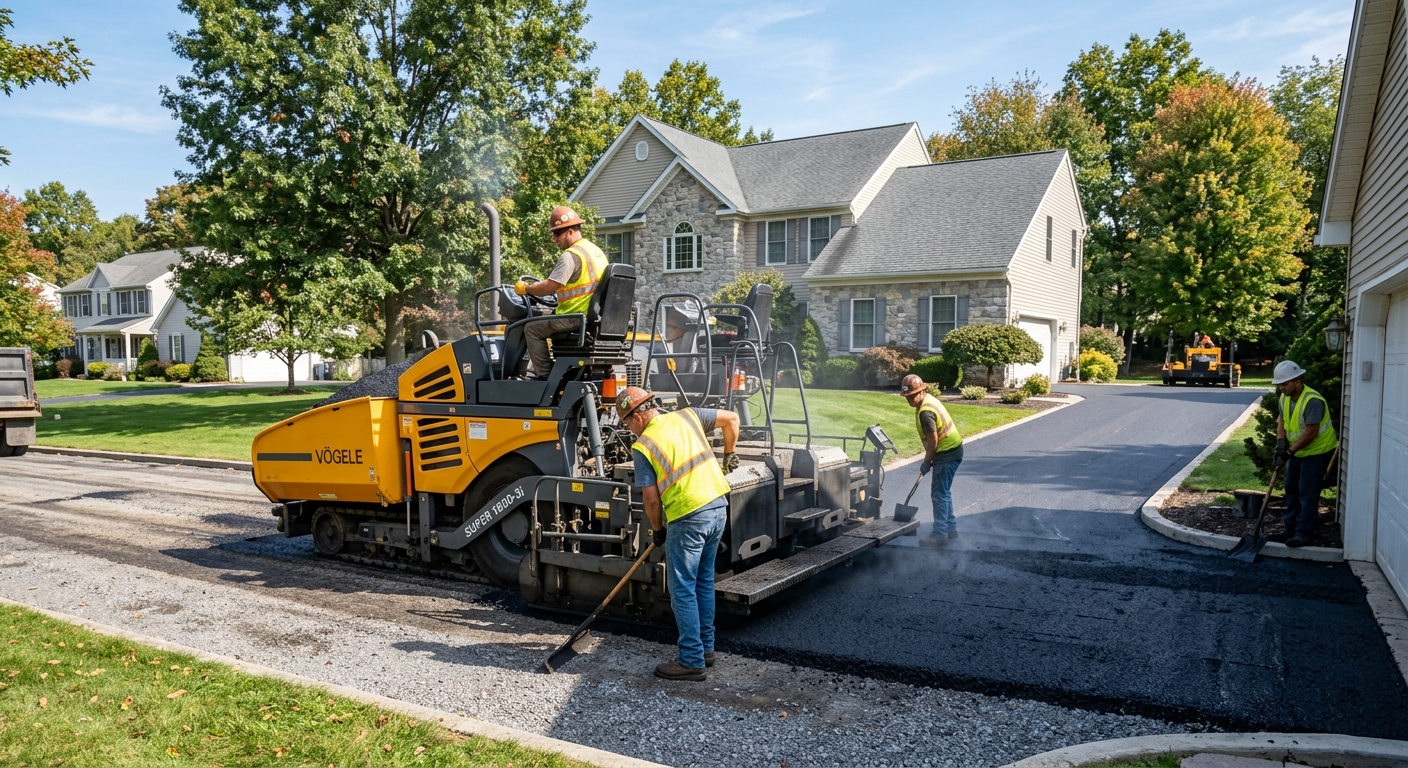
What a new driveway costs in Caln
In Caln, where 56.4% of homes are single-family and the homeownership rate sits at 71.3% (U.S. Census Bureau, ACS 2024), most driveway paving is a personal expense, not something covered by an HOA or landlord. The region’s moderate freeze-thaw cycle puts hidden stress on driveways, while the central Chester County subgrade is often limestone and dolomite, which can affect what paving methods perform best and how the job is priced.
The biggest difference between two asphalt quotes isn’t usually the visible surface work—it’s what’s happening below grade. One contractor may be fixing drainage, adding a thick aggregate base, and compacting properly; another may just be covering up old problems. That’s why square footage and subgrade condition matter more than the surface material. If your driveway is cracking, rutting, or moving, you probably need a full-depth replacement rather than a quick overlay. Meanwhile, minor cracks or surface aging need much less work to maintain.
| Service |
Best for |
Lifespan |
Price range |
| Asphalt — full replacement with new base |
failed base, structural cracking |
20–30 yrs |
$3,900–$9,900 |
| Asphalt overlay / resurfacing |
sound base, surface cracking only |
8–15 yrs |
$1,650–$5,000 |
| Sealcoating — single application |
preventive maintenance on sound asphalt |
2–4 yrs |
$225–$750 |
| Concrete — new installation |
long service life, low maintenance |
30–50 yrs |
$5,500–$13,000 |
| Crack filling and patching |
isolated cracks under a quarter inch |
1–3 yrs |
$200–$800 |
| Gravel driveway |
rural, budget, long runs |
5–10 yrs with upkeep |
$900–$3,500 |
Estimates for a typical Caln driveway. Square footage and base condition drive these figures more than material choice.
Finding a legitimate paver in Chester County
Getting a driveway paved in Chester County means sorting legitimate companies from operators who come and go. Always begin by checking that the contractor holds a Pennsylvania Home Improvement Contractor (HIC) registration — anything over $500 requires it, and you can confirm at hic.attorneygeneral.gov. Next, a Caln paver with a real business presence will have a local address, not just a mobile number or PO box, and be willing to show you their insurance and workers’ compensation coverage, which you can check at WCAIS (wcais.pa.gov).
Paving is equipment-intensive. Trusted outfits own or lease equipment, not borrow it job-to-job. They’ll have references from West Chester or Exton going back three or more years—not just last summer. Ask which Chester County asphalt plant they use; real contractors buy direct from local plants near Downingtown and Coatesville, taking advantage of short haul distances. A broker or “crew in a pickup” can’t answer these questions or show work that’s stood up to local freeze-thaw cycles and limestone subgrade.
- HIC registration — check at hic.attorneygeneral.gov
- Written contract for all work over $500
- Certificate of insurance with workers’ comp (verify at wcais.pa.gov)
- Local business address, not just a cell number
- Owned or long-term leased paving equipment
- References from jobs at least three years old
- Ability to say which Chester County plant supplies their asphalt
- Accurate estimate in writing, not just a handshake or voicemail price
- No demands for large advance payments or all-cash deals
- Clear description of all proposed layers and materials
- No vague claims about “special deals” or “leftover material”
Red flags: an out-of-area plate or unmarked truck, sketchy paperwork, only a verbal price, asking for cash up front, or references all within the last year.
Permits and approvals for paving in Caln
If you plan to repave a Caln driveway in its current footprint, there usually isn’t a need for a building permit from the township—most Chester County municipalities don’t require one for interior residential driveways outside the public right-of-way. This can save you time and hassle, but don’t skip the details if you’re connecting to a road or state route. The approach—where your driveway hits the street—often requires a separate permit. For state roads, that’s a Highway Occupancy driveway approach permit from PennDOT Engineering District 6-0, not your local code office.
If you’re enlarging your driveway, adding a parking pad, or increasing impervious area, you may need more approvals to address stormwater: Chester County townships may require you to manage runoff with dry wells or swales so that water doesn’t wash onto a neighbor’s property. Even where no township permit is required, directing water across property lines exposes you to liability and can lead to legal trouble, regardless of what your contractor says.
Before hiring anyone, verify their Home Improvement Contractor registration at hic.attorneygeneral.gov and check their workers’ compensation coverage at WCAIS (wcais.pa.gov). Pennsylvania’s Home Improvement Consumer Protection Act requires a written contract for all work over $500, and you get a three-business-day right to cancel. A reputable local paver knows all of this and won’t pressure you to skip the basics.
Why driveways behave differently in Caln
Caln sits on central Chester County ground dominated by limestone and dolomite bedrock. This “karst” means driveways are at higher risk for settlement and reflective cracking, since limestone pockets can form voids or unstable spots beneath the surface. A properly built driveway here needs a thicker aggregate base than you’d see just one county over—cutting corners on base prep almost always leads to problems in a few years.
Combine this with a moderate freeze-thaw cycle and a 30-inch local frost depth: as water makes its way into cracks and the sub-base, it freezes and heaves, stressing asphalt and concrete from below. Many homes in West Goshen, Exton, and similar tracts were built in the 1960s through 1980s, when driveway standards weren’t what they are today. Driveways from that era often went in with a thin base—or no aggregate at all—so by now, total failure of the underlying material is common. Overlays won’t solve these problems; a full-depth replacement with extra attention to base compaction is what stands up to Chester County winters, not just new blacktop on old mistakes.
The specifications to demand in writing
In Caln, don’t just shop for the lowest driveway price—demand details in writing. The specs that matter most are about the layers you’ll never see: how deep the excavation goes, what kind of aggregate is used as the base, and how each layer (from stone to asphalt) is compacted. In central Chester County, with its limestone substrate and significant freeze-thaw, a skimped base or thin asphalt will crack and settle within a few years—years before that “great deal” wears out.
When a contractor says “three inches of blacktop,” always ask: “Is that three inches before or after compaction?” Asphalt loses about 20% thickness when rolled, so you want 2.5–3 inches compacted, not just as laid. A proper Chester County driveway should specify base depth (usually 6–10 inches or more on limestone), number and thickness of binder and surface courses, the mix used, and edge reinforcement to avoid crumbling. Skip these details, and you’re overpaying for a short-lived result.
- Excavation depth below finished grade (inches)
- Aggregate base course material and thickness
- Compaction method and proof-rolling for each layer
- Asphalt binder course: type and compacted thickness
- Asphalt surface course: mix designation and compacted thickness
- Lift thickness for both base and asphalt layers
- Edge treatment (tapered, reinforced, or with stone shoulders)
- Drainage/grading details and slope specifications
- Total finished width and area (square feet)
- Supplier for both stone and asphalt mixes
Door-knocking crews and leftover material
Driveway paving in Chester County attracts transient crews because the work is visible, the problems stay hidden for years, and the payments are immediate. The most common pitches are: “We have leftover blacktop from a job nearby,” “We can give you a special price today only,” and “Just cash or check, no need for paperwork.” Unmarked trucks, out-of-area plates, demands for cash up front, and handwritten or verbal quotes with no details about materials or thickness—these are the telltale signs of a scam outfit. You’ll sometimes see oil sprayed on top and called “sealcoating”; it looks nice until the first rain washes it off and the driveway is no better than before.
Chester County’s dense, suburban nature means there’s competition if you’re patient, but scammers rely on the fact that legitimate contractors are sometimes booked out. Under Pennsylvania’s Home Improvement Consumer Protection Act, you must receive a written contract for any job over $500—and you get three business days to cancel, no questions asked. A legitimate outfit will always honor this law, not push you to sign away your rights with “special deals.” Waiving a homeowner’s insurance deductible is also prohibited; no real paver in Caln will offer this.
Five-minute defenses: check the contractor’s HIC registration at hic.attorneygeneral.gov, verify workers’ comp at wcais.pa.gov, and insist on a written contract with detailed specs. If a contractor won’t provide these or pressures you for immediate payment, the safe answer is always no.
Drainage: the failure nobody plans for
Poor drainage, not bad blacktop, is the most common reason Caln driveways fail early. A proper driveway slope—at least 2% away from buildings—is the difference between years of trouble-free use and constant crack repair. Crowning (a high point in the driveway center) or cross-slope helps shed water quickly, but long driveways that slope toward the garage are a real problem. If regrading isn’t possible, trench or channel drains are the fix, guiding water away before it gets under the slab or pavement.
In Chester County, a moderate freeze-thaw cycle means water trapped under the surface freezes, expands, and slowly works the pavement apart year after year. On limestone subgrades, water migration leads to voids and settlement—one winter can undo a quick paving job. Heavy clay is less common here, but if present, it holds water against the driveway base, turning small drainage mistakes into big heaves and cracking over time. Any runoff directed onto a neighbor’s property creates liability, regardless of what the township or paver says; stormwater needs to go to daylight, a swale, or (if code allows) an engineered dry well, not someone else’s lawn.
Frequently asked questions — driveway paving in Caln
When is the best time of year to pave in Caln?
The best time for paving a driveway in Caln is late spring through early fall, when average temperatures stay above 50°F and conditions are reliably dry. In southeastern Pennsylvania, starting a job before April risks frost in the subgrade, which can cause future settlement, while jobs rushed into late autumn sometimes don’t set properly before freezing weather. Most local contractors schedule the bulk of their paving work between May and October. This window ensures the asphalt plant is running at full hours—thanks to local suppliers near Downingtown and Coatesville—and the finished driveway has adequate cure time. If you’re considering a major job, expect prices from $3,900–$9,900 for a full-depth asphalt replacement. Always avoid the rare “winter deal”; the result rarely lasts.
What does compaction in lifts mean?
Compaction in lifts is the right way to build driveways in Caln, especially on limestone subgrades. “Lifts” are layers; each is spread at a limited thickness—say, 3–4 inches for aggregate or 2–2.5 inches for asphalt—then rolled with a heavy compactor before adding the next. This step matters because thick, un-compacted fills settle and crack in freeze-thaw conditions. Proper compaction in lifts reduces future settlement and ensures the entire driveway structure, from the crushed stone base to the finished asphalt, locks together. On a poorly compacted job, you’ll see depressions or alligator cracking within a couple of winters, turning what was supposed to be a $3,900–$9,900 investment into a recurring headache.
How often should I sealcoat my driveway in Caln?
In Caln, a good guideline for asphalt driveway sealcoating is every 2–4 years, depending on traffic, shade, and exposure to sun and salt. Sealcoating helps protect against UV degradation, water infiltration, and the local freeze-thaw stress, which are especially relevant in Chester County. If you just had new paving done, wait at least six months before applying sealer. Too-frequent sealing can trap moisture or turn the surface slick—don’t let anyone pressure you into “annual deals.” A single application typically costs $225–$750. Done at the right interval, sealcoating extends the lifespan of your existing bituminous pavement and keeps crack growth in check.
Is gravel a cheaper option in Caln?
Gravel remains the lowest upfront cost for driveways in Caln, with installation from $900–$3,500, depending on length and base work. It’s best for rural properties, long runs, or locations where frequent grading and maintenance aren’t an issue. However, gravel isn’t maintenance-free: Chester County’s freeze-thaw cycles and active limestone soils mean you’ll likely top-dress every year or two and re-grade after heavy rain. For most suburban homeowners, gravel is a practical solution for utility drives or overflow parking but is less desirable for front entrances due to dust, weeds, and migration into lawns or the street.
Why does my driveway have depressions that hold water?
Driveway depressions—often called “birdbaths”—are common in Caln for two reasons: improper grading or compaction on installation, or later settlement of the limestone and dolomite base. Trapped water in these low spots will accelerate freeze-thaw damage every winter as it infiltrates and expands. Sometimes these are small areas, which can be patched for $200–$800, but persistent depressions likely suggest the underlying base has failed and may need a full-depth replacement. In limestone karst areas like central Chester County, hidden voids can open up under the surface, forcing even newer driveways to sag prematurely.
Asphalt or concrete for a Caln driveway?
Both asphalt and concrete work in Caln, but the choice comes down to budget, appearance, and tolerance for maintenance. Asphalt is less expensive up front ($3,900–$9,900 for a full-depth rebuild) and repairs easily after Pennsylvania winters, but it needs periodic sealcoating. Concrete costs more to install ($5,500–$13,000), resists rutting, and stays light in color, but is vulnerable to salt and typically cracks eventually on limestone soils. For most single-family homes here, asphalt is the norm—especially when there’s movement in the subgrade—while concrete makes sense for low-maintenance, long-life installations or when a brighter look is wanted.
What kind of soil is under Caln driveways?
The ground under most Caln driveways is central Chester County limestone and dolomite, called “karst.” This subgrade can surprise you—it tends to settle unevenly because of buried voids and offers little resistance to water movement, making thicker stone bases and good drainage essential. While some neighboring areas have more shale or glacial till, Caln homeowners mostly deal with issues unique to limestone: reflective cracking and sudden depressions. Your driveway builder needs to compensate by increasing base thickness well beyond the minimum required elsewhere, or you risk premature failure even if the surface looks great at first. This is not an area where a thin, quick overlay will endure through the local climate.
Do I need an approach permit where my driveway meets the road?
Yes—if your Caln driveway meets a public road, especially a state route, you will generally need a permit just for the approach section from PennDOT Engineering District 6-0. The regular township code office may not be involved in this part. For purely interior driveway resurfacing that doesn’t touch the roadway, most Chester County townships do not require a permit, letting you handle maintenance on your timeline. But as soon as you plan any work within the public right-of-way, permit requirements kick in and you’ll need an official approval before work can start, regardless of which paving contractor you choose.
What does an asphalt overlay cost in Caln?
An asphalt overlay or resurfacing—where a new layer is put down over an existing, sound base—typically runs $1,650–$5,000 in Caln. This is the right choice if your base material is stable, with only surface-level cracks or wear. Overlays are less expensive than full replacements, and in Chester County’s competitive market, prices reflect a balance between material, local aggregate supply, and prep work. Beware of anyone suggesting inexpensive overlays when the base is spongy or shows severe settlement; in those cases, even a “bargain” overlay will fail quickly, making the upfront savings a mirage.