Driveway paving costs in Scranton — 2026
In Scranton, a city where almost half of all households own their homes and nearly as many are single-family houses (U.S. Census Bureau, ACS 2024), driveways are a standard feature—and a major expense. What most folks don’t realize is that the real cost difference between two paving quotes is rarely in what you see on top, but what’s hidden below. With Scranton’s deep freeze-thaw cycles, ground snow loads, and a base of glacial till, the soil and sub-base work are the first place where corners get cut or quality gets baked in. One crew hauling several inches of new base and grading for drainage can look similar to a crew patching over soft spots—until the first hard winter, when ruts or cracks reappear. Material prices matter, but labor and prep are the true drivers.
If you’re weighing new asphalt, a concrete upgrade, or a cheaper overlay, understand that your driveway needs to withstand more than just cars: Scranton’s winters are brutal and poor drainage in glacial till can ruin a driveway from below. The table below gives a realistic range for what you’ll pay to have these projects properly done in Scranton’s conditions:
| Service |
Best for |
Lifespan |
Price range |
| Asphalt — full replacement with new base |
failed base, structural cracking |
20–30 yrs |
$3,100–$8,000 |
| Asphalt overlay / resurfacing |
sound base, surface cracking only |
8–15 yrs |
$1,350–$4,000 |
| Sealcoating — single application |
preventive maintenance on sound asphalt |
2–4 yrs |
$175–$600 |
| Concrete — new installation |
long service life, low maintenance |
30–50 yrs |
$4,400–$10,500 |
| Crack filling and patching |
isolated cracks under a quarter inch |
1–3 yrs |
$200–$800 |
| Gravel driveway |
rural, budget, long runs |
5–10 yrs with upkeep |
$900–$3,500 |
Estimates for a typical Scranton driveway. Square footage and base condition drive these figures more than material choice.
When paving can actually be done in Scranton
In Scranton, deciding when to pave isn’t just a question of convenience—temperatures and material availability put hard limits on the paving season. For asphalt, contractors rely on hot-mix from local Northeastern Pennsylvania plants, which shut down when the weather turns cold. The winter design temperature here is 4 °F, and with 6,100 heating degree days, that means stretches of the year where the ground stays far too cold for successful paving. If it’s below about 50 °F, asphalt can cool too quickly during installation, leading to improper compaction and a driveway that falls apart far ahead of schedule.
Concrete isn’t much more forgiving, since it needs days above freezing to cure and set properly. That means late fall and early spring are risky for new slabs, especially with Scranton’s history of severe ice exposure. Most years, the realistic paving window runs from late April to mid-October, though a cool spring or early winter will shrink that even more. Aggregate and asphalt supply also depend on local quarries—if those hauls are delayed due to weather, your job is too.
Crews are busiest between Memorial Day and Labor Day; shoulder months are less crazy, and you might get better pricing or faster scheduling. Beware any crew promising a “deal” in late November—either they’re not using proper materials or aren’t worried about the final result. In Scranton, you can’t fudge the season; it shows in the finished product.
Driveway permits, approaches and stormwater rules
For most homes in Scranton, resurfacing or patching an existing driveway in the same footprint rarely triggers a full building permit, which saves time and money for straightforward repairs. However, any new driveway work—including expanding, replacing, or altering the approach where your driveway meets the road—does require a permit. In Scranton, that means getting a permit from the City of Scranton Department of Public Works. If your driveway connects to a state route, permits run through PennDOT District 4-0; township and city curb cuts are handled by the local municipality. This is different from what most expect, so start by checking with your local office about approach permits before you schedule anything.
Whenever you expand your driveway or replace a gravel drive with asphalt or concrete, you increase the impervious surface on your lot. That can trigger stormwater management requirements—especially in neighborhoods with drainage concerns on glacial till. Even if you have a permit, you’re liable if runoff causes problems for your neighbor, so don’t assume approvals settle the issue.
When hiring, verify contractor Home Improvement Contractor (HIC) registration through the Pennsylvania Office of Attorney General at hic.attorneygeneral.gov. Every employer needs valid workers' compensation coverage, which you can check via WCAIS (wcais.pa.gov). Get these in writing before a job starts, even for small projects.
Why driveways behave differently in Scranton
The subgrade in Scranton is mainly glacial till—an inconsistent mix of rocks, sand, and clay left behind by ancient glaciers. This soil often has drainage problems: it can hold water in places, but also wash out in others, both of which cause trouble when freeze-thaw cycles are so severe. With a local frost depth of 36 inches and frequent freeze-thaw swings, shallow or poorly compacted driveways heave, crack, or settle unevenly.
Most homes here were built before 1980, often with paving that wasn’t designed for today’s traffic or plowing, and a lot of those mid-century driveways need edge repair or were never built with a proper gravel base. Back then, standards were much looser on base thickness and drainage—something that shows now as driveways age and deteriorate at the edges, or as water finds its way underneath, lifts the pavement, and breaks it apart. Wider driveways and additions are particularly at risk, because undisturbed glacial till under a new section will settle differently than old, compacted subgrade. A cheap paving job on glacial till without drainage correction is wasted money here.
How paving fraud actually operates
Scranton’s location and moderate suburban density make it a regular target for paving scams—and the way these scams operate is deeply local. Driveways are visible from the street, and Scranton’s older neighborhoods have plenty that look like easy marks for “quick fixes.” The classic pitch: someone knocks on your door claiming they’re repaving nearby and have leftover asphalt, offering a deal if you let them do the work right then. Other telltale signs are “today-only” pricing, unmarked trucks with out-of-area plates, requests for cash up front, and vague verbal promises instead of written contracts. Fly-by-night outfits may also spray a thin coat of cheap oil or diluted sealer and call it sealcoating, leaving you with nothing but a darker driveway and no meaningful protection.
Market density factors here: suburban neighborhoods in Lackawanna County have enough turnover and distance between homes that scammers can disappear before word spreads. Pennsylvania’s Home Improvement Consumer Protection Act (HICPA) gives you the right to a written contract for any home improvement work over $500, and a 3 business-day right to cancel after signing. Never let anyone start until you’ve seen their HIC registration (which you can check at hic.attorneygeneral.gov), have a signed contract, and have verified workers’ compensation on WCAIS. If a contractor tries to waive your insurance deductible, walk away—it’s prohibited by law.
The checks that kill nearly all scams: verify registration online, demand a written contract, verify workers’ comp coverage, and never pay in full until the job is properly done and inspected. Five minutes doing these stops practically every scam cold.
What to put in a Scranton paving contract
Most people in Scranton still shop driveway quotes by price, but here—where freeze-thaw cycles, glacial till, and deep frost pose real challenges—the only smart move is to shop by specs. The critical details that must be in your contract (in writing and numbers) are: how deep will the existing drive be excavated (if any); what type and how much aggregate base will be used; method and number of compaction passes (and done in lifts if deeper than 4 inches); compacted—not just loose—depths for the asphalt binder and surface courses; the exact asphalt mix designation; and an edge treatment plan.
The phrase “we’ll put down three inches” is worthless unless it says three inches after compaction—uncompacted asphalt shrinks by a third or more. Without these details, you risk getting skimpy material that won’t last a Scranton winter.
- Total excavation depth (inches below finished grade)
- Type of aggregate used for base (crushed stone, size, source)
- Aggregate base depth (compacted thickness, not loose)
- Number of lifts and compaction passes for base
- Compacted thickness of asphalt binder course (inches)
- Compacted thickness of asphalt surface course (inches)
- Specific asphalt mix (designation/code)
- Description of edge support (taper, curb, backfill material)
- Drainage slope and water direction
- Start and finish timeline, with cleanup details
Widening, extending or adding a parking pad
If you’re considering more than just a replacement—like widening your driveway for a second car, extending it to a garage, or putting in a new parking pad—the rules and risks change. Any new footprint means building on undisturbed glacial till, which hasn’t been compacted by decades of use. This requires a brand-new gravel or stone base, properly compacted and often thicker than a direct replacement. The joint where old and new sections meet will always be a weak point: water and freeze-thaw cycles can cause separation or cracks there over time.
Scranton’s permit process comes into play any time you increase your paved area or add a new curb cut—see the discussion above on approach permits from the City or PennDOT. Impervious-surface restrictions may apply, especially if stormwater runoff becomes a concern. And every municipality enforces setback rules about how close you can build to your property line. Before expanding, weigh the full cost—which often means not just paving but regrading and drainage correction as well. Cutting corners on the base or skipping permits almost always ends in expensive repairs down the road.
Frequently asked questions — driveway paving in Scranton
What causes driveway cracks in Scranton?
Cracks in Scranton driveways are mostly the result of our severe freeze-thaw cycles and the region’s glacial till soils. Water seeps into even small surface imperfections, and when temperatures drop, it freezes, expands, and forces the pavement apart. If your driveway was built on a thin or poorly compacted base—which is common in older Scranton neighborhoods—you’re even more likely to see cracks, especially along the edges or over drainage problem spots. Salting, plow blades, and settling from our deep 36-inch frost depth only speed up the process. While small cracks can often be filled for $200–$800, extensive or repeating cracks usually point to bigger base or drainage issues underneath. Prevention comes from proper base prep, timely sealcoating, and keeping water out of the subgrade whenever possible.
How much does a concrete driveway cost in Scranton?
For a standard single-family home in Scranton, a new poured concrete driveway typically ranges from $4,400–$10,500 in 2026. Most jobs land around the $7,100 mark for a typical two-car width and length. Expect to pay on the higher end if your old drive needs full removal, or if you require additional base stabilization due to the region’s glacial till. Concrete costs more upfront than asphalt, but offers a longer lifespan—often 30–50 years with basic maintenance. Be sure that your contractor accounts for our local frost depth (36 inches) and strong freeze-thaw swings, which demand a properly compacted gravel base and perimeter joints to prevent cracking or heaving during Scranton winters.
How long before I can drive on a new asphalt driveway?
In Scranton’s climate, you’ll want to keep vehicles off your fresh asphalt driveway for at least 3 days after paving—sometimes longer in cool, damp weather. The exact time depends on outdoor temperatures; the hotter it is, the longer asphalt stays soft. In summer, a light car might be usable after 48–72 hours, but trucks, trailers and sharp turns should wait at least a full week, especially if your driveway was installed at the lower end of $3,100–$8,000 and the base was just replaced. Rushing things leads to tire marks, depressions, and surface scarring. Even after reopening, avoid parking in the same spot, jack stands, or placing heavy objects until the drive is completely cured, which can take up to 6 months in Scranton’s weather.
Should I repair or replace my Scranton driveway?
If your driveway is showing a handful of cracks under a quarter inch and the base feels solid—no major dips or crumbling—then crack filling and patching (usually $200–$800) is worth a try. But if you see large-scale alligator cracking, deep settling, or repeated edge failures—especially in older Scranton homes with thin original bases—a full replacement in the $3,100–$8,000 range is likely the only reliable fix. Overlay or resurfacing ($1,350–$4,000) saves money if the base is sound, but is a waste on failed subgrades. Always ask your contractor to check drainage and base depth before committing to major repairs, because in Scranton, hidden base issues are what usually bring a driveway down.
Does sealcoating fix cracks?
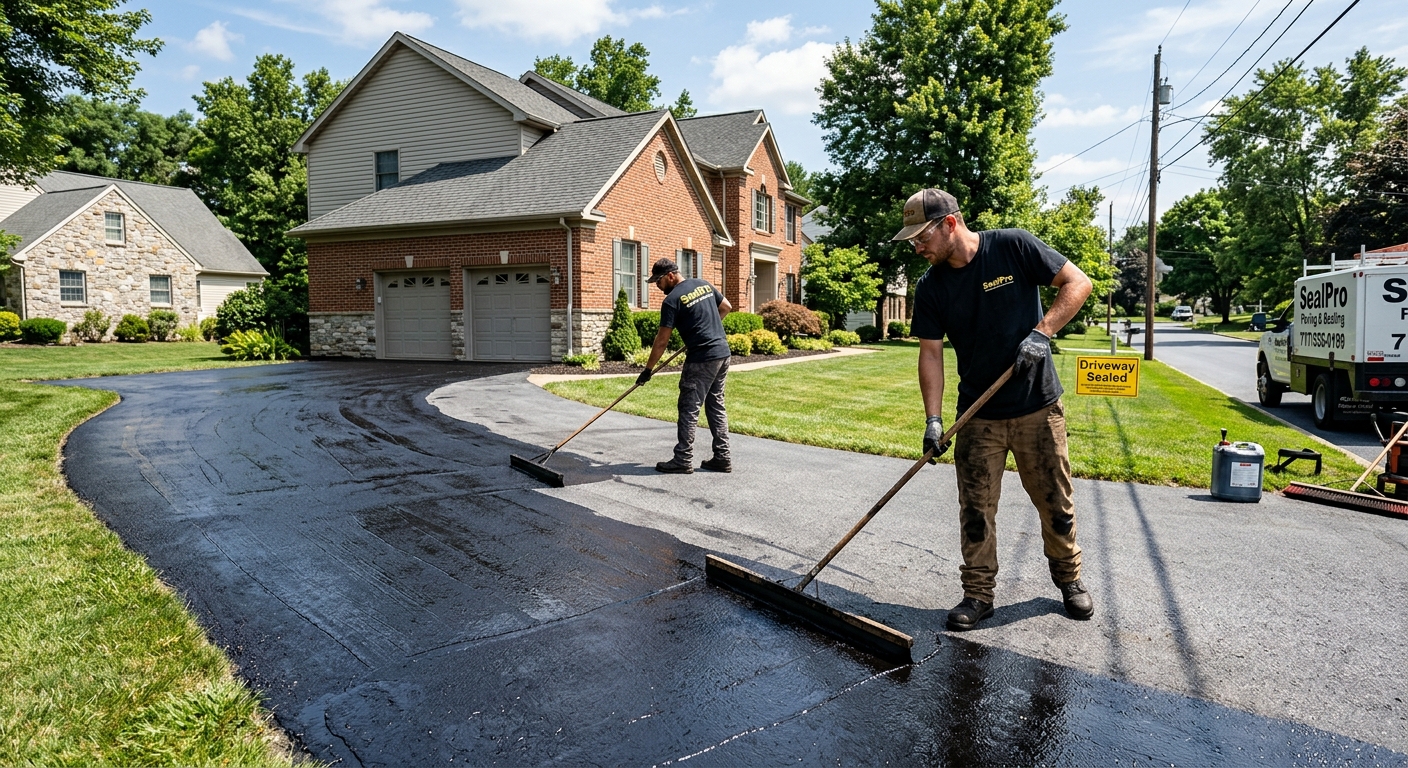
No—sealcoating in Scranton is preventive maintenance, not a crack repair solution. While a quality single application (about $175–$600) will slow oxidation and water penetration, it cannot fill or structurally reinforce cracks or holes. In fact, applying sealer over unfilled cracks can actually lock water under the coating, increasing the risk of freeze-thaw damage in Scranton’s severe winters. For cracks wider than hairlines (over an eighth inch), elastomeric crack filling should come first, followed by sealcoating once repairs are cured. If you see large or spreading cracks, sealcoating’s not a cure—get the structure evaluated before spending money just on surface protection.
Do I need a permit to repave a driveway in Scranton?
If you’re simply resurfacing or patching your existing driveway in Scranton without changing its size or access, you usually do not need a building permit. But for any new work that expands, replaces, or alters the approach—where your drive meets the city road—a permit from the City of Scranton Department of Public Works is required. If your approach connects to a state route, you’ll need a permit from PennDOT District 4-0 instead. Curb cuts or expansions also need local approval. Always check with your local authority before starting; skipping permits can result in fines or being forced to redo work, and compliance also ensures you’re protected if drainage or stormwater questions come up later.
How deep should the aggregate base be here?
Scranton’s driveways need a thicker base than many other areas because of our deep 36-inch frost depth and glacial till subgrade. For asphalt, a compacted gravel base of at least 6–8 inches is standard, with heavier-use drives (trucks, trailers) needing up to 10 inches. For concrete, minimum 6–10 inches of well-compacted crushed stone is common. Inadequate base thickness is the top reason that new driveways fail early, especially after a few hard freeze-thaw cycles. Skimping on the base might save a little up front, but with replacement costs running $3,100–$8,000 or more, it almost always ends up costing more in the long run. Insist on specs in writing and compaction in lifts (layers) for best results.
What does sealcoating cost in Scranton?
A basic single application of driveway sealcoating runs $175–$600 for a standard Scranton drive in 2026, with most jobs landing around $350. The size of your driveway, number of entry points, and amount of crack filling needed can shift costs up or down. Avoid anyone offering a “deal” far below this range—it’s usually a thin, diluted oil spray that does nothing to protect your pavement. Professional sealcoating, when paired with proper base maintenance and timely repairs, can extend your driveway’s service life and defend against Scranton’s harsh freeze-thaw conditions. Ask if prep and crack filling are included in the quote; they make all the difference in performance.
What kind of soil is under Scranton driveways?
Most Scranton driveways are built over glacial till—a mix of stones, gravel, sand, and clay left by retreating glaciers. This subgrade is unpredictable: it can hold pockets of water and drain unevenly, both of which lead to problems with settling and frost heave. In older neighborhoods, you sometimes find driveways paved directly over this till with little or no gravel base, which makes them especially prone to cracking and edge failure in Scranton’s deep winter freezes. Modern driveway installations dig deeper to replace some of the native till with compacted crushed stone, improving both drainage and stability. If you’re planning a new drive (typically $3,100–$8,000 for asphalt), make sure the contractor understands how to manage glacial till and isn’t just laying new pavement over old, unstable soil.