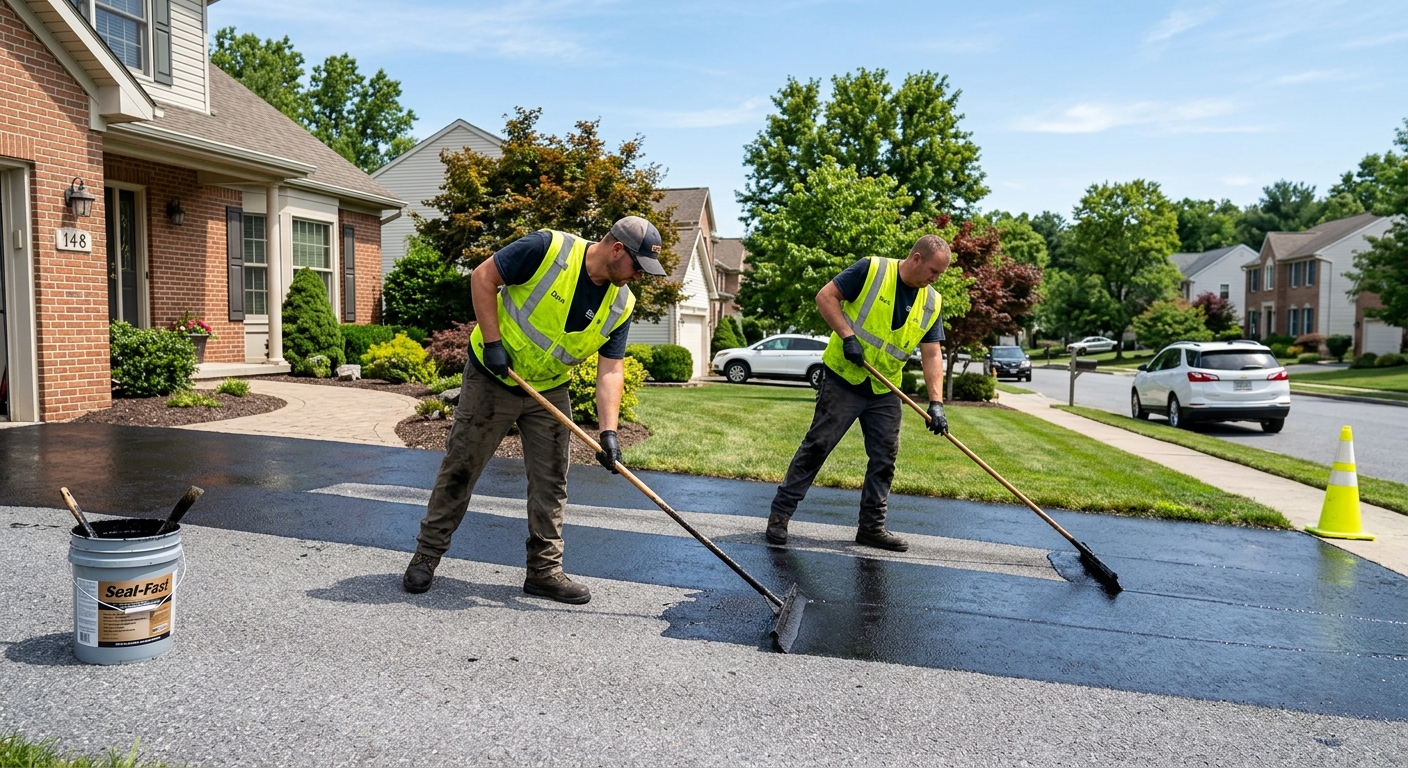
What a new driveway costs in Mechanicsburg
Mechanicsburg’s driveways are a major homeowner expense—especially since 56.2% of local homes are single-family (U.S. Census Bureau, ACS 2024), and nearly seven out of ten are owned rather than rented. That means most driveway repairs and replacements land squarely on homeowners, not landlords or associations. In this market, your dollar's value is determined as much by what goes beneath the surface as what you see on top. Two bids that look similar may differ dramatically in what’s done underground—and with frequent freeze-thaw cycles and the limestone karst underfoot, what you can’t see is exactly where failures begin.
On this kind of subgrade, a price that seems too good to be true almost always comes from lighter base prep, thinner lifts, or skipping drainage measures. You’ll see the difference after a couple of harsh winters, when the cheaper job develops cracks, soft spots, or edge breakup. Asphalt and concrete have price bands, but square footage and what’s under the pavement matter far more than surface material for total cost and longevity. Here’s what to expect for typical driveway work in Mechanicsburg:
| Service |
Best for |
Lifespan |
Price range |
| Asphalt — full replacement with new base |
failed base, structural cracking |
20–30 yrs |
$3,400–$8,900 |
| Asphalt overlay / resurfacing |
sound base, surface cracking only |
8–15 yrs |
$1,500–$4,400 |
| Sealcoating — single application |
preventive maintenance on sound asphalt |
2–4 yrs |
$200–$700 |
| Concrete — new installation |
long service life, low maintenance |
30–50 yrs |
$4,900–$12,000 |
| Crack filling and patching |
isolated cracks under a quarter inch |
1–3 yrs |
$200–$800 |
| Gravel driveway |
rural, budget, long runs |
5–10 yrs with upkeep |
$900–$3,500 |
Estimates for a typical Mechanicsburg driveway. Square footage and base condition drive these figures more than material choice.
Door-knocking crews and leftover material
Paving in Cumberland County, especially in and around Mechanicsburg, brings out operators who hope you don’t know your rights. If someone knocks and offers “leftover material from a job nearby,” promises a “today-only price,” or pulls up in an unmarked truck with out-of-state plates, you’re seeing classic red flags. Some will demand cash up front or give you a verbal number without writing anything down. Others sell an oil-based spray coat as “sealcoating” but deliver nothing like the real maintenance you’re expecting. These schemes work because the work is visible, neighbors are often out of earshot, and failures don’t show for months or years—common in a county where homes are more spread out.
Pennsylvania law protects you, but only if you insist on what’s yours: for any job over $500, the Home Improvement Consumer Protection Act requires a written contract and gives you a three-business-day right to cancel, no questions asked. If someone tries to avoid paperwork or pushes you to waive your rights, they are ignoring state law. And no one can legally offer to cover your insurance deductible or ask you to mislead your insurer—it’s flat-out prohibited.
Here are the checks that shut these door-knocker scams down in five minutes: verify their Home Improvement Contractor registration at hic.attorneygeneral.gov, confirm workers’ compensation at wcais.pa.gov, and demand everything in writing before any work is done or money changes hands. If the crew runs, you just saved thousands.
What you need before paving in Mechanicsburg
In Mechanicsburg and across Cumberland County, you can often repave or resurface a driveway in its exact footprint without a building permit—especially in townships like Silver Spring, which don’t require paperwork for routine resurfacing. That saves time and hassle if you’re not changing the size or shape. But there’s an exception for driveway approaches, where your drive meets the street: if you’re connecting to a state road, you’ll need a Highway Occupancy Permit from PennDOT District 8-0. For township roads, the local township office handles these permits. Expanding your driveway or pouring new pavement in Carlisle Borough? That usually triggers a municipal zoning or building permit, so check before pouring concrete or base stone.
Adding any pavement can increase runoff—if you expand your driveway, you could be required to address stormwater. Regardless of permit, Mechanicsburg property owners who direct water onto a neighbor’s lot are liable for damage. Plan grading so runoff handles itself on your own property, not across the lot line.
This is Pennsylvania: your paving contractor must have active HIC registration (verify at hic.attorneygeneral.gov) for any contract over $500. Every worker should be covered by workers’ compensation insurance, checkable at wcais.pa.gov. Do these two checks before you sign or pay for anything.
When paving can actually be done in Mechanicsburg
Mechanicsburg’s paving season is dictated by the freeze-thaw climate. Asphalt must be placed and compacted before it cools: if the air or subgrade drops near freezing, the mix sets too quickly, leaving you with weak, porous, short-lived pavement. That’s why local asphalt plants shut down during winter—there simply isn’t demand, and the quality risk is too high. Concrete has its own seasonal rules, because it won’t cure right in below-freezing temperatures. With winter design lows at 12 °F, paving in December, January, or most of February isn’t just unwise—it’s impossible, since you can’t even buy mix from the plant.
The shoulder seasons—April through early June, and September through October—are when local crews have scheduling flexibility and prices can be better. Summer is peak season, when everyone wants the job done and schedules fill weeks ahead. If someone offers to pave your drive in late November, especially after plant shutdowns, they’re signaling a disregard for standards or are simply moving low-volume leftover material that can’t meet spec.
Because material supply is local, with aggregate and asphalt plants clustered around Carlisle and Mechanicsburg, haul time rarely drives price—but getting your slot in the right weather window does. Book ahead, and understand that in south-central PA, good paving work waits for the right conditions.
Why Mechanicsburg driveways fail from the bottom up
The most common reason driveways in Mechanicsburg fail is not the surface; it’s what’s under it. The typical driveway assembly is three layers: the existing subgrade (soil), a compacted aggregate base (crushed limestone is local standard), and then the asphalt or concrete surface. Each layer is supposed to distribute load to the layer beneath. If the base is too thin, laid on soft spots, or isn’t compacted in layers (“lifts”), the weight of cars, plus cycles of freezing and thawing, will break it up from below.
Cumberland County’s limestone karst soils drain well in places, but sinkholes—and water movement—mean the base has to be thicker and properly compacted compared to regions with stable clay or rock underneath. Throw in pronounced freeze-thaw cycles, and you have added stress: when water in the subgrade freezes, it expands, pushing up under your driveway slab (frost heave). When it thaws, it settles unevenly. This is why driveways sometimes crack or develop sunken spots after winter—it’s not the pavement, but the ground moving below it.
Sadly, this is also where a too-low price comes from. Contractors may skimp on excavation (reuse old base even if it’s failed), run a thinner base stone layer, or skip compaction between lifts. None of this is visible in the finished product, but it all shows up within a few years—a failed, uneven driveway.
The specifics to demand—always in writing: a minimum 6–8" compacted aggregate base for asphalt (a little more over suspect subgrade), mention of local limestone, and that compaction is performed in 2–3" lifts. If any of these are omitted, ask for them, or walk away.
Where the water goes
Water is behind almost every driveway failure in Mechanicsburg. Proper grading is not just a detail at the end—it’s the most critical part of longevity here. The minimum slope for effective runoff is 2% (a quarter inch per foot), directing water away from buildings. Most often, a driveway is crowned in the middle to shed water to both sides, or cross-sloped if that fits the property better. Driveways that slope toward a garage or house are trouble: in freeze-thaw conditions, ponded water seeps into the base, freezes, and lifts the slab. That’s why surface slope and outlets matter in south-central Pennsylvania.
When the site won’t allow enough slope—common when the house sits lower than the street—trench drains or channel drains at the garage entry, with outlets that “daylight” on your own property or direct water to a dry well, can manage runoff. Heavy or poorly draining soils hold water right at the base; around Mechanicsburg, limestone soils usually help drainage but watch for sinkhole-prone areas where water can move suddenly and cause surface subsidence.
No matter what the permit says, deliberately dumping runoff onto a neighbor creates liability. Good design means keeping your water on your land. Any contractor who minimizes this risk hasn’t worked through a Mechanicsburg winter.
Comparing materials in south-central Pennsylvania
Choosing between asphalt and concrete in Mechanicsburg comes down to how each handles our climate and your willingness to maintain the product. Asphalt is flexible, so it flexes (not cracks) during freeze-thaw cycles—crucial in a region where winter causes the ground to move 30 inches deep. Concrete is stiffer, which means it can last far longer (30–50 years) if it survives—but it’s susceptible to spalling and surface scaling from salt-based de-icers that are common here after snow. That’s the honest trade: concrete costs more up front and lasts longer, but only if you treat it right; one winter’s worth of salt can ruin a new slab.
Paver driveways spread out the load, drain better, and each unit can be replaced if damaged (at a higher cost). Gravel is cheapest, with good drainage—but more maintenance, and not suited to every property.
| Option |
Installed cost |
Maintenance |
Freeze-thaw performance |
Lifespan |
| Asphalt — new install |
$3,400–$8,900 |
sealcoat every 3–4 yrs |
excellent, flexes |
20–30 yrs |
| Asphalt — overlay |
$1,500–$4,400 |
same |
good if base is sound |
+8–15 yrs |
| Concrete |
$4,900–$12,000 |
low, avoid de-icing salt |
fair, spalls with salt |
30–50 yrs |
| Pavers |
$7,900–$12,000 |
individual units replaceable |
good, settles gradually |
25–50 yrs |
| Gravel |
$900–$3,500 |
top-dress every 2–3 yrs |
excellent drainage |
indefinite with upkeep |
Frequently asked questions — driveway paving in Mechanicsburg
What kind of soil is under Mechanicsburg driveways?
The typical Mechanicsburg driveway sits atop limestone karst subsoils, a formation that drains well but can be unpredictable. This region’s natural geology means plenty of free-draining rock underfoot, reducing surface puddling but sometimes causing sinkhole issues if runoff isn’t managed. This base is both a blessing and a challenge—most of Cumberland County, including Mechanicsburg, requires extra attention to base thickness and proper compaction. If your installer recommends a thicker aggregate base, it’s not a money grab—it’s necessary for stability. Full-depth asphalt replacement, done right with a thick base, usually ranges between $3,400–$8,900 in Mechanicsburg.
Is sealcoating a scam?
Sealcoating isn’t a scam in itself—when done properly, it protects and extends the life of Mechanicsburg’s driveways, especially newer asphalt. The scam is in cheap, fast, “spray-and-go” jobs sold by crews using thin, oil-based sprays that don’t bond or seal. True sealcoating involves preparation (cleaning, crack filling) and a quality commercial-grade product applied at the manufacturer’s thickness. With proper service, a sealcoat job runs around $200–$700 in Mechanicsburg, and you shouldn’t do it more than once every 2–4 years. If someone quotes a deep discount, skips prep, or can “do it now with leftover material,” move on—they count on volume, not results.
Why does my driveway have depressions that hold water?
Depressions or “birdbaths” in Mechanicsburg driveways are almost always signs of poor base preparation or water infiltration below the surface. Sometimes, these form over time as the base settles in our freeze-thaw cycles, or if water has found a route through improperly compacted aggregate—common over the region’s limestone soils. If you see them after a few winters, it could mean the initial work didn’t account for local drainage patterns or soil movement. Fixes range from targeted patching and crack filling ($200–$800) to more serious resurfacing—best diagnosed by a contractor who understands south-central Pennsylvania conditions.
What slope does a driveway need for drainage?
A well-built driveway in Mechanicsburg needs a slope of at least 2%, or about a quarter inch per foot, away from buildings. That’s enough for typical rainfall to run off before it finds a way into the base, where our freeze-thaw climate can do real damage. If the lot’s contours don’t allow that slope, you may need trench drains or to “crown” the center of the drive. Poor drainage is expensive—the cost to address long-standing water problems can rival the cost of resurfacing, which in Mechanicsburg is typically $1,500–$4,400 for a quality asphalt overlay.
Is gravel a cheaper option in Mechanicsburg?
For long, rural, or budget-conscious driveways around Mechanicsburg, gravel is by far the cheapest option. With plenty of local limestone quarries supplying the base material, a new gravel driveway for a typical Mechanicsburg home can be installed for $900–$3,500. Gravel handles drainage and freeze-thaw well, but requires more regular maintenance—expect to top-dress with fresh stone every couple of years. For high-traffic or formal suburban lots, the higher maintenance often outweighs the initial savings, but gravel still has its place in this region.
How much does it cost to widen a driveway?
Widening a driveway in Mechanicsburg depends on how much area you’re adding and whether the base must be rebuilt. Minor widening—just a few feet for parking—can be more affordable than a full new install, but costs still run with the same price bands: for asphalt, expect $3,400–$8,900 if you’re rebuilding; overlays on stable ground can be less. Permits may be triggered if you expand the paved surface, especially in Carlisle Borough, and stormwater runoff will need to be addressed by code. Always get a site-specific written quote to avoid surprises.
How long does a driveway installation take?
For a typical Mechanicsburg home, a full-depth asphalt driveway replacement with new base takes about 2–4 days, depending on size, weather, and site conditions. Concrete can take a day or two longer due to curing time—local crews know winter weather can push projects off schedule fast. Resurfacing a stable base is faster; sealcoating is typically done in half a day. If you’re quoted a same-day turnaround on a major replacement for the full band cost ($3,400–$8,900), be wary—rushed timelines often go hand-in-hand with shortcuts you can’t see.
Are pavers worth the cost in south-central Pennsylvania?
Pavers cost more up front—expect $7,900–$12,000 in Mechanicsburg for a standard-size drive—but come with key advantages. They flex with our pronounced freeze-thaw cycles, resist cracking, and damaged sections can be replaced individually. Pavers require a well-prepared base (the same as concrete or asphalt, and just as critical) and cost more to maintain if weeds intrude. For homeowners who want a long-lasting, flexible surface that handles local climate, and are willing to pay for looks and easy repairs, pavers are worth considering.
How do I verify a paving contractor in Pennsylvania?
Pennsylvania law makes it straightforward: check their Home Improvement Contractor registration at hic.attorneygeneral.gov for any project over $500—no exceptions. They’re required to list this number on contracts. Confirm current workers’ compensation coverage at wcais.pa.gov, which protects you if a worker is injured on your property. Never take a verbal promise or handshake. Insist on a written contract with full scope, pricing (as in the band $3,400–$8,900 for a new asphalt drive), and warranty terms. Don’t be rushed—state law gives you three business days to cancel after you sign, and a legitimate Mechanicsburg contractor will expect those checks.