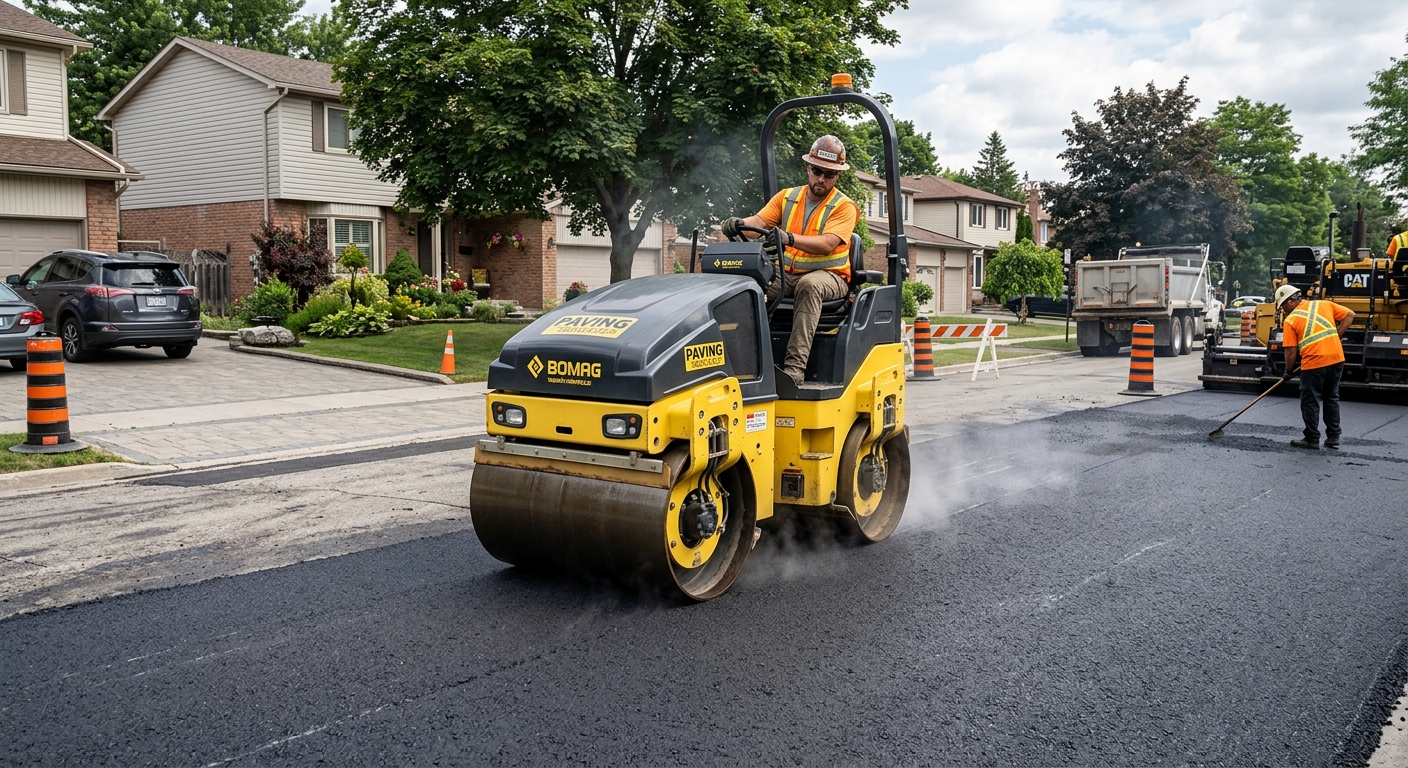
Hellertown paving prices by scope — 2026
Hellertown has a high share of single-family homes (56.8%) and a strong homeownership rate (68.5%) (U.S. Census Bureau, ACS 2024), making driveway paving a top recurring project for local households. With most homes built before 1980, many driveways in the borough have reached or passed the end of their intended lifespan.
The Lehigh Valley’s tough winters, heavy snow load, and routine freeze-thaw cycles all take a toll on driveways, especially when asphalt and base materials are not properly installed or maintained. Hellertown sits on Lehigh Valley limestone karst soils, which demand thorough base grading and drainage. That means the price spread between two quotes almost always comes down to how much work goes into the layers below the surface—where shortcuts are easiest to miss and costliest years down the line.
A skimpy base, skipped compaction, or poor grading won’t show up on the day the trucks leave, but Hellertown’s climate exposes those shortcuts in just a few seasons. Paying for quality base preparation is the real investment, whether for asphalt or concrete.
| Service |
Best for |
Lifespan |
Price range |
| Asphalt — full replacement with new base |
failed base, structural cracking |
20–30 yrs |
$3,500–$8,900 |
| Asphalt overlay / resurfacing |
sound base, surface cracking only |
8–15 yrs |
$1,500–$4,400 |
| Sealcoating — single application |
preventive maintenance on sound asphalt |
2–4 yrs |
$200–$700 |
| Concrete — new installation |
long service life, low maintenance |
30–50 yrs |
$4,900–$12,000 |
| Crack filling and patching |
isolated cracks under a quarter inch |
1–3 yrs |
$200–$800 |
| Gravel driveway |
rural, budget, long runs |
5–10 yrs with upkeep |
$900–$3,500 |
Estimates for a typical Hellertown driveway. Square footage and base condition drive these figures more than material choice.
Grading and water management on a Hellertown driveway
Water is the root cause behind almost every driveway failure in Hellertown. Good grading is not just a finishing touch; it is a necessity here. A driveway should have a minimum slope of 2% (about a quarter inch per foot) to ensure surface runoff moves away from your garage and foundation. For standard driveways, a slight crown in the center or a steady cross slope is key to pushing water off quickly and evenly.
If your driveway slopes toward the house or garage, you need to have trench or channel drains at the transition. These drains collect and redirect water before it gets a chance to infiltrate the base or reach your basement walls—an especially large risk on Lehigh Valley’s limestone subsoils, which can hold and transmit water unpredictably.
Freeze-thaw is relentless in this climate. Water that ponds on your driveway may infiltrate the base, freeze overnight, and upheave large sections by spring. Any design that holds water against the base—like a low spot near the center—will lead to cracked pavement, sunken spots, and edge failure in just a few winters.
When it comes to drainage, water should exit your property “to daylight” (discharging on a suitable downslope) or into an engineered dry well. Redirecting runoff onto a neighbor’s land is a real legal and neighborhood problem, regardless of your permit status. In short, grading and drainage are done right when you never have to think about them again.
Why Hellertown driveways fail from the bottom up
Every lasting driveway in Hellertown follows the same assembly from the ground up: first, the native subgrade (the undisturbed Lehigh Valley limestone soils), then a compacted aggregate base, and finally the asphalt or concrete layer itself. Each layer spreads load to the one beneath. If the aggregate base is too thin or poorly compacted, it does not matter how thick the asphalt above is—cracks and dips will form in short order.
In Hellertown’s climate—serious freeze-thaw, strong snow loads, and a 36-inch frost depth—water in the subgrade is the real threat. When this water freezes, it expands, lifting whole sections of your driveway. This process, called frost heave, cracks and breaks pavement from below, not just at the surface. That is why base depth and quality matter more here than in mild climates where the ground rarely freezes.
Here’s what shortcuts look like, and what to demand in clear writing before anyone breaks ground: Some contractors skip full excavation and try to lay new asphalt over a failed or soft base. Others use minimal or loosely compacted aggregate. Few cheap jobs test the compaction or layer the base in “lifts” (thin, compacted layers that, together, resist settlement). These shortcuts are almost invisible on day one, but by year three, the issues are obvious—cracking, settling, edge ravel.
Homeowners should insist (in writing) on these minimums: a full 6–8 inches of PennDOT 2A or 2B crushed aggregate, placed in two or more lifts with machine compaction after each lift; and a finished asphalt mat at least 2.5–3 inches thick after compaction. It should also state that old base will be removed where failure is found—not just paved over. These details separate lasting driveways from those doomed to early failure.
Beyond replacement: layout changes
Most Hellertown driveway work is straight removal and replacement, but sometimes you are looking to change the footprint—widen for more parking, lengthen to a detached garage, add a turnaround, or replace gravel with hard surface. These are more involved than they may seem.
New layout means new base over previously undisturbed ground. This soil—often well-packed limestone subgrade—needs to be excavated and compacted just like the driveway’s original footprint, and the seam where new and old paving meet is a permanent weak point that must be reinforced and sealed carefully. Expanding the impervious area can also bring township stormwater requirements or zoning overlays into play, especially in the Lehigh Valley’s regulated watershed areas.
You will likely need a new approach permit for the connection to the street or curb, especially if you change the driveway’s width or location. Local rules commonly limit how close you can pave to a property line—so check side and rear setbacks before work starts.
For work on state routes, PennDOT District 5-0 handles driveway approach permits, while township offices handle local curb cuts. Always check both if you are changing where or how your driveway meets the street.
Driveway permits, approaches and stormwater rules
In Hellertown and broader Northampton County, you typically do not need a building permit to repave a driveway in its existing footprint, which saves a lot of paperwork and time. However, the neutral zone is small—once you expand, move the curb cut, or change paving width, zoning and permit rules can come into play, especially in Bethlehem and other nearby municipalities. If your project involves the driveway approach (the curb cut or where your driveway meets the road), that is often a separate permit from your township or, for state roads, PennDOT District 5-0. Many homeowners expect their standard code office to handle it, but the approach permit is a different channel.
Any expansion of impervious surface can trigger stormwater management requirements. Even if your township’s permit office does not flag it, you are still legally responsible: sending new runoff onto a neighbor’s property creates a real liability risk under state law. Drainage must be contained, directed to daylight on your own lot, or managed with dry wells if possible.
By law, any driveway work with a contract over $500 must be done by a contractor registered under the Pennsylvania Office of Attorney General’s Home Improvement Contractor (HIC) program—always verify their registration at hic.attorneygeneral.gov. Check for valid workers’ compensation coverage through WCAIS (wcais.pa.gov), which is mandatory for every Pennsylvania employer.
Overlay, patch or full replacement?
Homeowners in Hellertown can do their own first pass diagnosis on whether it is time for patches, an overlay, or full replacement. It starts with what you see—and being honest about what it means for the base.
Widespread “alligator cracking”—that tarp pattern of interconnected cracks—signals that the base below has failed. No patch or overlay can fix that. Overlays can only succeed when the base is still solid and consistent. If you see mainly isolated linear cracks, that suggests surface aging, not a failed base, which means targeted repairs and sealing have a shot. Depressions or “birdbaths” (shallow puddles after rain) indicate base settling or subgrade issues—these require partial excavation and base rebuilding. Edge crumbling tells you there is no proper edge support, a shortcut sometimes seen on older Lehigh Valley driveways, and potholes mean water has already breached the base.
Be wary: contractors who propose overlays, or patching, without physically probing or core-sampling the base are selling a fix that may not last. An overlay over a failed base is money burned.
| What you see |
Likely cause |
Right fix |
Cost |
| Isolated cracks under 1/4 inch |
surface aging |
crack fill and seal |
$200–$700 |
| Alligator cracking over a wide area |
base failure |
full replacement |
$3,500–$8,900 |
| Depressions holding water |
subgrade movement |
excavate and rebuild that area |
$3,500–$5,400 |
| Crumbling edges |
no edge support |
edge repair, consider curbing |
$400–$1,500 |
| Potholes |
water into the base |
full-depth patch, then assess |
$250–$900 |
| Faded but sound surface |
oxidation only |
sealcoat |
$200–$700 |
Getting thirty years out of a driveway
Some driveways in Hellertown last only a decade; others go forty years with care. The single most important—and cheapest—maintenance is crack filling. If you seal cracks before water gets into the base, you have already doubled the life compared to a never-touched driveway. Support the edges with stone or soil and keep trucks and dumpsters off the sides; most early edge failures start with a foot running off the main base.
Drainage remains crucial. Keep downspouts and water run-off away from the driveway, and sweep sand or dirt off so water continues to run freely. On brand-new asphalt, wait at least 2–3 days before parking, allow thirty days before turning wheels sharply while stopped, and hold off any sealing for the first twelve months.
On de-icing: salt can break down concrete quickly in northeastern Pennsylvania, especially with 40 pounds per square foot snow load winters. Asphalt fares better, but the real risk is from salt’s freeze-thaw cycling—melting snow in the day, refreezing at night, driving small cracks wider. Opt for calcium magnesium acetate or plain sand for traction, though both cost more than bulk salt at the hardware store.
Frequently asked questions — driveway paving in Hellertown
Are there stormwater rules on paving in Hellertown?
Yes, stormwater management comes up whenever your driveway project changes how water runs off your lot in Hellertown or anywhere in the Lehigh Valley. If you expand your driveway or add new impervious areas, you can trigger township-level rules even if no specific permit is required for replacement. Directing runoff onto a neighbor’s property is a real legal liability in Pennsylvania whether or not you’re inspected, so proper drainage—either to daylight on your own lot or into an engineered dry well—is a must. Sometimes, a layout change means your project could be delayed while stormwater calculations are reviewed by the township or the city. Allow at least part of your project’s budget for drainage solutions: a simple channel drain install might run $900–$3,500, right in the range of a gravel drive.
How much does a concrete driveway cost in Hellertown?
In Hellertown and across Northampton County, a new concrete driveway installation falls in the $4,900–$12,000 range, with most typical jobs landing around $7,900. The cost depends on square footage, how deeply the base must be excavated, and how much work is needed to ensure water drains off—not toward the garage. Concrete costs more upfront than asphalt, but a well-built slab should last 30–50 years in the local climate if cared for. Keep in mind, the high winter snow load and freeze-thaw cycles here are tough on concrete. Always insist on a thick base, control joints, and quality grading for the upper end of the service life.
Are pavers worth the cost in northeastern Pennsylvania?
Pavers are an option, but most Hellertown homeowners choose asphalt or concrete for cost-efficiency and cold-weather durability. Interlocking concrete pavers can withstand northeastern Pennsylvania’s freeze-thaw cycles, but only if installed over a deep, properly compacted base. Expect full paver jobs to cost at least 1.5–2 times more than asphalt—easily passing $8,900 for a typical two-car drive. Repairs can be easier, as individual pavers are replaced, but snow plowing and shifting can be issues. For most, asphalt or concrete offers better value for the money unless high-end looks are the top priority.
Is sealcoating a scam?
In Hellertown, sealcoating gets a bad reputation because a lot of fly-by-night crews sell it as a cure-all, but it’s actually solid preventive maintenance for a sound asphalt driveway. It won’t fix cracks, potholes or base issues, but it does protect the asphalt surface from oxidation and water penetration—and helps extend lifespan for just $200–$700 per application. The real scam is on driveways that should have been replaced instead, or where repeated coats build up and start peeling. For newer asphalt or after proper patching, professional sealcoating every 2–4 years remains a cost-effective part of your maintenance plan.
How far ahead should I book a paver in Hellertown?
Hellertown is part of a very competitive Lehigh Valley paving market, but serious contractors book out weeks or even months at the height of the season (May through September). For a typical full replacement job in the $3,500–$8,900 range, expect to wait 3–8 weeks if you want a reputable, insured crew—especially after a wet spring when everyone’s driveways start failing at once. For smaller patch or seal jobs, turnaround might be a little faster. Don’t be rushed by a crew “in the area today”; quality work is worth the wait, especially in this climate.
What slope does a driveway need for drainage?
Here in Hellertown, a driveway should be graded with at least a 2% slope away from structures—that's about a quarter inch drop per foot of run. This is enough for surface runoff without making the driveway feel steep when shoveling or plowing snow. On existing lots and tight yards, sometimes a cross-slope or crown is used instead. Where slope can’t be achieved, you’ll need a channel drain. Poor grading is one of the biggest reasons driveways in the area (especially older ones) fail and end up needing replacement in the $3,500–$8,900 range instead of just a seal or overlay.
How much does it cost to widen a driveway?
Widening a driveway in Hellertown involves new excavation, base prep, and blending the seam between old and new work, which is always a weak point. For a basic two- to four-foot widening along a typical length, expect to pay in the $3,500–$5,400 range when adding new asphalt with a quality base—close to the lower end of full replacement, since much of the cost is in labor and materials for sitework, not just topcoat. If you’re switching to concrete or need complicated grading or approach work, costs can rise quickly.
Does Hellertown have local asphalt plants?
Yes, Hellertown benefits from its location in the Lehigh Valley, with active asphalt plants and quarries centered around Bethlehem and Easton. Haul distances are short, which helps keep material prices in check even as oil costs move. This local supply means less downtime and fewer excuses about “waiting for trucks,” and why driveway pricing remains competitive—expect quality work at $3,500–$8,900 for replacement. Having local plants also means emergency patching materials are almost always available in the busy season.
Why does my driveway have depressions that hold water?
Depressions (“birdbaths”) on Hellertown driveways typically come from base or subgrade settlement—a sign that the foundation material wasn’t compacted well, or that water’s been getting under the surface. This is common on driveways built before modern base standards, especially in areas with limestone soils that move when saturated. Unfortunately, patching just the surface rarely fixes the real problem. The right solution is to cut out and rebuild the affected section with deep compaction and quality aggregate, which usually puts you in the $3,500–$5,400 range for localized work. Ignore it, and frost heave will only make it worse come winter.