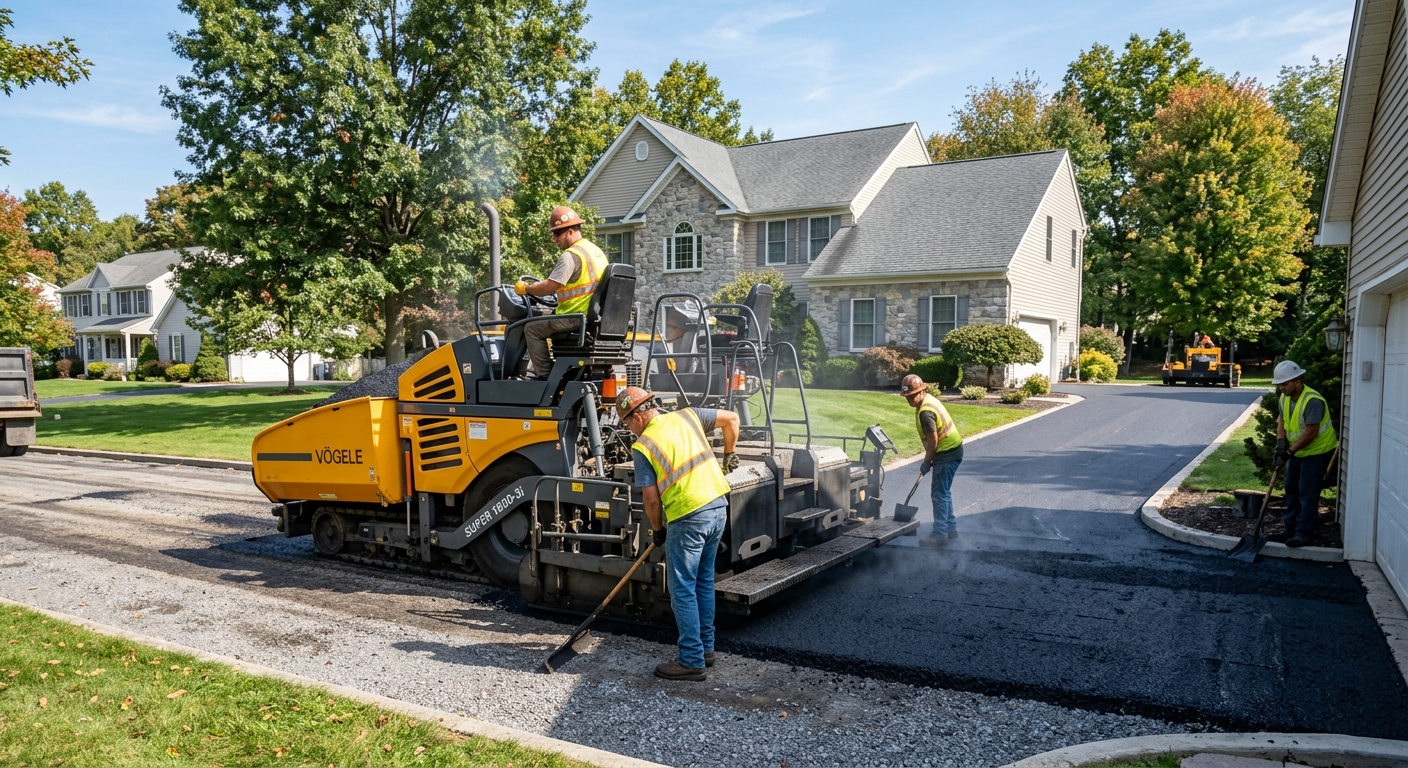
Brecknock paving prices by scope — 2026
Brecknock’s high rate of single-family homeownership (84.6% of homes are detached, and 79.5% are owner-occupied per U.S. Census Bureau, ACS 2024) means most driveway paving is a decision for the person living in the house, not a landlord. In our region, freeze-thaw cycles and prolonged cold snaps test driveways harder than in much of the country. Winter here means water seeps through cracks and then expands, causing base failures beneath the surface that homeowners can’t see.
When you get driveway quotes in Brecknock, know that what drives the cost is mostly invisible: the excavation depth, base material, and prep work. A beautiful surface on weak or thin base will not last, and the big gap you see in pricing is always due to what’s buried—not the asphalt itself. Topside patching or sealcoating can only postpone bigger repairs if the base is already failing underneath. Always ask for written specs that spell out what’s going below the surface, because that’s where the job is won or lost.
| Service |
Best for |
Lifespan |
Price range |
| Asphalt — full replacement with new base |
failed base, structural cracking |
20–30 yrs |
$3,600–$9,300 |
| Asphalt overlay / resurfacing |
sound base, surface cracking only |
8–15 yrs |
$1,550–$4,700 |
| Sealcoating — single application |
preventive maintenance on sound asphalt |
2–4 yrs |
$200–$750 |
| Concrete — new installation |
long service life, low maintenance |
30–50 yrs |
$5,200–$12,500 |
| Crack filling and patching |
isolated cracks under a quarter inch |
1–3 yrs |
$200–$800 |
| Gravel driveway |
rural, budget, long runs |
5–10 yrs with upkeep |
$900–$3,500 |
Estimates for a typical Brecknock driveway. Square footage and base condition drive these figures more than material choice.
Driveway permits, approaches and stormwater rules
In Lancaster County townships like Brecknock, if you are resurfacing an asphalt driveway in its existing footprint, you generally do not need a permit. That saves you both time and money. However, if your project involves constructing or modifying the driveway approach—the portion in the public right-of-way where your drive meets the township or state road—a permit is usually required. In Lancaster city, this is handled by the City of Lancaster Bureau of Engineering, while access to state routes goes through PennDOT District 8-0. If your Brecknock property is along a state road, that’s where your approach permit comes from.
Adding or widening your driveway can increase impervious surface. In Brecknock and Lancaster County, expanding paved area risks triggering stormwater management requirements. Even without a permit requirement, you remain responsible for runoff: if new paving channels water onto a neighbor’s land, you can be held liable. Always ask your contractor about finished elevations and drainage planning.
Anyone working on your property for more than $500 must have an active Home Improvement Contractor (HIC) registration from the Pennsylvania Office of Attorney General (verify at hic.attorneygeneral.gov) and, if they have employees, workers’ compensation coverage (check at WCAIS, wcais.pa.gov). If you’re in a pre-1978 home and disturbing painted surfaces, make sure the crew has EPA Lead RRP certification, which you can verify at certifiedrenovatorsearch.epa.gov.
Diagnosing a failing Brecknock driveway
Most of a paving project’s cost—especially what separates a cheap job from a good one—comes down to what’s under the old surface. You can save yourself from overspending by doing a quick self-check before calling for quotes. Alligator (mosaic-pattern) cracking across broader areas means the base has failed: no surface fix will last. Long, isolated cracks are different; these are just surface aging and are a candidate for crack filling and sealcoating. Depressions or birdbaths that hold water point to movement in the soil beneath, often due to freeze-thaw swelling during our winters. Crumbling edges signal a lack of base support, which eventually leads to breakup and weeds. Potholes indicate water has already penetrated through the surface and reached the base.
If a contractor recommends an asphalt overlay without checking the base—digging at least a test hole—they haven’t diagnosed the problem. An overlay on a failed or wet base is a waste; every spring and winter, it will deteriorate faster. Demand that any quote distinguish between surface aging (which can be overlaid) and a failed base (which requires excavation and replacement).
| What you see |
Likely cause |
Right fix |
Cost |
| Isolated cracks under 1/4 inch |
surface aging |
crack fill and seal |
$200–$750 |
| Alligator cracking over a wide area |
base failure |
full replacement |
$3,600–$9,300 |
| Depressions holding water |
subgrade movement |
excavate and rebuild that area |
$3,600–$5,700 |
| Crumbling edges |
no edge support |
edge repair, consider curbing |
$400–$1,500 |
| Potholes |
water into the base |
full-depth patch, then assess |
$250–$900 |
| Faded but sound surface |
oxidation only |
sealcoat |
$200–$750 |
Numbers, not adjectives
Paving in Brecknock is not about talk—it's about numbers. When conditions in Lancaster County mean 30 inches of frost depth and years of freeze-thaw cycles, you need specifications in writing, not verbal assurances. Don’t accept “three inches of blacktop,” because as laid, that might compress to much less. What matters is compacted depth. Base thickness is just as critical: limestone karst soils in the area need a deeper, well-compacted base to resist movement and drainage issues.
The only way to compare quotes is to line up specs—not adjectives like “premium” or “heavy-duty,” but real measurements. Demand details on every layer: aggregate type, thickness after compaction, subgrade prep (especially if soil is rocky or soft), and edge treatments. If it’s not written, it doesn’t count.
- Total measured square footage
- Excavation depth (inches removed below finished grade)
- Aggregate base depth after compaction
- Material type and source for base (local limestone, recycled, etc.)
- Compaction method and equipment (roller, plate compactor), compaction in lifts
- Asphalt binder course thickness after compaction
- Surface course thickness after compaction
- Asphalt mix designation (e.g., PennDOT 25mm binder, 9.5mm wearing)
- Edge treatment (tapered, curbed, reinforced)
- Grading and finished elevations for stormwater management
Reading a driveway proposal
A good proposal lets you compare apples to apples. Insist that the measured square footage appears on the estimate—no “about this much” guesses. Specify how deep excavation will go and where spoils will be disposed of. The base layer should list both type of aggregate and compacted depth in inches. Compaction should be done in lifts and called out that way. Asphalt, whether binder or surface course, must note compacted depth, not “as applied.” Edge treatment needs detail: hand-shaped, machine-rolled, or curbed. Drainage should be spelled out in terms of slope and where water goes. Good contractors include cleanup and restoration details, and warranty language (with exclusions, because most don’t cover surface cracking).
If you get a one-sentence quote with just a price, that’s a problem. It means you can’t compare it to anything else, and you’re at serious risk of paying for a shortcut you can’t see. This is the single most common way Lancaster County homeowners overpay.
| Line item |
What to look for |
Red flag if… |
| Area |
measured square footage stated |
eyeballed or absent |
| Excavation |
depth and disposal included |
'we'll pave over it' |
| Base |
aggregate type and depth in inches |
'proper base' |
| Compaction |
method, and done in lifts |
not mentioned |
| Asphalt |
courses and compacted depth |
'3 inches' unqualified |
| Drainage |
slope and water direction stated |
silent |
| Warranty |
what is covered and what is excluded |
verbal only |
| Payment |
modest deposit, balance on completion |
full cash up front |
Beyond replacement: layout changes
Many Brecknock homeowners are looking beyond simple replacement—widening for a second car, lengthening a driveway toward a new garage, adding a parking pad or turnaround, or swapping a gravel drive for asphalt. As soon as you go outside the existing footprint, you’re working on undisturbed subgrade that’s never seen traffic or compaction. A new base must be built from scratch, and because old and new paving never bond perfectly, the seam will always be the weak link.
Changing layout may also cross into setback or impervious-surface limits in Lancaster County, whether enforced at the township level or if you’re close to a municipal boundary. If any of your new driveway extends to the public street or changes how traffic enters, you'll trigger a new driveway approach permit—usually from the city engineering department for Lancaster proper or PennDOT for state roads. Finally, expanded drives mean more runoff, so be prepared for stormwater requirements as well.
Local soil, drainage and driveway lifespan
East Hempfield Township, not far from Brecknock, is known for its limestone karst subgrades, which have different drainage and settling risks than other soils in Lancaster County. Limestone karst can cause pockets or voids beneath driveways, so we must use a thicker stone base and ensure proper compaction to prevent settlement and cracking. That’s not just a best practice; it’s a local necessity—drive on an underbuilt base here and frost will show you the mistake in just a few seasons.
Add to that our region’s frost depth of 30 inches and its dramatic freeze-thaw cycling. This means substandard prep—like skimping on base thickness or subgrade compaction—is punished quickly. In Lancaster city, many homes were built before 1940, where driveways (particularly shared or narrow ones) were poured or paved over whatever ground was there. These often need subgrade correction and almost always a rebuilt apron when it’s time for a redo. Knowing what’s under your own drive is the step that decides how long a new surface will last.
Frequently asked questions — driveway paving in Brecknock
Does sealcoating fix cracks?
Sealcoating is a preventive maintenance treatment for Brecknock driveways, but it’s not meant to repair cracks. A fresh coat fills surface pores and protects from UV and water intrusion, extending the life of solid asphalt. It does not fill or bridge even small cracks—those require separate crack filling first. If your driveway just has fine surface cracking under a quarter inch, crack filler should be applied before sealcoating. If you have alligator cracking or wider seams, neither crack filling nor sealcoating will solve the real problem, and putting off a needed replacement just wastes money sitting at $200–$750 every few years.
How many freeze-thaw cycles does Brecknock get?
Brecknock, like the rest of Lancaster County, sits in south-central Pennsylvania where pronounced freeze-thaw cycling is standard each winter. You can expect dozens of cycles: temperatures drop below freezing at night and rise above freezing by day through late fall and early spring. Each cycle allows water to penetrate driveway cracks, freeze, expand, and force apart both asphalt and concrete. That’s a big reason why proper base thickness—at least what’s called for due to our 30-inch frost depth—is so critical here. Cutting corners on spec means seeing problems years earlier than in milder climates.
Are there stormwater rules on paving in Brecknock?
Yes—while resurfacing an existing driveway in Brecknock rarely triggers a special permit, any expansion, new paving, or change to the driveway approach can bring runoff and impervious surface regulations into play. Even if no formal permit is required for in-place repaving, you are responsible under Pennsylvania law if stormwater from your new surface is directed onto a neighboring property. There’s also the issue of local townships having their own runoff limits. Before you widen or extend your driveway, it’s wise to discuss drainage with both your contractor and the township, or risk costly changes after the fact.
How long does a driveway installation take?
For most single-family homes in Brecknock, a straight asphalt drive replacement—new base, new surface—typically runs two to three days of onsite work for demolition, base installation, and paving, then several days more before the drive is fully ready for vehicle traffic. Weather and scope push the timeline: rain or extended cold weather will push paving back, and concrete takes longer to cure, with new installs stretching to a week or more. Projects outside the current footprint (such as widening or extensions) may take longer due to excavation and subgrade prep. Costs for a full asphalt replacement generally range from $3,600–$9,300.
How much does it cost to widen a driveway?
For most Brecknock homeowners, widening a driveway costs similar per square foot to a new install, since you’ll need new base prep on undisturbed ground. Small additions—a few feet to park a second car—are often grouped with repairs or overlays and can land at $1,550–$4,700, while full expansions or side parking pads (especially if pouring new concrete) can climb toward $5,200–$12,500. If the driveway connects to a public road, include approach permitting costs and time. Always factor in drainage and setbacks for any new impervious surface.
Is an overlay worth it or should I start over?
In Brecknock, overlays are only a good value when your driveway’s base is still solid—no deep cracks, dips, or potholes. If you see isolated cracks and the surface is tired but firm underfoot, an overlay at $1,550–$4,700 (2026 figures) may be sensible. However, if there’s alligator cracking, edge breakup, or deep low spots, an overlay is throwing good money after bad; the underlying base issues will break through quickly, especially with our freeze-thaw cycles. Any contractor should probe underneath to diagnose, not just look at the surface.
What does an asphalt overlay cost in Brecknock?
Asphalt overlays in the Brecknock area cost between $1,550–$4,700 for a typical single-family home driveway, with most jobs falling near the middle of that range. Factors affecting the cost include the total square footage, the current condition of the base and edges, how much prep is needed for bonding (like making saw cuts or cleaning out problem areas), and how many transitions there are (garage, apron, sidewalk). If your base is questionable, a “cheap” overlay often leads to rip-out and a full replacement in just a few seasons, so discuss base probing before you green-light any overlay.
What is the difference between binder and surface course?
Binder course is the structural layer of asphalt—thicker aggregate, laid down first on top of the compacted stone base. It adds strength and thickness; in Brecknock’s climate, this is crucial for withstanding frost heave and heavy vehicles. The surface course (sometimes called “wearing course”) is finer, with smaller stones for a smoother finish, water shedding, and better durability against the elements. Good specs in Lancaster County call for at least two lifts: one binder course and one surface. Both must be described in your quote by compacted thickness, not just “three inches overall.” Full replacements range $3,600–$9,300 and include both.
Why are my driveway edges crumbling?
Edge crumble is a main complaint in Brecknock, especially where driveways lack proper base support at the sides or where runoff drains along the edge. Our regional freeze-thaw cycles and limestone karst subgrade make edges the weak point if built light. Water gets beneath, the base pumps out, and the asphalt shear off into the lawn. The fix is more than a quick patch: you’ll want the edge excavated for new stone, possibly a curb or heavy edge treatment, and compaction all the way out to the new edge. Realistically, edge repairs start at $400–$1,500.