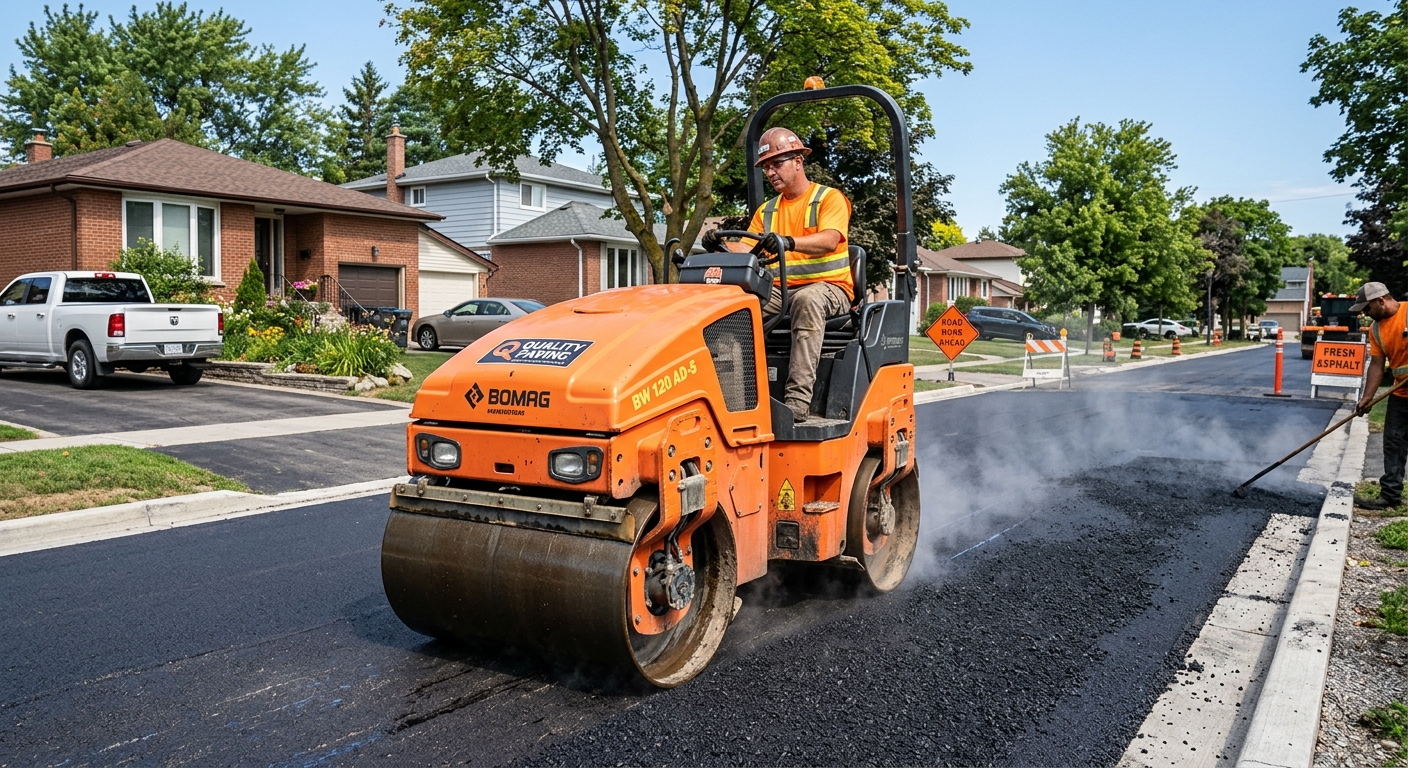
What a new driveway costs in Coolbaugh
Coolbaugh Township, with its high homeownership rate and the vast majority of properties being single-family houses (U.S. Census Bureau, ACS 2024), sees most driveway paving as a personal household investment. Most Coolbaugh households own their homes and manage detached drives—these long runs are typical on larger Pocono lots. Prices here swing widely, and it's rarely about the visible part of the job. What really governs cost are subgrade conditions and prep. Coolbaugh sits on rocky Pocono Plateau soils, and those pockets of glacial till can require a much thicker stone base than in flatter, less rocky parts of Pennsylvania.
Our winters bring frequent freeze-thaw cycles and snow loads well above the state average. A driveway holds up only as well as the base beneath it. Two driveways can look identical on day one, but if one crew cut corners under the surface, it's the frost heave and drainage failures you’ll notice three years later—not the finish of the asphalt up top. That’s where most of the price difference hides, so choose specs over sales talk.
| Service |
Best for |
Lifespan |
Price range |
| Asphalt — full replacement with new base |
failed base, structural cracking |
20–30 yrs |
$3,400–$8,800 |
| Asphalt overlay / resurfacing |
sound base, surface cracking only |
8–15 yrs |
$1,450–$4,400 |
| Sealcoating — single application |
preventive maintenance on sound asphalt |
2–4 yrs |
$200–$700 |
| Concrete — new installation |
long service life, low maintenance |
30–50 yrs |
$4,900–$11,500 |
| Crack filling and patching |
isolated cracks under a quarter inch |
1–3 yrs |
$200–$800 |
| Gravel driveway |
rural, budget, long runs |
5–10 yrs with upkeep |
$900–$3,500 |
Estimates for a typical Coolbaugh driveway. Square footage and base condition drive these figures more than material choice.
Permits and approvals for paving in Coolbaugh
In most of Coolbaugh Township, you don't need a building permit to repave your driveway if you're staying within the existing boundaries. If you're just resurfacing or patching what's already there, it's usually a straightforward process—no township sign-off required, which means less paperwork for routine maintenance. However, the junction between your driveway and the public road is a different matter. If your drive connects onto PA Route 611 near Stroudsburg, for example, the approach itself usually requires a permit from PennDOT District 5, not your local township office. That catches a lot of homeowners off guard, especially those who assume everything funnels through the township.
If you expand, add width, or change the impervious area footprint, stormwater rules may apply. More paving means more runoff—this can trigger review for drainage compliance by your municipality, and you could be liable if runoff directs onto a neighbor’s property and causes flooding or erosion, regardless of whether you have a permit.
Every driveway contract over $500 in Pennsylvania requires the contractor to be registered with the Home Improvement Contractor registry from the PA Office of Attorney General. Always verify at hic.attorneygeneral.gov before signing. Any crew with employees must hold workers’ compensation coverage, which you can check via WCAIS (wcais.pa.gov)—this protects you if a worker is hurt on your site.
Caring for a new Coolbaugh driveway
The best way to get your money’s worth from a driveway in Coolbaugh is seasonal maintenance—and timing matters more here, where winters are serious. First, fill cracks as soon as they appear, especially before fall. Water working down to the base is what shortens driveway life, and our freeze-thaw cycles make small cracks bigger every winter. Second, support the edges: don’t let grass or traffic eat away at the sides, or alligator-cracking starts where support is lost. Third, keep gutters, downspouts, and landscape grading directing water away from pavement. Poor drainage alongside the drive means base failure, soft spots, and frost heave.
On newly-paved asphalt, wait at least two to three months before sealing. That gives the oils time to cure and ensures you aren’t locking in too much moisture. Don’t park heavy vehicles, jacks, or dumpsters on fresh asphalt—point loads will leave depressions and permanent marks that the freeze-thaw will only make worse. When shoveling, use plastic blades instead of steel, especially in the first year.
For de-icing, plain salt is rough on concrete, accelerating surface pitting and spalling. On asphalt, salt’s main hazard is not chemical—it's the repeated melt-refreeze that works water into the base and opens cracks. Sand and calcium chloride work, but they cost more. In our area, with a winter design temperature of 4 °F, mechanical shoveling and early crack seal are simply smarter investments in the long run.
Changing the footprint of a Coolbaugh driveway
Widening a driveway for a second car, extending pavement to a new garage, adding a parking pad, or converting gravel to asphalt are all common in Coolbaugh as families grow or needs change. These projects are different from a basic resurfacing job—when you change the footprint, you need new base construction over undisturbed ground, not just patching the surface. The seam between old and new will always be a long-term weak point for cracking and water entry.
Adding more paved area also means you may hit impervious-surface limits set by the township, which tie into stormwater runoff. If your plan sends more runoff onto public roads or neighboring lots, expect review or conditions from the code office. Any new tie-in to a state road like PA Route 611 will, again, need PennDOT District 5 approval for the driveway approach, separate from any township input.
Setbacks can keep you from paving right up to your property line, especially in more rural parcels. If you’re thinking of a substantial change, start by asking the township zoning officer or reviewing the local rules for setbacks and stormwater—it’s cheaper than tearing out work after the fact.
Why you can't pave in February
Crew schedules in Coolbaugh follow the calendar, not customer demand, and for good reason. Hot-mix asphalt must be laid when both the material and the ground hold enough heat—the target is typically air and surface temperatures above 50°F. Below this, asphalt stiffens too quickly, can’t be compacted properly, and ends up porous and short-lived—something you won’t spot until next winter’s frost breaks it apart. Local asphalt plants, which pull aggregate from Stroudsburg and Tobyhanna pits, shut down once consistent freezes set in. In practical terms, material is simply not available from mid-November through March here.
Concrete faces its own constraints: anything below freezing slows curing and risks permanent damage to the slab, especially with our 4 °F winter design temp. Even with chemical accelerators and insulated blankets, it’s not a wise spend—surface flaking and freeze-blisters reduce lifespan from the start.
If you want to get the best price and a job that lasts, aim for May through early November. In the May–June and September–October shoulder seasons, crews have more flexibility and prices are often more favorable. Summer bookings fill up fast as soon as schools let out. If you meet a crew willing to lay asphalt in late November or February here, what they’re really saying is that quality isn't their concern—or they’re dumping leftover plant mix, which is never worth the risk.
What's under the asphalt matters more than the asphalt
Every driveway in Coolbaugh lives or dies by what’s beneath it. The typical assembly goes: native subgrade, followed by several inches of compacted aggregate base (crushed stone or modified stone), capped by a layer or two of hot-mix asphalt. Each layer serves to spread out the weight of vehicles to the layer below—if the base is thin, poorly compacted, or the subgrade wasn’t prepared right, even the thickest and blackest asphalt will crack, rut, or heave in just a few winters.
The Pocono Plateau subsoil is notorious—rocky, patchy, and shot through with glacial till. Water doesn’t drain uniformly, and in a high freeze-thaw region like this, any water trapped below the asphalt will freeze, expand, and jack the pavement up unevenly. That’s frost heave: water in the subgrade expands in freezing weather, forces the driveway upward in spots, and as it thaws, the asphalt settles back—cracked and weakened. That is why base depth and proper drainage mean more here than almost anywhere else in Pennsylvania.
Less-reputable contractors make their money by skimping where you won’t see it. Common shortcuts: skipping excavation, laying new asphalt over a failed base, spreading stone too thin, or not compacting base in layers (“lifts”). These shortcuts look fine on day one and reveal themselves by year three—with soft spots, edge failures, and cracks. Always get, in writing: at least 6–8 inches of compacted 2A modified stone base, compacted in multiple lifts; a surface course of hot-mix asphalt at least 2–2.5 inches compacted; and clear confirmation that compaction was performed each step. Ask for aggregate specs and compaction details just as you would for any other vital structural part of your property.
What a real paving quote contains
A proper driveway quote in Coolbaugh should read more like a construction contract than a fast-food menu. Each line item tells you where your money is going—and only with these details can you compare bids or hold a contractor accountable. Look for: total measured square footage (never just “about 2,000 square feet”); excavation depth and if debris haul-off is included; specified aggregate base (type, graded size, and depth, in inches); notes on compaction method, done in lifts (multiple passes, not just one roll); asphalt courses, with thickness stated both before and after compaction (since 3 inches loose only yields about 2.5 inches finished); and clear drainage and water-shed plan. Edge treatment—how the asphalt meets the lawn or walks—matters for durability. Cleanup should be included, not left for you. Payment terms should be a modest deposit and the balance on job completion; warranty terms should list what’s included and excluded—most do not cover future cracks.
The most common way Coolbaugh homeowners lose out is accepting a one-line quote with no specifications. That makes it impossible to compare or contest cut-corners later on.
| Line item |
What to look for |
Red flag if… |
| Area |
measured square footage stated |
eyeballed or absent |
| Excavation |
depth and disposal included |
'we'll pave over it' |
| Base |
aggregate type and depth in inches |
'proper base' |
| Compaction |
method, and done in lifts |
not mentioned |
| Asphalt |
courses and compacted depth |
'3 inches' unqualified |
| Drainage |
slope and water direction stated |
silent |
| Warranty |
what is covered and what is excluded |
verbal only |
| Payment |
modest deposit, balance on completion |
full cash up front |
Frequently asked questions — driveway paving in Coolbaugh
Do I need a permit to repave a driveway in Coolbaugh?
For most homeowners in Coolbaugh Township, simply repaving your existing driveway doesn't require a building permit if you are not increasing the size or changing the layout. This is especially true for straightforward resurfacing or asphalt overlay jobs, which keep within the original footprint. However, any change to the driveway approach where it meets a state road, like PA Route 611, usually does require a separate permit from PennDOT District 5. Also, if you're expanding your driveway or adding new pavement, township approvals may kick in to check stormwater runoff or impervious coverage. It's best to clarify with the township first if your plans go beyond a one-for-one replacement. Getting the permit issue out of the way early helps avoid costly surprises on a job running anywhere from $1,450–$8,800, depending on the scope.
Is an overlay worth it or should I start over?
Asphalt overlay can be a smart investment in Coolbaugh if your existing driveway base is solid and the problems are just with surface cracks, minor pitting, or faded color. An overlay means spreading a new layer of hot-mix asphalt right over the top, at a fraction of the cost of a full tear-out—generally $1,450–$4,400 for most local homes. If you have deep cracks, sunken areas, root heaves, or chronic puddling after rain, you’re throwing good money after bad with an overlay. Those issues point to base failure or water issues that can't be addressed by adding more surface. On the rocky soils and freeze-thaw cycles we have in Coolbaugh, skipping a needed full replacement almost always means the overlay will fail much sooner than you’d like, often needing major repair again within a few years.
How much does a concrete driveway cost in Coolbaugh?
A new concrete driveway in Coolbaugh will generally run between $4,900–$11,500, with most typical suburban-sized jobs landing around $7,800. The higher cost compared to asphalt reflects not just the material, but also the extra labor and thicker base needed for concrete on our rocky Pocono Plateau soils. Concrete lasts far longer—30 to 50 years with good care—and handles point loads better, so some homeowners prefer it for heavy use or when long-term value matters more than initial cost. Just keep in mind that salt used for ice can pit or spall the surface, and repairs are costlier than with asphalt. If your existing driveway is failing due to poor base or serious drainage problems, expect those site factors to push you toward the higher end of the range.
What slope does a driveway need for drainage?
In Coolbaugh and throughout Monroe County, proper driveway drainage is critical because of our high snow and rainfall totals. The general rule is to have at least a 2% slope away from buildings and toward the street or designated runoff area—that’s about a quarter inch per foot. For long drives or those running parallel to a garage, side-to-side “cross slope” helps shed water off the pavement, preventing ponding or ice. Townships may have their own specific codes, but if your contractor doesn't mention slope—or wants to lay something dead flat—it's a red flag, especially when spending anywhere from $3,400–$8,800 for a full asphalt replacement. Getting drainage right at the outset helps prevent freeze-thaw damage and costly repairs.
Can asphalt be laid in cold weather?
Asphalt paving in Coolbaugh stops once cold weather hits and local plants shut down, usually by mid-November. Hot-mix asphalt needs warm air and ground—ideally above 50°F—to compact and bond properly. Laying it in cold temps, especially in a climate where winter lows can reach 4 °F, guarantees the surface won’t last. Asphalt delivered cold from Stroudsburg or Tobyhanna plants just can’t be compacted enough before it stiffens up, leading to early cracks and weak spots. If a crew offers to pave for you in late fall or winter, that’s a red flag. Wait until spring—your project might cost $3,400–$8,800 for a full replacement, but trying to rush it can turn that investment into a waste within a few years.
Are door-to-door pavers a problem in Coolbaugh?
Door-to-door paving crews do show up in Coolbaugh, especially in spring and summer when homeowners see winter damage. The risk is high here because they often offer prices that seem too good to be true—sometimes quoting well below $1,450–$4,400 for an “overlay” or “leftover load”—but cut corners on prep and materials, skip compaction, or disappear after collecting a cash deposit. In Pennsylvania, every paving contractor must be registered with the state Home Improvement Contractor registry for jobs over $500. If a crew won’t give you this number (check at hic.attorneygeneral.gov), or won’t put the details in writing, keep your money in your pocket. Most problems locally are either poor quality or no warranty backup when issues show up the next winter.
How long should an asphalt driveway last in Coolbaugh?
If installed with a proper base and maintained well by filling cracks and sealing every few years, an asphalt driveway in Coolbaugh can last 20–30 years. It’s important to remember that our Pocono climate is tough on pavement—the freeze-thaw cycles and heavy snow loads mean that edges and poorly-drained spots fail first. Driveways without enough base or with drainage problems often need replacement much sooner, sometimes in as little as 8–10 years. A full replacement with 6–8 inches of compacted stone and 2.5 inches of asphalt, running $3,400–$8,800, is what delivers the longest life. Shortcuts up front show up after the second or third winter—don’t let a low-ball price fool you.
How much does driveway paving cost in Coolbaugh?
Paving costs in Coolbaugh run a wide range, depending on material, base prep, and access. A full asphalt replacement—including excavating and rebuilding the base—usually falls between $3,400–$8,800, while an overlay on a solid base averages $1,450–$4,400. If you’re just sealing an existing drive, expect $200–$700 per application. Concrete, chosen for surface longevity, comes in at $4,900–$11,500. Differences between quotes are almost always due to what's under the surface—thickness of the stone base, amount of excavation, and whether subgrade issues like soft spots are actually corrected. That’s why it pays to get every detail in writing, so you know what you’re actually paying for and can compare properly.
When can I seal a brand new asphalt driveway?
In Coolbaugh’s climate, you should wait at least 90 days after installation before sealing a new asphalt driveway. This allows time for the oils to cure out and the surface to harden, so that the sealer adheres properly and doesn’t trap moisture. If you seal too soon, you can actually cause the surface to soften and shed in hot weather or during our freeze-thaw cycles. Once it’s ready, a proper sealcoating job costs $200–$700 and gives you the best return if you reseal every 2–4 years. Holding off the first season is a small patience test that pays off with longer driveway life and fewer repair headaches over time.