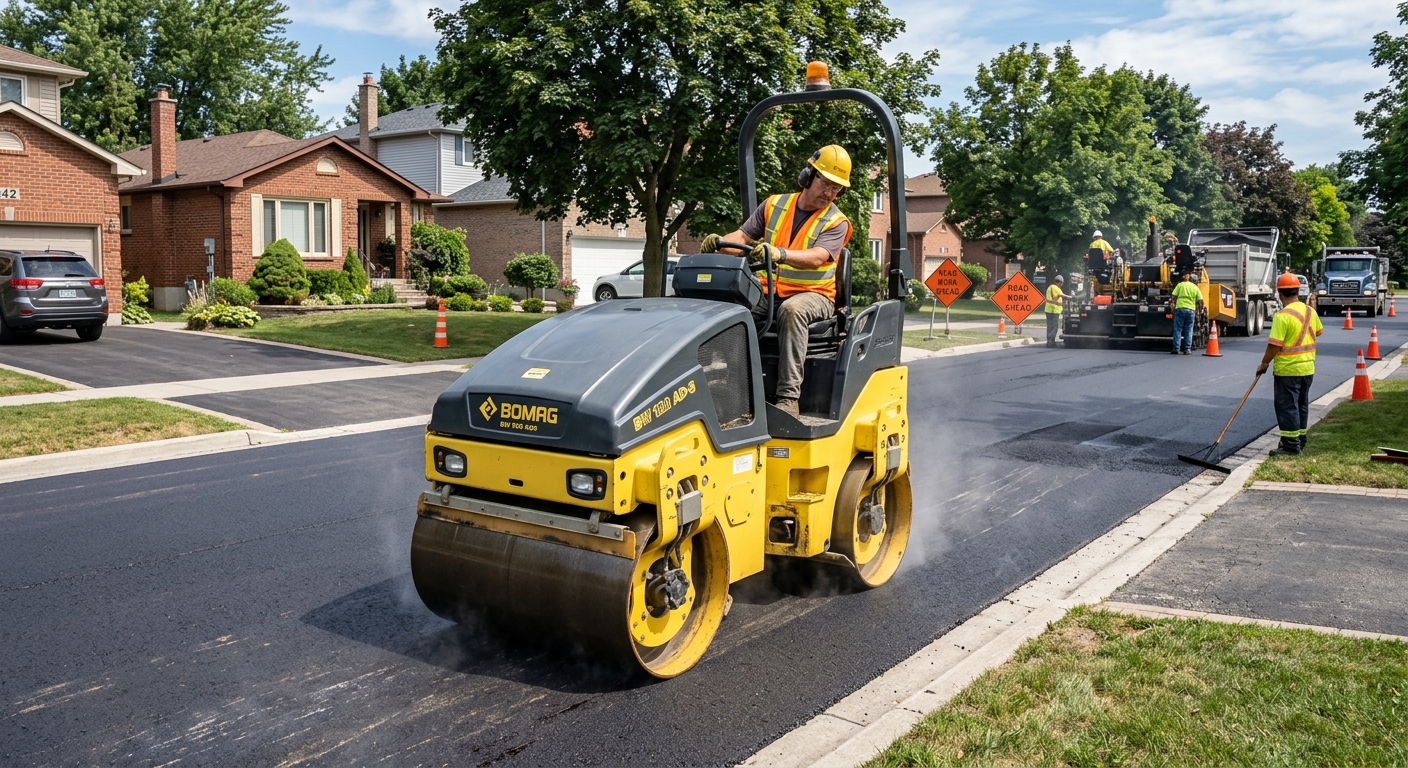
What a new driveway costs in Carnegie
In Carnegie, where 52.3% of homes are single-family and the homeownership rate stands at 56.3% (U.S. Census Bureau, ACS 2024), a driveway is one of the most significant exterior investments for a property owner. The steepest cost in paving work is often invisible, hidden in how the contractor prepares the ground under your drive. In a hilly, older town like Carnegie, where heavy freeze-thaw cycles and a clay and shale subgrade are the norm, shortcuts under the surface can turn what seems like a deal now into a problem three winters down the line.
When comparing quotes, remember: the largest price swings aren’t about the top layer you see—they’re about what lies beneath. Thicker base material, deeper excavation, and real compaction cost more up front, but are essential in Allegheny County’s climate and soil. Saving money by skimping here will not pay off. Whether you’re faced with a patched-up postwar driveway or considering a new install, these factors drive 90% of the durability and nearly all of the cost difference between contractors.
| Service |
Best for |
Lifespan |
Price range |
| Asphalt — full replacement with new base |
failed base, structural cracking |
20–30 yrs |
$3,300–$8,500 |
| Asphalt overlay / resurfacing |
sound base, surface cracking only |
8–15 yrs |
$1,400–$4,200 |
| Sealcoating — single application |
preventive maintenance on sound asphalt |
2–4 yrs |
$200–$650 |
| Concrete — new installation |
long service life, low maintenance |
30–50 yrs |
$4,700–$11,500 |
| Crack filling and patching |
isolated cracks under a quarter inch |
1–3 yrs |
$200–$800 |
| Gravel driveway |
rural, budget, long runs |
5–10 yrs with upkeep |
$900–$3,500 |
Estimates for a typical Carnegie driveway. Square footage and base condition drive these figures more than material choice.
Why driveways behave differently in Carnegie
The subgrade under Carnegie driveways is mostly clay and shale, a combination that shapes how long a driveway lasts and how it needs to be built. Clay’s tendency to hold water leads to swelling and heaving when temperatures drop below freezing, while shale fragments drain unevenly and offer unpredictable support if not compacted properly. These soils demand a thicker, well-compacted aggregate base to avoid surface cracking, rutting, and premature failures.
Allegheny County is marked by hilly terrain and a frost depth of 36 inches. Because water trapped in clay expands as it freezes, anything less than robust drainage and deeper base work is a risk. Many driveways in Carnegie—especially in neighborhoods built during the postwar 1945–1975 boom—suffer from inadequate or missing base layers. During that era, rapid subdivision growth in places like McCandless and Penn Hills often led to shortcuts under the surface. As those driveways approach 50 years of age, overlaying the top alone doesn’t address the real problem below.
What this means for a homeowner in Carnegie is simple: conventional standards from one county over may not work here. Pittsburgh’s heavy freeze-thaw pattern and these soils require both deeper excavation and careful attention to building up the foundation—not just resurfacing the pavement.
Numbers, not adjectives
In Carnegie and across Allegheny County, the difference between a driveway that lasts and one that fails early is numerical, not just a matter of choosing “quality” materials. Quotes should specify exact depths and materials, not just “thick” or “sturdy” asphalt. In this climate—with sustained freeze-thaw cycles, heavy clay and shale subgrade, and 36-inch frost depth—cutting corners on these numbers shortens driveway life drastically.
When a contractor claims “three inches of asphalt,” ask if that’s compacted thickness or before rolling, because a three-inch loose lay compacts down to about two and a quarter inches. Without documented compaction—preferably in multiple lifts, not all at once—the bottom of an asphalt layer may never fully settle, especially over soft subsoil. Every layer, from subgrade to surface, must be measured and proven before paving goes down.
- Excavation depth (inches below finished grade)
- Aggregate base depth (minimum 8–12 inches for local clay/shale soils)
- Aggregate base type (2A modified stone or similar, not crushed concrete)
- Base compaction in lifts (document method and pass count)
- Asphalt binder course depth (typically 2–2.5 inches compacted)
- Asphalt surface course depth (1.5–2 inches compacted)
- Compaction method and final density test
- Mix designation (such as PennDOT ID-2 wearing, appropriate for residential)
- Edge treatment (tapered edge, supported by aggregate rather than left hanging)
- Drainage slope (documented per linear foot, away from structures)
Insist every one of these details appears in writing. Anything left vague often gets skipped—and you don’t see the consequences until puddles, cracks, and ruts appear years later.
Getting thirty years out of a driveway
In Carnegie, the cheapest and most effective way to stretch a driveway’s life is with timely crack filling—especially before freeze-thaw cycles let water reach the base. This simple annual or biennial step does more to prevent major damage than any other routine maintenance. Supporting driveway edges with soil and avoiding drop-offs stops cracks from propagating at the margins. Equally important is keeping water moving: clear gutters and grade slopes so meltwater and rain run away from the drive, not under it.
Avoid loading new asphalt prematurely with heavy vehicles, dumpsters, or turning wheels in place. For the first week after fresh paving, stay off it if possible. On a concrete drive, limit de-icing salt use—salt attacks the surface, causing flaking and spalling over several seasons. For ice, consider using sand or calcium magnesium acetate; both cost more than salt but do not damage the surface. With asphalt, the problem isn’t surface chemistry but water infiltration; the melting and refreezing cycles create mechanical damage beneath the surface, especially if drainage is poor.
With Allegheny County’s 8°F winter design temperature and over 5,600 heating degree days, a bit of prevention goes farther than a thicker driveway ever will. Nothing does more for lifespan, dollar for dollar, than basic crack filling ($200–$800 per round).
Comparing materials in southwestern Pennsylvania
For Carnegie homeowners, the decision between asphalt and concrete is less about looks and more about local survival rates. Asphalt’s flexibility lets it ride out ground movement from freeze-thaw cycles and shifting subgrades common with our clay and shale base. It may not last as long as concrete on paper (20–30 years for full reconstruction), but it resists the surface cracking and upheaval that cripple concrete in southwestern Pennsylvania’s winter climate.
Concrete can reach 30–50 years when given a perfect base and kept free of road salt, but that’s the catch. In Carnegie, where de-icing salt is used heavily, concrete driveways often show pitting and scaling within a decade or two, as salt works into the surface and weakens it. Homeowners must avoid using salt-based de-icers—or accept a shortened lifespan for the higher upfront cost ($4,700–$11,500).
Paver and gravel options have real places here too. Pavers suit sloped drives near hillsides, since individual units can be leveled or replaced if settlement occurs, and gravel remains the lowest cost over long, rural runs where snow melt and drainage are paramount.
| Option |
Installed cost |
Maintenance |
Freeze-thaw performance |
Lifespan |
| Asphalt — new install |
$3,300–$8,500 |
sealcoat every 3–4 yrs |
excellent, flexes |
20–30 yrs |
| Asphalt — overlay |
$1,400–$4,200 |
same |
good if base is sound |
+8–15 yrs |
| Concrete |
$4,700–$11,500 |
low, avoid de-icing salt |
fair, spalls with salt |
30–50 yrs |
| Pavers |
$7,500–$11,500 |
individual units replaceable |
good, settles gradually |
25–50 yrs |
| Gravel |
$900–$3,500 |
top-dress every 2–3 yrs |
excellent drainage |
indefinite with upkeep |
What's under the asphalt matters more than the asphalt
No part of the paving job matters more for a Carnegie driveway than what gets buried. Every long-lived drive in Allegheny County starts with a properly prepared subgrade—our region’s typical clay and shale soil needs extra attention, more depth, and real compaction. The hierarchy is simple: subgrade at the bottom, covered by a thick, compacted aggregate base (not construction debris or a dusting of stone), capped by the asphalt or concrete surface.
Clay in the subgrade absorbs water and, when winter hits, expands as it freezes—a phenomenon called frost heave. Instead of simply moving up and down, the driveway slab lifts unevenly, leading to cracks and “alligator” patterns that signal failure from below, not above. This is why a typical six-inch base that might work elsewhere is not enough here. For Carnegie homes, a base of at least 8–12 inches of 2A modified aggregate is essential, compacted in lifts of three to four inches at a time with vibratory rollers, not just a truck tire.
Where a quote gets cheap is almost always here: skipping excavation, dumping thin or ungraded stone, or laying asphalt in a single thick pass. All of this is invisible until the first freeze-thaw cycle turns your driveway into a patchwork of ruts and cracks by year three. Insist every bid breaks out:
- Excavation depth (how deep they’re going below the old drive)
- Base material (“2A modified” aggregate, not leftover demo)
- Base depth (minimum 8 inches, 12 is better on clay or hillsides)
- Compaction method (mechanical, in separate lifts)
- Proof of compaction (density test or multiple roller passes per lift)
If a quote skips these figures, you’re not getting a solid driveway—just a new surface over old problems.
What you need before paving in Carnegie
For most Carnegie homeowners, repaving an existing driveway entirely within the residential property lines doesn’t usually call for a building permit. However, if any part of your project touches the public right-of-way—like modifying a curb cut or sidewalk apron—permits are handled locally within your municipality, and in Pittsburgh proper, you’d go through the Department of Mobility and Infrastructure. For driveways connecting to state-maintained roads, a Highway Occupancy Permit from PennDOT District 11-0 is required, not your local borough office.
Be alert to stormwater: in Allegheny County, expanding the impervious area may add requirements for controlling runoff, especially if you’re changing slopes or regrading. Even if permits aren’t involved, Pennsylvania law recognizes liability if drainage is altered and causes water to run onto a neighbor’s land, so the grading plan matters as much as permission on paper.
Legally, any paving job over $500 must come with a written contract under the Home Improvement Consumer Protection Act, and a contractor must have an active Home Improvement Contractor registration from the Pennsylvania Office of Attorney General. For jobs with employees on site, workers' compensation coverage is required—check at WCAIS for proof. It’s a good practice to verify these at hic.attorneygeneral.gov and wcais.pa.gov before signing.
Frequently asked questions — driveway paving in Carnegie
How much does it cost to widen a driveway?
Widening a driveway in Carnegie can range from a simple extension along one edge to a full reconstruction with a matching new base. If you are adding a few feet of width to an existing driveway with a solid base, you might only pay for excavation, new base, and match-paving that section—still expect to spend somewhere in the range of $3,300–$8,500 for a full-width replacement, or a prorated share based on the new square footage. On older properties (83.8% built before 1980 in Carnegie), edge soils are often unstable clay, which may require deeper excavation and more drainage than an initial quote suggests. Permits may be needed if you’re widening at the approach to a state or municipal road, not just within your property lines.
Is sealcoating a scam?
In the right circumstances, sealcoating is a valid preventive maintenance measure for asphalt driveways in Carnegie. With genuine application—typically every 2–4 years at $200–$650—it protects against sunlight, water, and surface oxidation. Where homeowners get burned is when a failing driveway gets sold a sealcoat as a cheap fix for deep cracks or base failure. That never works; it’s just covering a symptom. For drives in reasonable shape, sealcoating keeps small cracks from widening and extends pavement life, especially given Allegheny County’s freeze-thaw cycles. But always check the base first—if there’s heaving or crowding cracks, save your money for a real repair.
Are door-to-door pavers a problem in Carnegie?
Yes, door-to-door pavers operating in Carnegie and the Pittsburgh area are a recurring issue. They often offer cut-rate prices—sometimes below $1,400–$4,200 for resurfacing—using leftover material “from a job nearby.” What they leave out is the real work, like base prep and compaction, because they’re more interested in a quick sale than long-term quality. Pennsylvania law requires a written contract and a Home Improvement Contractor registration for jobs over $500, but these outfits usually disappear after the job, leaving customers with a surface that won’t last two winters of Carnegie’s freeze-thaw cycles. Always verify credentials at hic.attorneygeneral.gov before hiring.
How much does driveway paving cost in Carnegie?
For a typical single-family home in Carnegie, a full asphalt driveway replacement including new base ranges from $3,300–$8,500. If your existing base is sound, resurfacing costs are lower—expect $1,400–$4,200—but that only makes sense if you know the substructure is solid. The variation in cost comes from differences in driveway size, soil conditions (clay and shale in most neighborhoods), and whether prior work skipped on base prep. Concrete driveways run higher: $4,700–$11,500. Square footage and site access drive most of the price, not the visible finish.
How long before I can drive on a new asphalt driveway?
In Carnegie’s climate, you should wait at least 3–5 days before driving passenger vehicles on a new asphalt driveway, and a full week before parking heavy vehicles. Asphalt cools rapidly in late fall or early spring, but in the humid summers typical here, it may take longer to fully set. Turning wheels while stationary and all sharp maneuvers should be avoided for the first month, as soft pavement will scuff and rut easily. Allowing the driveway early, unrestricted use is a leading cause of marks and dips before the paving has truly cured. Don’t rush it just to get cars off the street—a longer wait means fewer problems later (“patience saves more than a $200–$650 round of patching”).
What is the difference between binder and surface course?
In Pennsylvania and specifically for Carnegie jobs, the binder course is the first layer of asphalt placed over the prepared aggregate base. It’s coarser—using larger aggregates—to carry structural loads and distribute stress from freeze-thaw cycles and vehicle traffic. The surface course, also called the wearing or top course, has finer aggregate and provides the smooth, finished driving surface. Both are essential; combining into a single thick layer is cheaper upfront ($1,400–$4,200 for an overlay) but leads to premature rutting and cracking in our climate. For best performance in Carnegie’s situation—where clay and shale are common—always insist both courses are included, with written specs for thickness after compaction.
Should I repair or replace my Carnegie driveway?
Most driveways in Carnegie were laid decades ago, with over 83% of homes built before 1980. If you’re seeing isolated cracks under a quarter inch and the surface hasn’t deformed, crack filling or patching ($200–$800) can buy a few more years. But if you notice widespread alligator cracking, large areas dipping, or chunks breaking loose, the base has likely failed—at that point, replacement is typically more cost-effective than continuous repair. For driveways in reasonably good structural condition, a professional overlay can add 8–15 years at lower cost. If you’re unsure: don’t spend money on sealcoating or patches until a contractor checks the base’s integrity.
How do I verify a paving contractor in Pennsylvania?
In Pennsylvania, including Carnegie, you can (and should) verify any paving contractor’s Home Improvement Contractor (HIC) registration through the Pennsylvania Office of Attorney General at hic.attorneygeneral.gov. Look before you sign—by law, any contract over $500 (that includes almost every driveway job, even a basic sealcoat at $200–$650) must be in writing. For contractors with employees, active workers’ compensation is also required; check coverage at WCAIS (wcais.pa.gov). A reputable contractor will provide proof of both without hesitation. Don’t be swayed by trucks and flyers—verify the paperwork. It protects your investment in a Carnegie driveway.
What are the signs of a failing driveway base?
In Carnegie, the telltale signs of a failing driveway base include widespread cracking (especially the “alligator” pattern), sagging or sunken areas, and sections that shift underfoot. If water pools after rain or seeps under the edges, that’s often due to soil movement beneath—common in Allegheny County’s clay and shale subgrade. Annual patching or sealcoating ($200–$800) won’t solve it; these symptoms point to a bigger hidden problem. Most postwar driveways in the borough were built with thin or poorly compacted base, so once these signs appear, surface repairs buy only a little time. At this stage, replacement with thorough base prep is the only real fix.