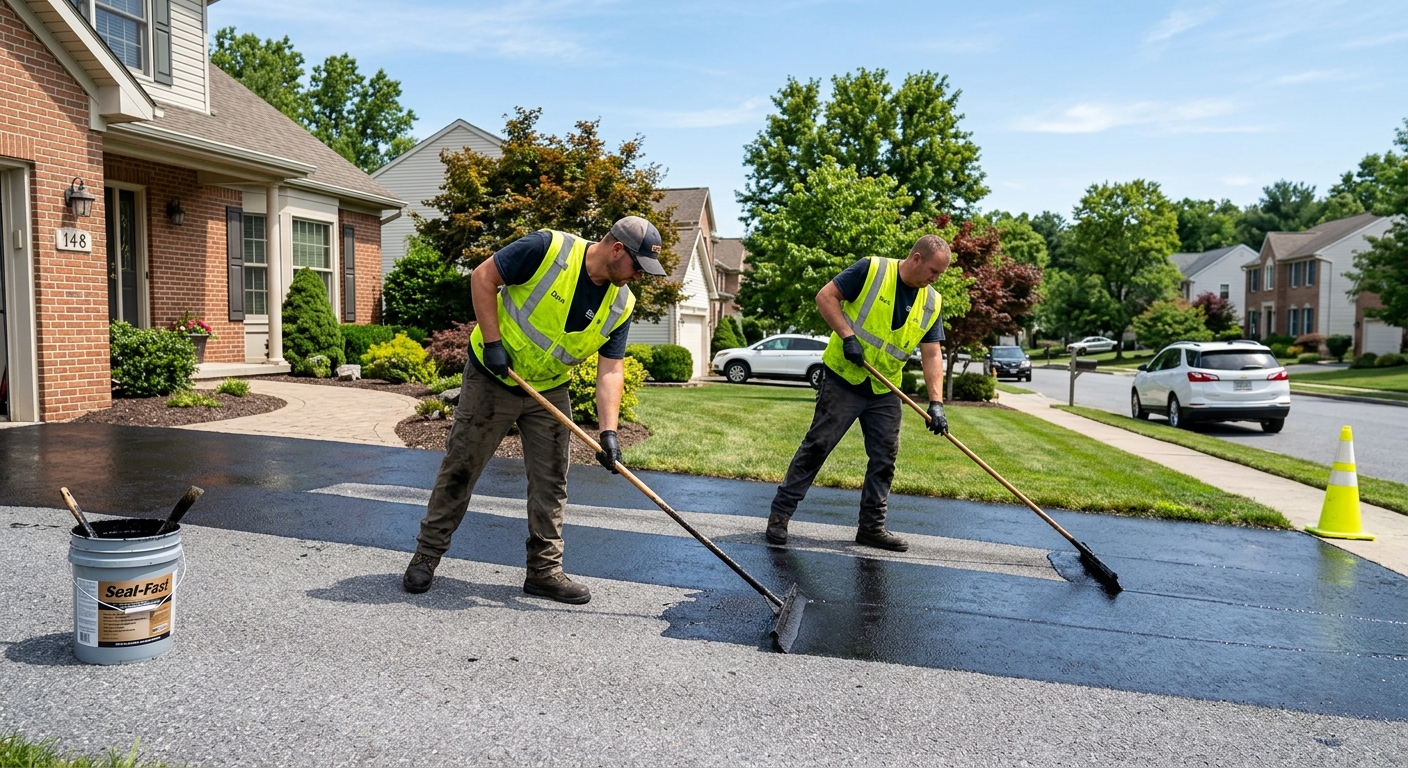
Driveway paving costs in Easton — 2026
In Easton, residential driveway paving is an investment decision unique to detached homeowners. Only about 26.9% of local homes are single-family, and with a homeownership rate of 46.6% (U.S. Census Bureau, ACS 2024), most driveways here serve older, often narrow, lots that weren’t designed for modern vehicles or the freeze-thaw cycles of northeastern Pennsylvania. In this climate, with winter lows reaching 4 °F and frost sinking to 36 inches, both the ground and what’s beneath the pavement matter as much as what’s visible up top.
The most important price difference between two paving quotes in Easton is almost always in the unseen work: excavation depth, stone base thickness, and proper drainage—especially with the Lehigh Valley’s limestone karst subsoil, which can settle unevenly if not graded and compacted correctly. The surface finish and asphalt thickness matter, but shortcuts or cost-cutting below the surface are why one driveway lasts decades and another cracks in four years. You get what you pay for underneath, not just on top.
| Service |
Best for |
Lifespan |
Price range |
| Asphalt — full replacement with new base |
failed base, structural cracking |
20–30 yrs |
$3,400–$8,600 |
| Asphalt overlay / resurfacing |
sound base, surface cracking only |
8–15 yrs |
$1,450–$4,300 |
| Sealcoating — single application |
preventive maintenance on sound asphalt |
2–4 yrs |
$200–$650 |
| Concrete — new installation |
long service life, low maintenance |
30–50 yrs |
$4,800–$11,500 |
| Crack filling and patching |
isolated cracks under a quarter inch |
1–3 yrs |
$200–$800 |
| Gravel driveway |
rural, budget, long runs |
5–10 yrs with upkeep |
$900–$3,500 |
Estimates for a typical Easton driveway. Square footage and base condition drive these figures more than material choice.
How paving fraud actually operates
Driveway paving attracts short-term and out-of-area operators to Easton because it’s a visible job—the work sits out front, neighbors see it, and the problems take years to show up. Typical scams sound like “leftover material from another job,” “today-only discount,” or a price that disappears if you ask for a contract. Watch for unmarked trucks with out-of-area plates, “crew in the neighborhood” pitches, demands for large cash deposits, or jobs priced out with a handshake instead of written scope. One of the most common schemes in the Lehigh Valley—especially in counties where neighborhoods are further apart and word of mouth travels slower—is spraying a thin, oily emulsion and calling it sealcoating. That “quick” job peels up in months.
For Easton homeowners, Pennsylvania’s Home Improvement Consumer Protection Act (HICPA) exists for exactly these reasons. Any job over $500 requires a written contract, and you have a three-business-day right to cancel after signing. Contractors must be registered for any project over $500—verify at hic.attorneygeneral.gov—and waiving your homeowner’s insurance deductible for repairs is strictly illegal. These protections are not just fine print; they are your main defense against disappearing crews and driveway failures you can’t see coming.
Before agreeing to anything: (1) confirm they’re registered as a Home Improvement Contractor, (2) verify active workers’ compensation at wcais.pa.gov, (3) get the contract in writing, and (4) never pay in full before any work starts. These checks take five minutes and close the door on nearly every drive-by paving scam.
What's under the asphalt matters more than the asphalt
A driveway in Easton isn’t just a top layer of asphalt or concrete. It’s a three-layer assembly designed to handle Pennsylvania’s punishing freeze-thaw cycles and limestone-rich subsoils. From the bottom up, there’s the subgrade (natural soil), a compacted aggregate stone base, and the finished surface. Each layer spreads out the weight of cars and trucks above. If the asphalt is thick but the stone base is thin, uncompacted, or poorly drained, the whole drive can crack and settle unevenly within a few winters—right about the time a cheap quote stops looking like a bargain.
The Lehigh Valley’s limestone karst subgrade settles if not graded and compacted properly. Water passing through weak spots pools under the drive, freezes in winter, and creates frost heave: ice expands, forces parts of the driveway up, and cracks the asphalt from beneath. That’s why Northeast PA driveways need a thicker gravel base and precise grading, not just a nice top coat.
This is where most cut-rate jobs get cheaper. They may skip full excavation, drop a thin or loosely spread aggregate base, omit compaction in separate layers (“lifts”), or lay new hot-mix asphalt directly over a failing base. None of that is visible to a homeowner on day one—only in the spring, as ruts, potholes, or wide cracks start to return.
For Easton, demand all of the following in writing: (1) aggregate base depth (at least 6 inches of 2A modified stone), (2) type of aggregate used, and (3) compaction in lifts, not just a drive-over with the roller. Anything less risks throwing money after the first cosmetic fix.
Driveway permits, approaches and stormwater rules
In Easton and most surrounding Northampton County townships, repaving or resurfacing an existing residential driveway in the same footprint usually doesn’t require a building permit—so in many cases, you can skip a trip to the code office if you’re not widening or relocating the drive. But where your driveway meets the road—known as the driveway approach—a separate permit is usually required, and this comes from PennDOT District 5-0 for state routes or from your local township office for local street curb cuts. If you’re changing the entry or adding a new curb cut, always check first with the correct agency identified in the permit requirement facts.
Stormwater is a real concern in Easton: expanding the paved area can set off zoning or runoff reviews. Draining your new surface onto the neighbor’s property doesn’t just cause hard feelings—it carries real liability in Pennsylvania, regardless of permits. Plan to direct runoff into your own yard, a permitted swale, or a storm drain when expanding.
Before signing, always confirm that your contractor is registered at hic.attorneygeneral.gov for jobs over $500 and has current workers’ compensation coverage listed in WCAIS (wcais.pa.gov), unless they’re a true owner-operator. These are non-negotiable and easily checked.
Diagnosing a failing Easton driveway
Homeowners in Easton can narrow down what their driveway truly needs with some simple self-checks—especially important because most contractors profit either way, but only you pay the price for wasted repairs. The base condition determines everything: if the problem is deep, a patch or overlay is just lipstick.
Look for “alligator” cracking—web-like patterns across large areas mean the base has structurally failed, and no surface overlay will hold up. Long, straight cracks often reflect surface aging or joint opening. Depressions that hold water (birdbaths) show where the base or soil has shifted below. Crumbling at the sides signals no edge support. And potholes? Water has worked its way into the base, destroying aggregate from underneath.
A reputable contractor should probe or core the existing surface to check the base. If they quote a thin overlay without even looking, that tells you the fix won’t last.
| What you see |
Likely cause |
Right fix |
Cost |
| Isolated cracks under 1/4 inch |
surface aging |
crack fill and seal |
$200–$650 |
| Alligator cracking over a wide area |
base failure |
full replacement |
$3,400–$8,600 |
| Depressions holding water |
subgrade movement |
excavate and rebuild that area |
$3,400–$5,300 |
| Crumbling edges |
no edge support |
edge repair, consider curbing |
$400–$1,500 |
| Potholes |
water into the base |
full-depth patch, then assess |
$250–$900 |
| Faded but sound surface |
oxidation only |
sealcoat |
$200–$650 |
Easton's ground and what it means for paving
Easton and the Lehigh Valley sit over limestone karst subgrade—a ground condition not common even in the next county over. Limestone karst can settle unpredictably when water finds a path through the soil, undermining driveways that lack proper base grading or drainage. That means every driveway, especially those serving Easton’s large stock of 1900–1940 homes, needs extra attention to excavation and how water will move under and away from the drive.
Combine that with our local frost depth of 36 inches and a climate known for hard freeze-thaw swings: driveways here need a deeper, well-compacted aggregate base—typically at least 6 inches—and well-managed drainage. Many Easton and Bethlehem drives were poured or paved long before modern standards and are often too thin, too narrow, and set on marginal stone. When replacing, updating to today’s wider, thicker, properly graded standards is not just a luxury; it saves asking for the same work again in a decade.
If your old driveway shows early edge crumbling or new dips every spring, karst and frost heave together are usually to blame. Upgrading isn’t just about surface looks—it’s defense against Easton’s unique ground giving way when you least expect it.
When paving can actually be done in Easton
Paving season in Easton is strictly limited by our climate, not just by contractor preference. Hot-mix asphalt must be set and compacted while it’s hot enough to remain workable—if the air or ground is too cold, as is typical outside the April‒October window, the mix cools mid-roll and develops early cracks and porosity. Local asphalt plants around Bethlehem and Easton simply close for much of the winter, so the material isn’t even available for several months.
Concrete is also temperature sensitive: it can’t be reliably cured if nighttime lows are consistently below freezing, which is common from late November through March when our winter design temperature sits around 4 °F.
Most Lehigh Valley paving work books up in summer while spring and early fall (shoulder seasons) offer more flexibility and sometimes better pricing as crews thin out. If someone offers to pave your drive in December or March here, you’re likely looking at a cut-corner job. The labor and haul times are not the issue—temperature and material quality are. Don’t be rushed by claims of “getting you in before winter”; in Easton’s climate, it’s better to wait for the right weather and the consistent material that comes with it.
Frequently asked questions — driveway paving in Easton
Should I repair or replace my Easton driveway?
The decision comes down to the condition of the base under your driveway, not just the surface. In Easton, if you see widespread “alligator” cracking, multiple deep depressions, or frequent potholes, it means the aggregate base below the asphalt has failed—likely because of our region’s freeze-thaw cycles and limestone karst subgrade. In that case, patching buys only another season or two, so full replacement ($3,400–$8,600) is the only real solution. If the surface just has isolated cracks, is faded, or shows minor raveling, repair and resealing is usually enough. A trustworthy contractor should probe or core-sample the drive before recommending replacement. Don’t let anyone sell you a pricey overlay or “add a layer” job before confirming the base is actually sound, since overlays over a bad base will fail quickly in Easton’s climate.
How deep should the aggregate base be here?
In Easton, the right aggregate base depth is more important than anywhere with different ground. Because of the Lehigh Valley’s limestone karst subgrade and 36-inch frost depth, you need at least 6 inches of compacted 2A modified stone under asphalt (and 4‒6 inches under concrete). Shallower or loosely placed bases won’t handle settlement and won’t stand up to freeze-thaw cycles. Most older driveways in Easton and Bethlehem from the pre-1940 era were built with thinner bases, which explains why you see so much cracking and settling now. A proper base is the best long-term investment—cutting corners upfront will cost a lot more in premature repair or total replacement ($3,400–$8,600) later.
How long does a driveway installation take?
In Easton, a standard asphalt driveway replacement (including full base work) for a typical single-family home can often be completed in two to three working days under good weather: one day for excavation and base prep, another for setting the asphalt, and a half day for finish grading and rolling. For concrete drives, allow three to five days, since the concrete must cure before it's ready for vehicle traffic. Bad weather, larger areas, or permitting for approach cuts can delay things. Getting on a reputable local contractor’s schedule during peak season may be a much bigger wait than the actual installation time. Expect that during the busy summer months, wait times for start dates climb as every homeowner tries to get jobs done before winter.
What does sealcoating cost in Easton?
For Easton homeowners, a professional single-pass sealcoating for a standard driveway usually falls in the $200–$650 range. This assumes the surface is in generally good condition, with cracks under a quarter inch sealed beforehand. Pricing is tied to square footage, current surface health, and how much edge clean-up is needed. Be wary of quotes at the extremely low end—these often mean watered-down or oil-based products that don’t last through even one Lehigh Valley winter. A quality sealcoat actually helps extend the life of a sound asphalt drive, but is no substitute for real repairs if the base is failing.
What causes driveway cracks in Easton?
Easton driveways are subject to several crack causes. Our limestone karst subgrade settles when water moves through, stressing the surface. Even with a good base, the region’s freeze-thaw cycles drive water into microcracks in the asphalt and expand it into bigger gaps each winter. Heavy vehicles, plowing, and lack of edge support also create stresses. Most older driveways here weren’t built with enough gravel base, which compounds the cracking as water gets trapped beneath. Small cracks can be filled and sealed ($200–$650), but widespread cracking across the surface signals a deeper base issue—not just weathering.
How much does it cost to widen a driveway?
Widening a driveway in Easton usually requires full excavation of the area to be added, matching the current base depth and material. For a typical expansion of 2 to 4 feet along one side of a single-car driveway, the cost is generally included in the higher end of a new installation—most commonly $3,400–$8,600 for asphalt or $4,800–$11,500 for concrete, depending on total square footage. Keep in mind that most municipalities, especially in the city of Bethlehem, treat a driveway widening as a new install for permit purposes and may trigger a review for runoff and approach cut. The subgrade must be matched to avoid future settlement where old meets new.
What kind of soil is under Easton driveways?
Easton sits on Lehigh Valley limestone karst—a specific ground makeup where limestone dissolves and settles over time, leaving voids and soft spots that are trouble for unprepared driveways. Unlike clay soils that just heave or sandy soils that drain, karst can surprise you with a solid-looking drive that suddenly dips or cracks as the ground below shifts. This is why a proper thick base is so important here, and why older driveways laid directly on top of soil without enough stone fail early. Any reputable Easton contractor should probe to check for soft or wet patches before quoting, since those areas need extra care. Skipping that step means repeated repairs—not savings.
Do I need a permit to repave a driveway in Easton?
Usually, you do not need a building permit in Easton just to repave an existing residential driveway in the same footprint—saving you one administrative step. But any work that extends your driveway, changes its entrance to the public road (the approach), or cuts a new curb always requires a separate approach permit. For state routes, apply to PennDOT District 5-0; for local streets, your township or city office handles it. Still, before any contract over $500, make sure your contractor is registered at hic.attorneygeneral.gov and carries valid workers’ compensation. If in doubt, call your local code office, but resurfacing alone rarely triggers a permit unless you’re also widening, relocating, or changing drainage.
Is sealcoating a scam?
In Easton, sealcoating is a legitimate and effective maintenance tool when applied to healthy asphalt—it helps slow oxidation and repels water, potentially extending driveway life by several years for a typical investment of $200–$650. The scam comes in when unmarked crews spray thin, shiny “sealant” (often oil or watered-down tar) and call it protective—a trick common in the Lehigh Valley because bad work disappears before the next season. Real sealcoating is a heavy, brush-applied product laid over sound pavement and won’t mask deep cracks or base failure. If you’re offered a price that’s suspiciously low or pressured for cash up front, walk away: sealcoating is for preserving, not repairing. In Easton, judge the offer by surface prep, written contract, and local references—not sales talk.