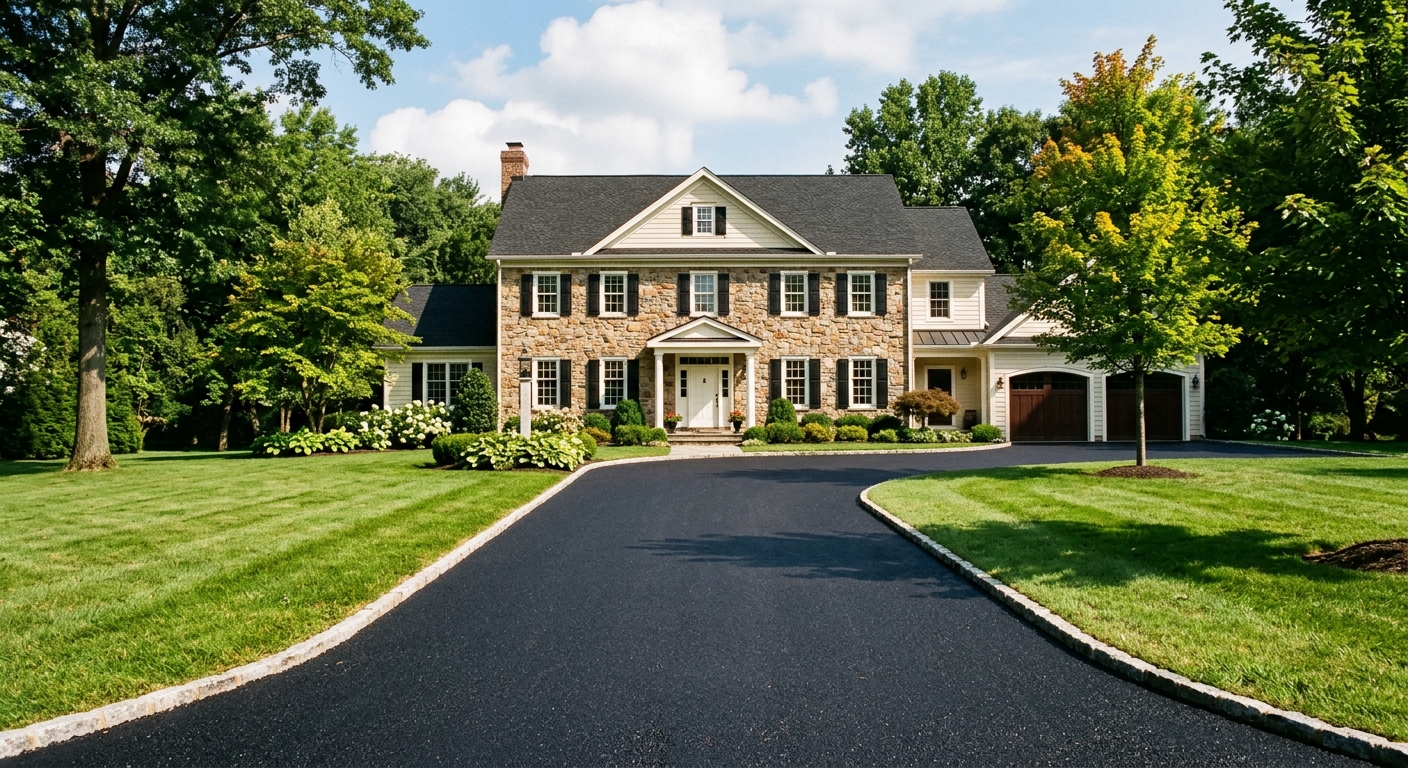
What a new driveway costs in Blooming Grove
Blooming Grove sits in the hills of Pike County, where more than 97% of homes are single-family and the vast majority are owner-occupied (U.S. Census Bureau, ACS 2024). For many residents, the driveway isn't just curb appeal—it's a necessity for weather, slope, and access.
Pricing here is shaped by factors most people never see. Our region's freeze-thaw cycles and deep winter frost line (36 inches) are rough on pavements. Glacial till and rocky subgrade mean most driveways need substantial excavation and a thicker, well-compacted aggregate base than you’d find in milder places. Upfront price differences between paving quotes usually hide under the surface: less base, less excavation, thinner asphalt, or skipping compaction won’t show up until the first few winters have passed—and by then, repair or full replacement is your only fix.
The table below outlines typical costs. The low end reflects short, flat drives with good drainage and easy access. The high end covers longer, steeper, or more complex layouts—the kind common in 1970s–2000s vacation homes here.
| Service |
Best for |
Lifespan |
Price range |
| Asphalt — full replacement with new base |
failed base, structural cracking |
20–30 yrs |
$3,500–$9,000 |
| Asphalt overlay / resurfacing |
sound base, surface cracking only |
8–15 yrs |
$1,500–$4,500 |
| Sealcoating — single application |
preventive maintenance on sound asphalt |
2–4 yrs |
$200–$700 |
| Concrete — new installation |
long service life, low maintenance |
30–50 yrs |
$5,000–$12,000 |
| Crack filling and patching |
isolated cracks under a quarter inch |
1–3 yrs |
$200–$800 |
| Gravel driveway |
rural, budget, long runs |
5–10 yrs with upkeep |
$900–$3,500 |
Estimates for a typical Blooming Grove driveway. Square footage and base condition drive these figures more than material choice.
Door-knocking crews and leftover material
Paving is notorious for attracting transient operators in rural counties like Pike. In Blooming Grove’s spread-out neighborhoods, you’re more likely to get a knock on the door with an offer to “use leftover asphalt from a job down the road.” The pitch is always some version of “today only,” “cash up front,” and “no need for paperwork or permits.” Unmarked trucks (often with out-of-area plates), requests for cash before unloading, and verbal promises instead of a written contract are staples of this racket.
Another red flag is the thin oil-based “sealcoat” sprayed in minutes and sold as professional sealing for a few hundred dollars—this does little more than darken the surface for a season.
Because Pike County is rural, word doesn’t travel quickly, and it’s harder for neighbors to compare notes or warn each other. That creates easy opportunities for crews who intend to do one pass through the area and disappear before driveway problems emerge—usually in year two or three. The most common issues: paper-thin overlays, no base prep, cold asphalt seams, or low-grade materials.
State law is clear: any home improvement job over $500—including nearly every driveway—requires a written contract and gives you a three-business-day right to cancel. Never waive this right, and do not accept last-minute pressure to skip paperwork. The Home Improvement Consumer Protection Act was written for exactly this situation, so use it.
A five-minute check with hic.attorneygeneral.gov for contractor registration, a written and detailed estimate, and proof of insurance are all it takes to defeat every one of these scams.
What you need before paving in Blooming Grove
For most driveways in Blooming Grove, repaving an existing residential drive in its current footprint does not typically require a building permit—saving you one paperwork step. But the “approach”—meaning the apron where your drive meets a public road—generally falls under PennDOT control, not the local township. That applies if your driveway connects to a state route anywhere in Pike County; you’ll need a Highway Occupancy Permit through District 4 before touching that apron. It’s a different process than zoning or building permits, which are county-managed for other additions or sitework.
If you’re adding width or length to your driveway and increasing pavement, local zoning may also look at impervious-surface coverage and stormwater drainage. Even if permits are not triggered, the law holds you responsible if paving pushes runoff onto a neighbor’s property.
Choosing a contractor? Pennsylvania’s Home Improvement Contractor (HIC) registration is mandatory for projects over $500—verify this directly at hic.attorneygeneral.gov. Any employer, even a small crew, must also carry workers’ compensation coverage, which you can check through the WCAIS system (wcais.pa.gov). Written proof beats a phone promise every time.
Widening, extending or adding a parking pad
Projects that go beyond basic replacement—adding width for a second car, extending out to a garage, installing a turnaround, or converting a gravel stretch to asphalt—come with rules and structural risks that many homeowners overlook. Any time you expand the driveway’s footprint, you are working over native subgrade, not stable compacted fill. That means all new base must be excavated and built up properly, or the seam between old and new will turn into a permanent weak spot, likely to crack and settle in our freeze-thaw cycles.
More paving also increases “impervious surface,” which may run into local zoning limits. Pike County land development oversight has stricter controls near wetlands or runoff-prone slopes; you may be asked for a stormwater plan or setback compliance to avoid creating drainage issues for neighbors or the road.
Most extensions change your approach—the driveway’s tie-in with the public street. If you’re adding a second apron or widening an existing one onto a state highway, PennDOT’s Highway Occupancy Permit through District 4 applies. Even on a township road, check for setback and apron rules before you proceed.
In short, expansions are not just more expensive—they’re trickier, and they need closer planning on grading, drainage, and structure. If any step feels rushed, hit pause and ask for details in writing.
Why Blooming Grove driveways fail from the bottom up
A driveway is only as durable as its weakest layer—and around Blooming Grove, that’s almost always underground. Here’s how a driveway is built to last in our climate: start with the native soil (the subgrade), followed by a properly compacted aggregate base (stone), and finally the asphalt itself. Each component spreads out the weight of vehicles and sheds water.
Our local ground is mostly glacial till with rocks and uneven soils, not the stable clay or sand you find elsewhere. Combined with deep winter freezes (down to 36 inches), this makes driveways especially prone to frost heave. When water sits in the subgrade and freezes, it expands—lifting whole sections of asphalt unevenly. This cracking comes from below and worsens over time.
Base thickness and drainage matter much more here than in warmer places. For most homes, a proper driveway starts with at least 6–8 inches of compacted 2A modified stone—sometimes more, if the soil is soft or the drive is sloped. The asphalt itself should be laid at 2–2.5 inches compacted (not raw depth).
Where a cheap paving quote “saves” you money is always out of sight: maybe they’ll skip excavation, lay asphalt over a failing base, use thinner stone, or compact less. Rarely will you see a difference with the naked eye when they drive off, but by year three, you’ll have spider-cracking, low spots, or alligatoring. Those failures almost never come from the asphalt itself—they come from too little base, poorly compacted stone, or no attention to drainage.
Protect yourself by demanding, in writing:
- Aggregate base thickness (inches), type (2A modified or approved equivalent)
- Excavation depth and offsite disposal of material
- Compaction in lifts (smaller, repeated layers)
- Final paved thickness to be measured after rolling
If any of those are missing, ask before signing. They matter far more than brand or price per ton.
What a real paving quote contains
Comparing driveways starts with comparing what’s actually being built, not just the bottom-line price. A real paving estimate for Blooming Grove will detail the square footage measured on site—never just by Google maps. It will break out excavation depth and where removed soil or old asphalt goes. It will name the kind and thickness of aggregate base, with compaction done in stages (“lifts”). Asphalt courses should be specified by compacted depth. There should be explicit mention of how edges are finished, grading for water runoff, restoring lawn or landscaping disturbed by the work, payment schedule, and what the warranty really covers. Most “warranties” in paving are actually quite limited and won’t cover the cracks that matter most.
The main reason people get burned? A vague, one-line quote (“pave driveway, $X”) cannot be compared, cannot be enforced, and is the #1 tool for underbuilt, overpriced work. If a contractor refuses to specify these points, it’s time to walk.
| Line item |
What to look for |
Red flag if… |
| Area |
measured square footage stated |
eyeballed or absent |
| Excavation |
depth and disposal included |
'we’ll pave over it' |
| Base |
aggregate type and depth in inches |
'proper base' |
| Compaction |
method, and done in lifts |
not mentioned |
| Asphalt |
courses and compacted depth |
'3 inches' unqualified |
| Drainage |
slope and water direction stated |
silent |
| Warranty |
what is covered and what is excluded |
verbal only |
| Payment |
modest deposit, balance on completion |
full cash up front |
Finding a legitimate paver in Pike County
In Pike County, where jobs are rural, travel surcharges are common, and the market is thin, it’s especially important to check who you’re hiring. Always start with state-required Home Improvement Contractor (HIC) registration at hic.attorneygeneral.gov—that’s a legal must for any contract over $500. Verify active workers’ compensation coverage for every crew member through wcais.pa.gov.
Legitimate asphalt contractors will have a permanent local address, not just a cell number or borrowed shop in another county. They own their equipment (because hauling out here with rentals is expensive) and have real supply relationships. Test this by asking which plant they source their asphalt or aggregate from—for Blooming Grove, that usually means a truck haul from Scranton or Lackawanna County. If they cannot name a plant, they’re a broker, not a paver.
Ask for references from jobs done at least three years ago. A driveway looks good for the first year no matter who lays it. What survives the third winter is what matters.
- Verify HIC registration at hic.attorneygeneral.gov
- Check workers’ comp at wcais.pa.gov
- Written contract with scope and specs
- Physical local business address
- References: jobs 3+ years old in Pike County
- Owned, marked trucks and equipment
- Supplier name for asphalt and stone
- Clear payment schedule—no full cash up front
- Proof of insurance (liability and comp)
- Detailed, line-item quote
- Explanation of warranty—what’s covered, what’s not
- Ability to explain drainage, base prep, grading
Red flags? Any push for cash, refusal to give paperwork, vague promises, or “one-day only” pricing. Move on—reputable Pike County crews don’t cold-call or offer a deal they can’t stand behind.
Frequently asked questions — driveway paving in Blooming Grove
How do I verify a paving contractor in Pennsylvania?
To verify a paving contractor in Pennsylvania—including Blooming Grove—start by checking the state’s mandatory Home Improvement Contractor (HIC) registration at hic.attorneygeneral.gov. Enter the contractor’s business name or registration number, and confirm the registration is current and matches their proposal. Second, verify their workers’ compensation insurance for anyone working on your property. This check is done at the WCAIS system (wcais.pa.gov). Never accept a verbal assurance—always ask for certificates or proof from both registries. If you’re considering major work, request written references from jobs completed at least three years ago in the Pike County area, because many paving issues do not appear until after the first couple of winters. Finally, ask where they source their asphalt or aggregate. A legitimate paver in Blooming Grove should have no trouble naming their supplier. For a typical replacement in this area, the expected cost is $3,500–$9,000—be suspicious of quotes far outside this band.
Should I repair or replace my Blooming Grove driveway?
In Blooming Grove, whether to repair or replace your driveway mainly depends on what’s happening beneath the surface. For drives with only minor or isolated cracks under a quarter inch wide, crack filling and patching makes sense and can extend life for $200–$800. If your base is solid and you just have raveling or surface cracks, an asphalt overlay (resurfacing) may get you 8–15 more years for $1,500–$4,500. But if you see deep cracks running across, sunken or soft spots that become muddy after rain, or multiple freeze-thaw “alligator” cracks, that usually means the base or subgrade has failed. In that case, full excavation and replacement is the only long-term solution. Pike County’s tough winters and rocky soils mean repairs only buy time on structural problems. It’s always cheaper to maintain, though—don’t wait until the whole slab has to go.
What does sealcoating cost in Blooming Grove?
For most residential drives in Blooming Grove, a single professional application of asphalt sealcoating generally falls in the $200–$700 range, with most jobs costing around $400. Price varies with total square footage—steep, long, or wide driveways are more. Sealcoating is preventive maintenance for solid, crack-free asphalt. It helps protect against UV, water, and salts especially after our Pike County winters. You’ll see the offers for “quick spray” or “leftover sealer” for less, but these are rarely professional jobs and don’t provide more than a year of protection. Stick with a local, verifiable contractor: you’re entitled to a written contract for anything over $500 in Pennsylvania, so avoid anyone unwilling to provide one.
How long before I can drive on a new asphalt driveway?
In Blooming Grove’s climate, you should wait at least 48–72 hours after new asphalt paving before driving a passenger vehicle on the drive, longer if temperatures are high. Trucks or heavy vehicles should wait at least 5–7 days. Asphalt cures faster in cool weather, so late spring or fall projects tend to set up best. Even after that window, the surface remains soft for a month or more—sharp turns, parking in the same spot, or using kickstands can leave marks until full cure. If you’re getting a full replacement driveway (typically $3,500–$9,000), always ask your contractor for written care instructions specific to Pike County. Quick rush jobs, or contractors who promise you can drive on it the same day, are cutting corners you’ll pay for in the long run.
How much does driveway paving cost in Blooming Grove?
Driveway paving costs in Blooming Grove typically fall between $3,500–$9,000 for a full asphalt replacement with new base. Asphalt overlay or resurfacing on a stable base ranges from $1,500–$4,500. If you are looking at concrete for its longevity and low maintenance, those installations run from $5,000–$12,000 for similar footprints. Costs reflect not just materials, but also our local challenges: rough glacial soils, deeper base needs, and longer haul distances from the Scranton area plants. Always get a quote with the square footage measured and excavation depth specified—most of the price difference between contractors in Pike County is in the labor and base work beneath the surface, not the asphalt itself.
Why are my driveway edges crumbling?
Crumbling edges are a constant issue for Blooming Grove driveways, especially if the drive was paved flush with the lawn or allowed to overhang poor base. Our deep frosts, glacial till, and freeze-thaw cycles here can push unsupported asphalt upward or crack it sideways. The usual cause is either no compacted aggregate beneath the edge or cutting the base too shallow. Water has an easy path in, freezes, and blows out the edge each spring. This is a construction shortcut in thinner rural markets. For new driveways, edge strengthening with additional stone and beveling is worth the upfront cost—on a $3,500–$9,000 job, a few hundred dollars buys years of extra life. For existing edges, patching is a short-term fix, but if you see deep cracks, it’s a sign the whole base is failing.
How many freeze-thaw cycles does Blooming Grove get?
Blooming Grove sits in the Poconos, one of Pennsylvania’s regions with the highest number of freeze-thaw cycles each year. This means the ground moves as moisture in the native glacial till freezes, expands, then thaws—over and over, often dozens of times per winter. These cycles are the main reason our driveways suffer surface cracks and base shifts earlier than in milder parts of the state. The climate data for northeastern Pennsylvania shows a frost depth of 36 inches and winter design temperatures as low as 4°F. This is why our driveways need deeper, stronger bases. It’s also why work with a shallow or poorly compacted base, even if it saves on initial cost ($1,500–$4,500 for overlay), usually costs more to repair later.
How thick should asphalt be for a residential driveway in Blooming Grove?
For Blooming Grove homes, asphalt should be laid in two courses totaling at least 2 to 2.5 inches compacted thickness over a properly prepared base. The base itself—usually 6–8 inches of 2A modified aggregate—is even more critical, especially with the region’s rocky and variable soils. Each layer must be compacted in lifts, not all at once. Some Pike County contractors try to save a truckload by skimping on base or using looser stone; the result is early cracking and rutting. For most drives here, a full replacement with these specs will run $3,500–$9,000. Always get depths written into your contract and confirm with your contractor how compaction is handled, so you get what you pay for.
Does sealcoating fix cracks?
Sealcoating in Blooming Grove is a preventive maintenance step—it protects against water, sun, and salt, but it will not permanently fix cracks. The thin layer of sealer smooths hairlines but does not fill or bond cracks larger than hairline width. Cracks under a quarter inch should be filled and repaired separately before any sealcoating. Applying sealer over active cracks lets water move right through, freezing and popping in our intense Poconos winters. Professional sealcoating costs $200–$700 and should always include crack filling as a step beforehand. When done right, sealcoating extends the lifespan of sound asphalt. But as a cure for cracking, it’s a myth—if you have deeper cracking, talk with a contractor about patching or resurfacing first.