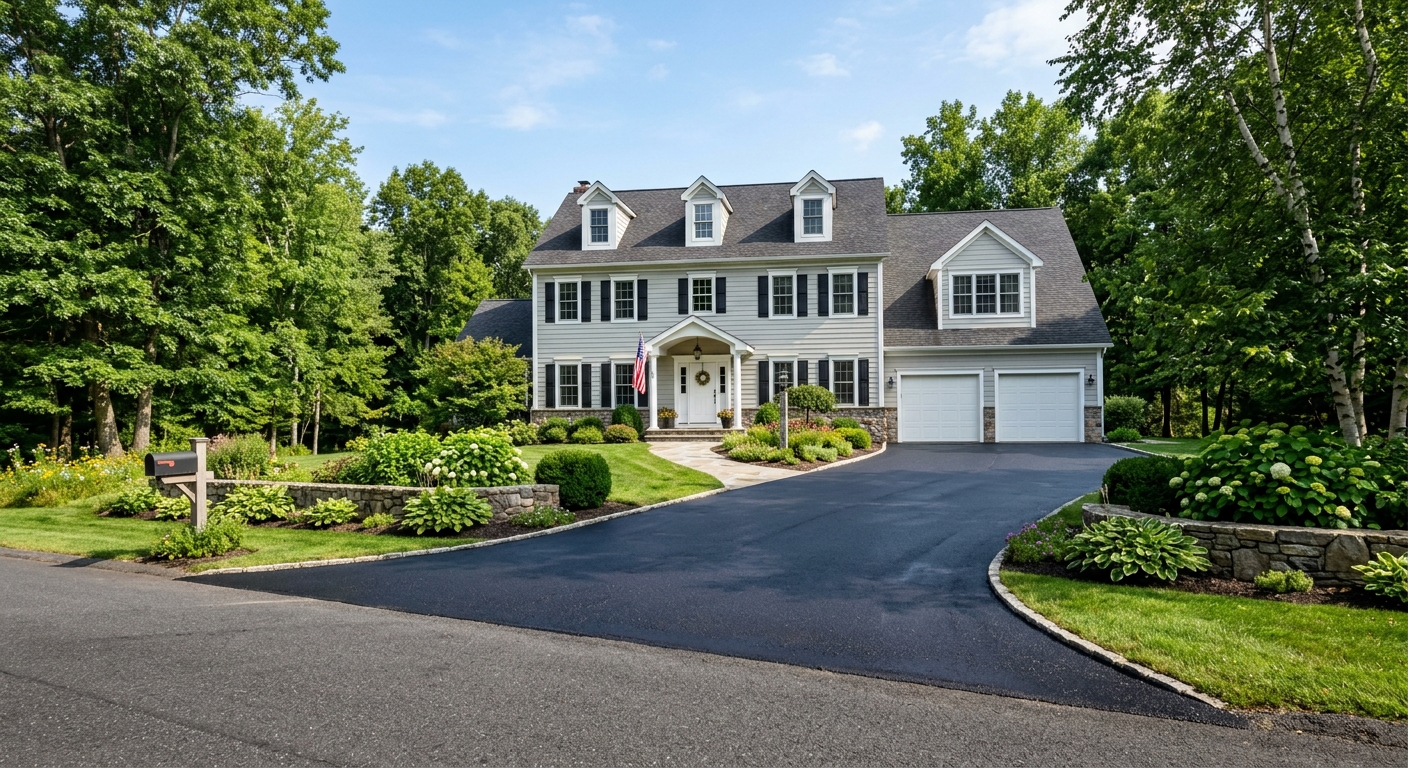
Pleasant Hills paving prices by scope — 2026
In Pleasant Hills, where 77.4% of homes are single-family and the homeownership rate stands at 78.3% (U.S. Census Bureau, ACS 2024), driveways are an owner’s investment — not a landlord’s expense. This region’s heavy freeze-thaw cycles and the local clay and shale soils put driveways to the test year after year. Pleasant Hills paving prices can look steep, but much of what you pay for is buried: the excavation and base prep you’ll never see once the job is done.
The main reason two quotes for the “same” new asphalt driveway can differ by thousands is that one contractor may address the subgrade and compaction — and the other might not. Surface looks can be deceiving; a smooth finish today says nothing about base quality or drainage. Ignore this step, and Allegheny County’s climate will exploit it, turning small savings up front into cracks, heaving, and repairs down the road.
Here’s what different options cost for a typical Pleasant Hills driveway. The bulk of your investment, especially with asphalt or concrete, goes under the surface: base excavation, aggregate delivery, and detailed prep for drainage.
| Service |
Best for |
Lifespan |
Price range |
| Asphalt — full replacement with new base |
failed base, structural cracking |
20–30 yrs |
$3,600–$9,300 |
| Asphalt overlay / resurfacing |
sound base, surface cracking only |
8–15 yrs |
$1,550–$4,600 |
| Sealcoating — single application |
preventive maintenance on sound asphalt |
2–4 yrs |
$200–$700 |
| Concrete — new installation |
long service life, low maintenance |
30–50 yrs |
$5,100–$12,500 |
| Crack filling and patching |
isolated cracks under a quarter inch |
1–3 yrs |
$200–$800 |
| Gravel driveway |
rural, budget, long runs |
5–10 yrs with upkeep |
$900–$3,500 |
Estimates for a typical Pleasant Hills driveway. Square footage and base condition drive these figures more than material choice.
Drainage: the failure nobody plans for
Water is the main culprit in almost every driveway failure seen in Pleasant Hills. Grading isn’t a finishing detail — it’s a structural requirement, especially here with heavy clay soils and relentless freeze-thaw cycles. A driveway that doesn’t move water fast enough will have water sitting on or just beneath the surface. When that water freezes, it expands, lifts the slab or pavement, and leaves you with cracks and sunken spots by spring.
A minimum slope of 2% (about a quarter inch per foot) is a baseline to move water off the surface. Some driveways are crowned in the center, pushing water to both sides. Others rely on a gentle cross-slope. If your driveway sends water toward the house or garage, it’s a setup for basement leaks and slab damage — that’s a critical fix, not a cosmetic concern. Where adjusting the grade isn’t possible, trench or channel drains at the garage entry or low spots collect runoff and move it elsewhere.
Pleasant Hills’ compacted clay also slows natural drainage. Installing a drain is only half the battle; water has to discharge (“daylight”) safely on your property or into a suitable dry well. Just pushing water to the neighbor’s lot is a liability, not a solution, regardless of what the permit requires. With the area’s soils, correcting existing grade is always better than band-aid drains when possible.
Caring for a new Pleasant Hills driveway
The best way to get value from your driveway in Pleasant Hills is early, regular care focused on keeping water away from the base. First, crack filling: get small cracks sealed before water works down below. This is a cheap fix — often under $800 — but skipping it guarantees bigger trouble later. Second, support the edges by keeping soil, stones, or curbs right up to the edge so it doesn’t crumble away. Third, keep water moving — clear leaves from drains, avoid piling snow or mulch against the edge, and don’t let downspouts aim at the pavement.
Don’t park dumpsters or trailers on new asphalt, especially inside the first 60–90 days. Avoid tight wheel turns in hot weather, which can scar soft, curing pavement. For de-icing, choose calcium chloride or magnesium chloride instead of salt for concrete (salt will eat it alive, especially with our 8 °F winter design temperatures). On asphalt, any de-icing chemical speeds the freeze-thaw cycling, so go light unless ice is a safety hazard.
Our local climate means no shortcut works — prevent moisture from getting below the surface and don’t overload fragile edges, and both asphalt and concrete will last longer in Pleasant Hills than a neighbor’s who skips these basics.
What a real paving quote contains
When comparing paving quotes in Pleasant Hills, the difference isn’t just the number at the bottom — it’s the detail in the specifications. Always look for measured square footage, not just “standard” sizes. The quote should spell out how deep they will excavate and dispose of existing material. It must name the aggregate base type, thickness in inches, and if compaction will be done in layers (“lifts”). Asphalt quotes should show how many courses (layers) will be installed and their compacted depth.
Edge treatment and drainage plans matter — will they grade the edges back to blend with your lawn, and how will surface water be managed? Cleanup and full restoration are worth confirming in writing. For payment: a modest deposit is reasonable, with the balance due on completion. Beware of any quote that asks for the bulk of payment up front.
Most warranties exclude cracking outright, which surprises many homeowners. Get warranty details in writing and check for what is not covered. If a contractor hands you a one-line quote with only a total, no specs, and a handshake, you can’t compare it to anything — and this is how homeowners in Pleasant Hills wind up paying more for an underbuilt driveway that looks fine on day one…but not on day 1,000.
| Line item |
What to look for |
Red flag if… |
| Area |
measured square footage stated |
eyeballed or absent |
| Excavation |
depth and disposal included |
'we'll pave over it' |
| Base |
aggregate type and depth in inches |
'proper base' |
| Compaction |
method, and done in lifts |
not mentioned |
| Asphalt |
courses and compacted depth |
'3 inches' unqualified |
| Drainage |
slope and water direction stated |
silent |
| Warranty |
what is covered and what is excluded |
verbal only |
| Payment |
modest deposit, balance on completion |
full cash up front |
What you need before paving in Pleasant Hills
In most of Allegheny County, including Pleasant Hills, resurfacing or replacing a driveway in its existing footprint usually does not require a separate building permit. There is an exception if you are altering the approach — the portion where your driveway meets a state road. For those locations, a Highway Occupancy Permit from PennDOT District 11-0 is required, not your borough or local municipality. Most homeowners expect to call local offices, but for state route access, PennDOT is the authority.
If you plan on expanding the paved area or changing your driveway layout, watch out for more than just permits. Increasing the impervious surface can trigger stormwater management requirements, potentially involving dry wells or engineering to keep runoff on your property. Even with all the paperwork in order, you remain responsible if water from your new or widened driveway floods a neighbor’s yard.
Pennsylvania’s Home Improvement Contractor (HIC) registration is required for contracts over $500. You can and should verify a contractor at hic.attorneygeneral.gov. Every paving crew must have active workers’ compensation, which you can check via the state WCAIS system (wcais.pa.gov).
Base preparation: the part you pay for and never see
The difference between a Pleasant Hills driveway that lasts 20 years and one that fails in three is what’s under the surface. Base preparation is where every honest paving contractor either earns their money or cuts corners you’ll never see — until the cracks appear.
Every driveway starts with the subgrade: that’s your native ground, mostly heavy clay and shale in this part of Allegheny County. Next comes the compacted aggregate base, a layer of crushed stone (often 2A or DGA) spread and compacted in 3–4 inch lifts until the full specified depth is reached. Only then is asphalt laid, also in two or more compacted lifts.
Frost heave is the main threat here. Water sits in the local clay soil, and when temperatures drop to 8 °F (our area’s winter design minimum), that trapped water expands, lifts the base, and cracks the driveway from beneath. This is not a surface defect — it’s a structural failure caused by inadequate base depth or poor drainage. Thicker bases, usually 6–8 inches on Pleasant Hills’ hillsides, and good drainage are what keep your drive from rippling and breaking apart.
When a quote comes in suspiciously low, it’s almost always because the contractor plans to skip excavation, short the base depth, use cheap fill, or skip compaction between layers. These are things you cannot see on the final day, but year three will tell the story. Always demand in writing: the number of inches of aggregate base (usually 6–8"), aggregate type, and confirmation that compaction is done in lifts. Anything less, and you are rolling the dice with your money.
Asphalt or concrete for a Pleasant Hills driveway?
Choosing between asphalt and concrete is mostly about how they cope with Pleasant Hills’ climate. With frequent freeze-thaw cycles and annual snowfalls, asphalt's flexibility gives it a real advantage — it bends, heals, and sheds surface cracks more easily when the base moves in our clay soils. Concrete, being rigid, can last much longer — 30–50 years isn't hype if you take care of it — but in southwestern Pennsylvania, its weak spot is spalling and scaling from salt and de-icing chemicals. This is the main way Pleasant Hills concrete driveways fail, not cracks.
Asphalt is less expensive to install — $3,600–$9,300 for a new driveway versus $5,100–$12,500 for concrete — and is easier for most homeowners to maintain. But even a perfect concrete pour won’t last if you use salt every winter, and most people eventually will. If you want maximum years and are good about not using salt, concrete will outlast asphalt. If not, a thick, well-built asphalt drive is usually the more forgiving choice.
Pavers are a premium option — they cost more up front, but damage rarely spreads, and settling is more gradual and repairable. Gravel is the most economical, perfect for long or steep runs, but it does bring maintenance and isn’t the right aesthetic fit for every Pleasant Hills home.
| Option |
Installed cost |
Maintenance |
Freeze-thaw performance |
Lifespan |
| Asphalt — new install |
$3,600–$9,300 |
sealcoat every 3–4 yrs |
excellent, flexes |
20–30 yrs |
| Asphalt — overlay |
$1,550–$4,600 |
same |
good if base is sound |
+8–15 yrs |
| Concrete |
$5,100–$12,500 |
low, avoid de-icing salt |
fair, spalls with salt |
30–50 yrs |
| Pavers |
$8,200–$12,500 |
individual units replaceable |
good, settles gradually |
25–50 yrs |
| Gravel |
$900–$3,500 |
top-dress every 2–3 yrs |
excellent drainage |
indefinite with upkeep |
Frequently asked questions — driveway paving in Pleasant Hills
How long before I can drive on a new asphalt driveway?
It’s important to wait at least 3–5 days before driving on new asphalt in Pleasant Hills, and even longer during summer heat. Our local contractors recommend waiting a full week if possible, especially when average daytime temperatures are above 70 °F, because the asphalt remains softer in the heat. Parking too soon leads to tire marks, wheel depressions, or early surface scarring. For heavy vehicles, like delivery trucks or dumpsters, hold off for 2–3 weeks. Full curing takes up to six months, but normal family car use is fine after the first week if you avoid tight turns. This short wait helps protect your investment, which, given a new install costs $3,600–$9,300 in Pleasant Hills, is worth respecting the initial curing time.
Are pavers worth the cost in southwestern Pennsylvania?
In Pleasant Hills and southwestern Pennsylvania, pavers are a premium choice, with typical installed costs from $8,200–$12,500. They’re worth it if you want a distinctive, high-end appearance and easy spot repair: if one area settles or stains, only those units need replacement. Pavers handle our freeze-thaw cycles well because they “give” a little when the subgrade moves. However, snow removal can be trickier if you use unsmooth pavers, and weeds will find the gaps unless you maintain them. For most owner-occupied homes in Pleasant Hills, where more than three-quarters are single-family, pavers are overkill unless you want the aesthetic — they won’t last longer than concrete, but they won’t spall or crack the same way.
Is gravel a cheaper option in Pleasant Hills?
Gravel is hands-down the lowest-cost paving option in our area, typically between $900–$3,500, depending on length and width. It’s very popular in rural Allegheny County and for steep or long runs, where asphalt or concrete can be cost prohibitive. Gravel handles drainage issues far better than paved surfaces, especially because Pleasant Hills sits on clay and shale, which otherwise trap water. Still, gravel isn’t for everyone: you’ll need to add new stone every couple of years, regrade after heavy rain, and live with some tracking of stone into the house or yard. For short suburban driveways, gravel is rarely the first pick, but for large or sloped sites, it keeps costs and stormwater concerns under control.
Do I need a permit to repave a driveway in Pleasant Hills?
Typically, you do not need a permit to resurface or replace your driveway if you aren’t changing the footprint in Pleasant Hills — saving you time and paperwork. However, if your driveway connects to a state road, you will need a Highway Occupancy Permit from PennDOT District 11-0, not just from the borough. If you widen the drive or change its layout, expect local stormwater rules to come into play. Always double-check with your local officials for any unusual situations. And, no matter the scope, make sure your contractor has valid HIC registration on hic.attorneygeneral.gov and active workers’ compensation; this is required for any job over $500.
How much does it cost to widen a driveway?
Widening a driveway in Pleasant Hills generally involves excavating and building new base, not just laying more surface material. Costs run comparably to a partial new install: expect $3,600–$9,300 for asphalt and $5,100–$12,500 for concrete, prorated for the extra square footage you add. In most cases, widening also means new grading work for drainage and sometimes the extension of aprons or approaches, which triggers permit and stormwater issues. Always ask for a detailed quote itemizing base prep, edge treatment, and surface thickness so you don’t get shortchanged on the “hidden” part you won’t see — that’s where corners are cut in Pleasant Hills.
What is the difference between crack filling and sealcoating?
Crack filling targets individual cracks, usually less than a quarter inch wide, before water gets into the base layer. This is a focused, preventive repair and costs between $200–$800 in Pleasant Hills. Sealcoating, on the other hand, is a thin protective layer spread across the entire asphalt surface. It doesn’t stop water from getting into existing cracks but protects the surface against oxidation, sun, and mild chemical spills. Sealcoating here costs $200–$700 per application and is best for driveways in generally good condition. If you only sealcoat and ignore cracks, water will reach the base, and you’ll get heaving and driveway failure — so both are best done on their own schedule, not just when things look rough.
What kind of soil is under Pleasant Hills driveways?
In Pleasant Hills, driveways typically sit on shale or heavy clay soils, just like the rest of Allegheny County’s hillsides. Clay drains very slowly, holding water against the base, while shale is stable but unforgiving if not properly compacted. The main threat is frost heave — when temperature drops, water in the clay expands, lifting and cracking pavement and concrete. Because 90.5% of Pleasant Hills homes were built before 1980 (U.S. Census Bureau, ACS 2024), many older driveways have thin or unreinforced bases that can’t cope with these soil mechanics. Any new or replacement drive should specify a thicker aggregate base and correct drainage, or the old failures will just return.
Why are my driveway edges crumbling?
Crumbling driveway edges are a common problem in Pleasant Hills. The reasons are simple: lack of edge support, water runoff, and freeze-thaw damage are all at play with our climate and clay base. When the aggregate base doesn’t extend laterally past the paved surface, the asphalt or concrete edge settles, cracks, and starts breaking apart under tire and mower pressure. Snow plows nicking the edge or water pooling there accelerate the process. Inexpensive repairs involve backfilling the shoulders with compacted soil or stone, but the permanent fix is to have the base and pavement deliberately overbuilt at the edges by at least 6 inches and graded to shed water away. It’s the classic “hidden” shortcut that saves a contractor money upfront but costs the homeowner later.
How deep should the aggregate base be here?
In Pleasant Hills, due to our clay and shale soils and pronounced freeze-thaw cycles, the aggregate (stone) base under a driveway should be at least 6–8 inches thick, compacted fully and laid in 3–4 inch lifts. Lesser depths might work in milder climates, but here, thin or uncompacted bases rapidly lead to frost heave and settlement. Older driveways, built before codes focused on base prep, often have only 3–4 inches — and those are the ones that fail after a tough winter. Insist on seeing the written spec on your contractor’s quote for base depth and type; for a typical Pleasant Hills asphalt replacement at $3,600–$9,300, that’s what separates a 20-year drive from one that crumbles and cracks in just a few seasons.