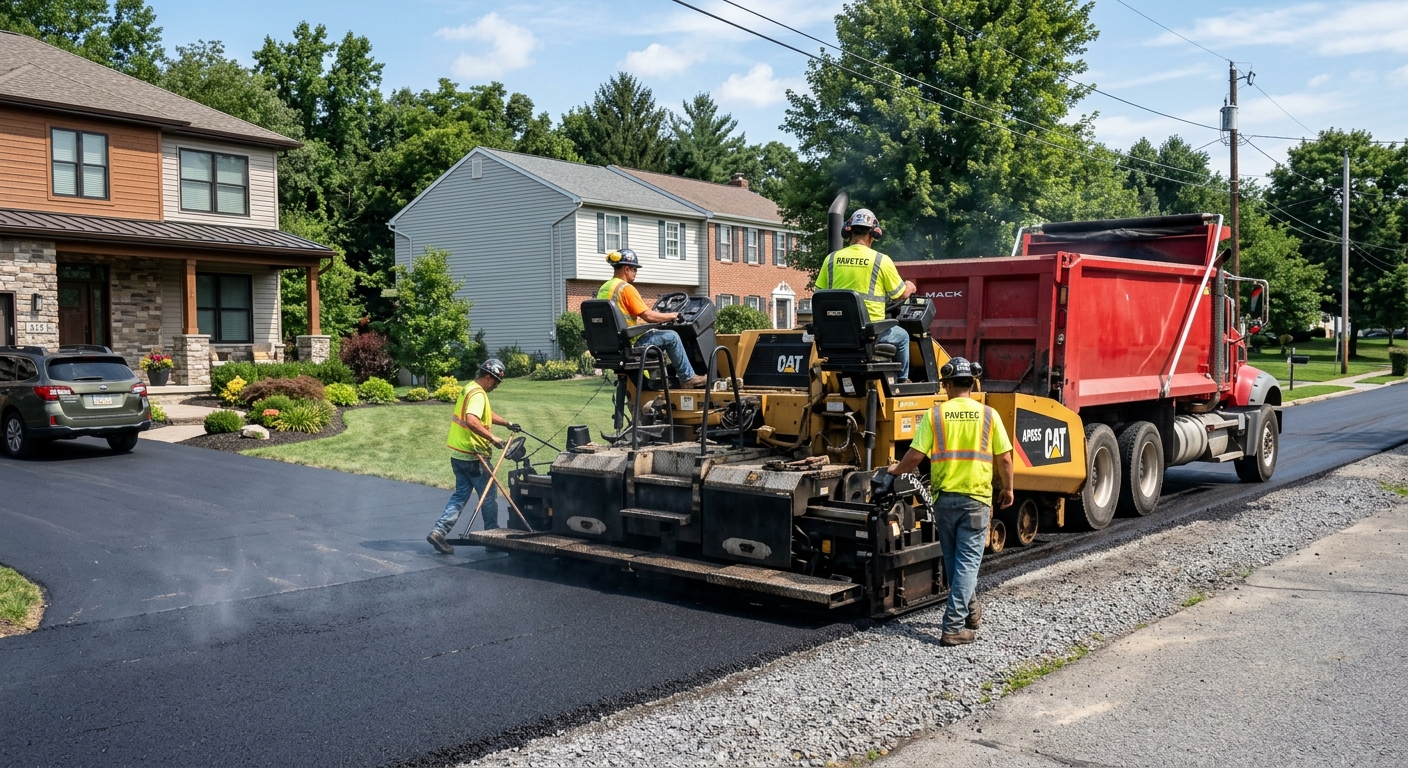
What a new driveway costs in East Earl
In East Earl, where 79.2% of homes are single-family and over three out of four houses are owner-occupied (U.S. Census Bureau, ACS 2024), installing or replacing a driveway is a typical upgrade for long-term homeowners. Driveways here contend with south-central Pennsylvania’s strong freeze-thaw cycles, which puts extra pressure on both the surface and what lies underneath. The region’s climate swings mean that driveway failures—cracking, heaving, or rutting—often reflect what’s under the pavement as much as the paving itself.
When you compare driveway paving quotes, realize that most of the price difference is buried below the surface. Two jobs that look similar when finished may have drastically different amounts of gravel base, compaction, or drainage work. That’s especially true in this part of Lancaster County, where some sites naturally drain well and others trap water close to the surface. Material cost matters, but poor base prep is the most common cause of early failure and expensive repairs.
| Service |
Best for |
Lifespan |
Price range |
| Asphalt — full replacement with new base |
failed base, structural cracking |
20–30 yrs |
$3,700–$9,600 |
| Asphalt overlay / resurfacing |
sound base, surface cracking only |
8–15 yrs |
$1,600–$4,800 |
| Sealcoating — single application |
preventive maintenance on sound asphalt |
2–4 yrs |
$200–$750 |
| Concrete — new installation |
long service life, low maintenance |
30–50 yrs |
$5,300–$12,500 |
| Crack filling and patching |
isolated cracks under a quarter inch |
1–3 yrs |
$200–$800 |
| Gravel driveway |
rural, budget, long runs |
5–10 yrs with upkeep |
$900–$3,500 |
Estimates for a typical East Earl driveway. Square footage and base condition drive these figures more than material choice.
The driveway scams that work in East Earl
Paving scams are unfortunately common in areas like East Earl and the rest of rural Lancaster County, where homes are spaced out and word travels slower than a crew in an unmarked truck. The classic pitch is the "leftover material" story—someone knocks and claims they have asphalt from a job down the road, offering you a one-time deal. Others pressure you with "today only" pricing or want cash up front. An unmarked truck with out-of-area plates, a handshake contract, or a quick verbal quote are all warning signs. One of the most expensive mistakes in this county is accepting a thin, sprayed-on oil sealer as real sealcoating, which wears away in months and offers no real protection.
Because paving is so visible, transient crews focus on lower-density rural counties like Lancaster, where neighbors aren’t at their windows and police know fewer license plates. Scammers count on not being tracked down when problems arise. Your protection is built on state law: for any contract over $500, Pennsylvania’s Home Improvement Consumer Protection Act requires a written contract and gives you three business days to cancel—even if you signed at your door. Never accept pressure to "waive your insurance deductible" or finalize work without paperwork; those actions are specifically addressed in state law.
Five-minute checks defeat these scams: demand a written contract; verify the contractor’s Home Improvement Contractor (HIC) registration at hic.attorneygeneral.gov; confirm workers’ comp at wcais.pa.gov; never pay in full until work is complete; and walk away from anyone who won’t provide a local reference.
East Earl's ground and what it means for paving
Subsurface conditions make all the difference in how a driveway survives East Earl’s combination of cold winters and periodic heavy rains. While townships to the west like East Hempfield have stretches of limestone karst subgrade—demanding extra aggregate and drainage—East Earl soils can vary, and knowing what’s under your existing driveway matters more than many realize. In older neighborhoods, especially where homes pre-date 1940 (a pattern seen more in Lancaster city, but present in some East Earl parcels too), driveways were often installed without the deep, compacted stone base required today.
Limestone subgrade, common just west of East Earl, can mean water drains away quickly but also brings a risk of settlement if not sufficiently supported—driveways in those spots need a thicker, tightly compacted aggregate base. In contrast, poorly draining soils or older “farm lane” bases hold water, magnifying frost heave as freezing weather hits the 30-inch frost depth typical here. That’s why properly rebuilding the base is necessary for driveways showing sinking or severe cracking, not just a new surface coat.
The lesson is simple: in East Earl, you can sometimes get by with a resurfacing if both the drive and its base were done right, but patching or sealcoating over structural problems is only ever temporary. Ask your contractor specifically about subgrade type and base depth before signing on.
What's under the asphalt matters more than the asphalt
A long-lasting East Earl driveway comes down to what’s below the blacktop. The proper assembly is: undisturbed or compacted subgrade, eight to twelve inches of crushed aggregate base, then one or more courses of compacted asphalt. Each layer is designed to take loads from above and distribute them to the ground below. If any of those layers are skimped—especially the base—even thick, expensive surface asphalt won’t last long in south-central Pennsylvania’s freeze-thaw cycle and 30-inch frost depth.
Here’s how frost heave works: when winter arrives, water held in the subgrade freezes, expands, and pushes the paved surface up. As it thaws, the ground settles unevenly and cracks appear. Limestone karst, found in townships nearby, drains better but is vulnerable to subsidence without the right base thickness. For East Earl driveways, what matters most is drawing water away from the base or letting it drain through. That’s why shortcuts like skipping excavation or compacting only the top layer lead to cracks, dips, and shifting during year three—just out of warranty, just after you’ve forgotten the crew’s number.
A cheap quote almost always comes from skipping base prep: reusing a failed base, thin (or poorly compacted) aggregate, or simply not compacting in layers ("lifts") at all. None of this is obvious on paving day and all of it guarantees trouble soon after. If you take away one concrete step, let it be this: get these figures in writing—aggregate base depth in inches (usually 8–12"), aggregate type (2A modified or local DOT-spec), and a clear statement that each base layer will be compacted in lifts, not just at the end. Quality here is invisible on Day One, but never on Year Five.
How often should a East Earl driveway be sealed?
Sealcoating can help preserve East Earl driveways, but only if it’s used the right way. Sealcoating acts as a sacrificial coat: it delays oxidation, helps shield against fuel or oil spots, and improves the appearance of faded pavement. But it does not add structural strength, stop subsurface cracks, or rescue a driveway with base failure—that myth is often pushed by those selling cheap, fast jobs. If your driveway is already crumbling or alligatored, a sealcoat is little more than black paint.
There’s another side that rarely gets mentioned. Sealing new asphalt too soon (before the volatiles cure out of the surface) can actually trap chemicals and weaken the top layer. And sealing too frequently—more than every 2–4 years—means layers of material will flake and peel. The right interval is every few years, not every spring. For fresh asphalt, wait a full season—at least 3–6 months—before adding a coat.
In truth, crack filling does more to keep out water than sealcoating does. A proper crack filler, placed before winter, stops freeze-thaw damage and foundation washout. A suspiciously cheap sealcoat, under $200, almost always means a quick-drying oil spray that offers no real protection. Expect to pay $200–$750 for a quality job, properly cleaned and hand-applied, not sprayed in five minutes from a tank truck.
Reading a driveway proposal
Comparing driveway quotes in East Earl means reading past the total. The essentials: measured square footage (not guesswork), clear excavation depth and disposal, base material and its compacted depth, compaction in lifts (not just the surface), the makeup of asphalt layers and their final thickness, edge and apron detail, and a payment schedule with a modest deposit. Also: slope and water management—does the quote specify where water drains and how? Lastly, laundry-list warranties are less important than specifics; most driveways aren’t warrantied against cracking at all, but you should know what is.
A one-line quote ("driveway paving, 75 feet, $7,000") can’t be compared to anything. That’s how underbuilt, overpriced driveways get sold. If there’s no written spec for the base or compaction, you’re rolling the dice. Demand line items—and if a contractor won’t provide them, move on.
| Line item |
What to look for |
Red flag if… |
| Area |
measured square footage stated |
eyeballed or absent |
| Excavation |
depth and disposal included |
'we'll pave over it' |
| Base |
aggregate type and depth in inches |
'proper base' |
| Compaction |
method, and done in lifts |
not mentioned |
| Asphalt |
courses and compacted depth |
'3 inches' unqualified |
| Drainage |
slope and water direction stated |
silent |
| Warranty |
what is covered and what is excluded |
verbal only |
| Payment |
modest deposit, balance on completion |
full cash up front |
Driveway permits, approaches and stormwater rules
In Lancaster County townships like East Earl, repaving or resurfacing your existing private driveway almost never requires a building permit, so you can save the call in most cases. But if you’re constructing a new driveway approach or modifying how your driveway meets the public road—adding a new entrance or changing the curb cut—you’ll need a permit. Inside Lancaster city, these are handled by the City of Lancaster Bureau of Engineering. If your property fronts on a state route, PennDOT District 8-0 is the authority to contact for approval.
Stormwater matters even without a permit: adding more impervious surface almost always comes with the expectation that you’ll manage runoff responsibly. Channeling stormwater onto your neighbor’s property creates liability whether you have a permit or not, so ask how your project will handle water—good local contractors will answer before you ask.
Pennsylvania law also requires every contractor with employees to carry workers’ compensation insurance, verified through WCAIS (wcais.pa.gov). For any contract over $500, check their HIC registration at hic.attorneygeneral.gov. These two checks protect you from surprise legal and insurance issues months down the road.
Frequently asked questions — driveway paving in East Earl
How much does it cost to widen a driveway?
In East Earl, widening a driveway is usually priced like a partial new installation, since it requires excavation, aggregate base, and matching the existing surface. If your current drive is asphalt and you’re widening by a car width (about 8–10 feet), expect costs to land between $3,700–$9,600 for a full-width job, with expansions alone often running on the lower end of that range. The exact cost depends on base preparation and tie-in details—matching new asphalt with old is more work than simply overlaying a prepped surface. Also, if you’re widening beyond your lot or up to the public road, permit requirements come into play.
What does compaction in lifts mean?
Compaction in lifts means the contractor installs the aggregate base or asphalt in thin layers, or “lifts,” and compacts each one separately—usually 2–4 inches at a time—before adding the next. This is essential for driveways in East Earl. Our climate’s freeze-thaw cycles and a 30-inch frost depth punish any shortcut here. Compacting thick layers all at once leaves soft spots, which later settle and produce cracks and dips. You want to see "compacted in lifts" in your proposal, especially if you're spending $3,700–$9,600 on a full replacement. Always ask your contractor to document how they will compact the base and asphalt.
Can I cancel a paving contract I signed at my door?
Yes, if you live in East Earl—or anywhere in Pennsylvania—the Home Improvement Consumer Protection Act gives you three business days to cancel any contract over $500 signed at your home. This law was made for situations where you feel pressured after a high-pressure or door-to-door sales pitch. Your written contract must include the cancellation form and instructions, and you can cancel for any reason within that three-day period. This is your safeguard against scams, rushed decisions, or if you have second thoughts once you check the company’s credentials. Always get all terms in writing before agreeing to work.
Can asphalt be laid in cold weather?
In East Earl, there’s a narrow window for paving season. Asphalt must be hot enough to compact properly—ideally laid when air temperatures are above 50°F and the ground isn’t frozen. In cold weather, asphalt cools too fast for proper compaction and joint bonding, leading to early cracks and weak spots. Some small patching and repairs can be done in cooler months, but full installations should be scheduled April through October for the best results. Trying to rush in late fall to save a few dollars may lead to replacements costing $3,700–$9,600 just a few years later.
Can I pave over my existing driveway?
Sometimes you can, but only if the base is stable and free from structural issues. In East Earl, an asphalt overlay or resurfacing—usually $1,600–$4,800—makes sense if your drive only has surface cracks or minor wear and the foundation is solid. But anything like sinking, widespread cracking, or base movement calls for full excavation and rebuilding, not just another layer. Resurfacing over a compromised base wastes money; the new pavement fails as quickly as the old one did. A good contractor will core or test the base before giving a price.
Is gravel a cheaper option in East Earl?
Gravel is usually the cheapest permanent driveway surface in East Earl, with costs ranging from $900–$3,500. It’s best suited for long rural drives or properties where budget or maintenance tolerance matter more than looks. While gravel is much easier to repair yourself, it does require regular grading and top-ups, especially after winter plowing or summer storms. If your driveway drains poorly, you’ll also need a thicker base—otherwise, ruts and mud become a yearly issue.
What kind of soil is under East Earl driveways?
East Earl sits in a transition zone: while neighboring East Hempfield has a lot of limestone karst, East Earl soils can range from well-draining loam to denser, less permeable layers. You might find some limestone influence on the west side, which drains well but risks settling. Dense areas, especially older farm properties, more often trap water close to the surface. Whatever the variety, the region’s soils interact with freeze-thaw cycles, so a proper driveway here always demands the right base depth—usually 8–12 inches of crushed stone. For the price of $3,700–$9,600 on a full replacement, make sure your contractor knows the subgrade.
How long should an asphalt driveway last in East Earl?
A well-built asphalt driveway in East Earl should last 20–30 years, matching the higher end of the national average thanks to quality local aggregate and proper base prep. Lifespan depends heavily on the depth and compaction of the gravel base and how well drainage is managed through harsh freeze-thaw cycles. Cheaper jobs—especially those at the lower end of the $3,700–$9,600 band—tend to show cracks and rutting earlier. Proper maintenance (crack filling, periodic sealcoating every few years) helps stretch the lifespan closer to three decades.
When can I seal a brand new asphalt driveway?
You should wait until new asphalt in East Earl has cured—typically at least three to six months, and ideally until the next paving season—before applying any sealcoat. Asphalt needs time to harden and release excess oils; sealing too early (and spending even $200–$750 on a rushed job) traps these volatiles, weakening the surface and encouraging peeling. Letting the surface weather and cure is critical in our climate. The rule of thumb: if water beads strongly or the drive still looks shiny, it’s too soon to seal. Always ask your contractor for recommendations based on the exact material and time of year of installation.