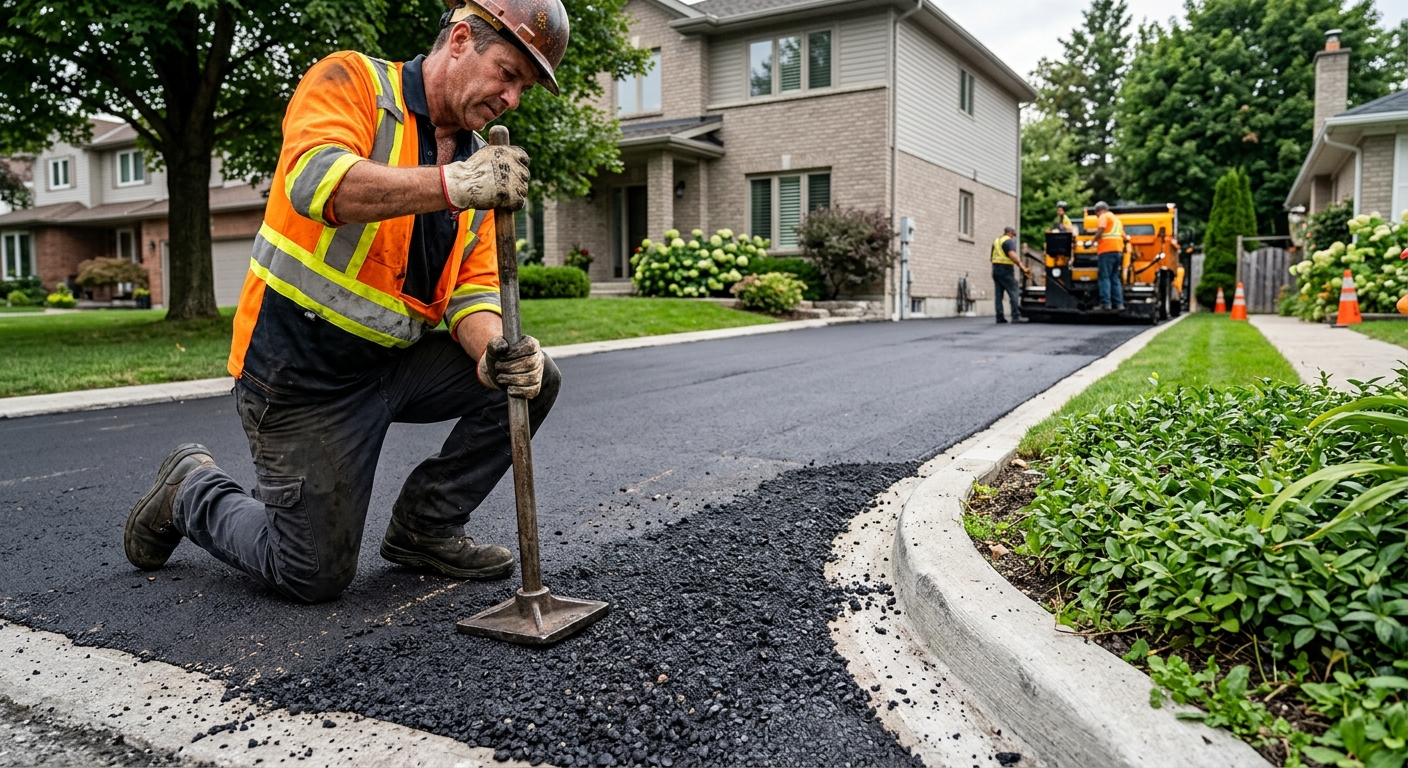
What a new driveway costs in Downingtown
In Downingtown, driveway paving is a decision that matters most for the 52.9% of homes that are owner-occupied—yet because only 19.9% are single-family houses, the expense falls on a smaller share of the population than you might think (U.S. Census Bureau, ACS 2024). If your home is one of those standalones, you’re in a group facing the rising wave of 1960s–1980s driveways now reaching the end of their dependable life. Our region’s moderate freeze-thaw cycles and limestone-derived soils demand thicker, properly compacted bases to prevent settlement and cracks that start from below—critical in Chester County’s central zone.
When comparing estimates, remember: most of the visible differences in a finished driveway are minor—curb appeal or surface texture. The real difference in quality (and therefore cost) is under the surface. Cheap quotes almost always skimp on preparation, excavation, and base thickness, which won’t show for a few years but makes all the difference for lifespan. Here’s what you can expect to pay, based on the type of work and condition of what you have now:
| Service |
Best for |
Lifespan |
Price range |
| Asphalt — full replacement with new base |
failed base, structural cracking |
20–30 yrs |
$3,800–$9,900 |
| Asphalt overlay / resurfacing |
sound base, surface cracking only |
8–15 yrs |
$1,650–$4,900 |
| Sealcoating — single application |
preventive maintenance on sound asphalt |
2–4 yrs |
$225–$750 |
| Concrete — new installation |
long service life, low maintenance |
30–50 yrs |
$5,500–$13,000 |
| Crack filling and patching |
isolated cracks under a quarter inch |
1–3 yrs |
$200–$800 |
| Gravel driveway |
rural, budget, long runs |
5–10 yrs with upkeep |
$900–$3,500 |
Estimates for a typical Downingtown driveway. Square footage and base condition drive these figures more than material choice.
What a real paving quote contains
Comparing driveway quotes in Downingtown isn’t about finding the lowest number—it’s about making sure you’re shopping for the same thing. A proper proposal spells out the measured square footage of your job, not just a guess. It lists the depth of excavation, how the old material and debris get hauled away, and what type and thickness of stone aggregate gets installed for the new base. Compaction matters—a good quote describes whether it’s done in lifts, not just rolled once on top.
The asphalt work itself should specify the number of courses and their compacted depths. Edges need to be explained: are they hand-tamped, sloped, or left vertical? Drainage direction and grading should be described. Restoration means more than raking out ruts; expect the quote to promise basic touch-up to lawn and boundary as part of cleanup. Finally, a standard payment schedule and a written warranty—with clear exclusions—should be set in the contract. Most warranties here specifically exclude cracking because that’s driven by base and subgrade conditions, not just the surface work.
The single detail that marks a poor deal in Chester County is the one-line quote—“pave driveway $4,800”—with no breakdown. If you can’t compare specs, you can’t compare value, and this is how people around here end up paying for a new driveway and getting only a fresh topping.
| Line item |
What to look for |
Red flag if… |
| Area |
measured square footage stated |
eyeballed or absent |
| Excavation |
depth and disposal included |
'we'll pave over it' |
| Base |
aggregate type and depth in inches |
'proper base' |
| Compaction |
method, and done in lifts |
not mentioned |
| Asphalt |
courses and compacted depth |
'3 inches' unqualified |
| Drainage |
slope and water direction stated |
silent |
| Warranty |
what is covered and what is excluded |
verbal only |
| Payment |
modest deposit, balance on completion |
full cash up front |
The specifications to demand in writing
If you want your Downingtown driveway to last, stop comparing just the bottom-line price and start comparing the numbers that describe the work. A “3-inch asphalt driveway” can mean drastically different things—a 3-inch compacted surface placed over a 6-inch crushed aggregate base dug out of native soil will outlast and outperform 3 inches of asphalt dumped on worn-out stone or old blacktop every time.
The only real defense a homeowner has here is to insist every material and every thickness is spelled out in the proposal. Because Chester County gets regular freeze-thaw cycles and sits over limestone and dolomite base soils, skimping on depth or base material means you’ll see settlement and cracks far sooner than in a milder region. The difference between a 2-inch and a 4-inch asphalt base is sometimes ten more years without a pothole. Demand specifics, not generalities:
- Driveway area in measured square feet
- Excavation and removal depth in inches
- Aggregate base type (e.g., PennDOT 2A modified stone) and compacted depth, minimum 6–8 inches
- Number of aggregate lifts and method of compaction
- Binder course (base asphalt) type and compacted depth (e.g., 2–3 inches)
- Surface course (top asphalt) mix designation and compacted depth (e.g., 1–2 inches)
- Treatment at driveway edges (hand-tamped, angled, retained, or not)
- Exact drainage plan—pitch, slope, and where runoff is directed
- Cleanup, including soil or seed to restore disturbed yard edges
- Written warranty, with clear description of what is and isn’t covered
Permits and approvals for paving in Downingtown
For most homes in Downingtown and wider Chester County, simply resurfacing or replacing an existing driveway in its original footprint generally does not require a building permit—so in many cases you save yourself time and paperwork. But if the project touches the area where your driveway meets the public road—the approach—a separate driveway permit is almost always necessary. If you’re working anywhere close to a township or state-maintained road, PennDOT Engineering District 6-0 is the authority for approach permits, not the local code office. North Coventry Township and a few others may require a driveway permit for new paving, extensions, or any work in the right-of-way.
Whenever a driveway expansion increases the area of hard surface, be aware that Chester County municipalities can impose stormwater requirements—meaning you can’t direct drained water toward a neighbor or the street, regardless of what permits you have. If your project changes the layout, or if you see visible water problems now, get drainage addressed in the contract.
State law here requires any contractor doing more than $500 of paving to carry Home Improvement Contractor (HIC) registration issued by the Pennsylvania Office of Attorney General (verify at hic.attorneygeneral.gov). All employers must provide workers’ compensation coverage—check via the state’s WCAIS system (wcais.pa.gov) before signing.
The paving season in southeastern Pennsylvania
The paving season in Downingtown is dictated by our climate—there’s no workaround. Because hot-mix asphalt must be laid and compacted while it’s still hot, major pavement work is usually restricted to April through early November, when average daytime highs and the ground temperature allow for proper compaction. With winter design temps around 14 °F and a frost depth of 30 inches in Chester County, asphalt plants close for winter and reopen only when it’s warm enough for quality paving.
Concrete work has its own weather window. It needs to be poured and finished when overnight temperatures stay well above freezing to allow proper cure, or surface flaking and premature cracking will follow. Both asphalt and concrete work risk failure if rushed outside these limits.
Local material supply is rarely a bottleneck in Chester County thanks to nearby quarries and asphalt plants, but getting onto a reputable crew’s schedule is hardest during the peak summer months. Prices and scheduling are more homeowner-friendly in spring and fall when there is more flexibility and less backlog. If a Downingtown crew offers a winter paving slot, something isn’t right—either the material is wrong for the season, or the quality will not hold. Trust the calendar over a promise of a “great deal” outside the reliable season.
Beyond replacement: layout changes
Projects that alter the footprint—widening for a second car, extending to a garage in back, adding a parking pad, or converting gravel to hard surface—require a different approach than straight-up replacement. Anything that puts new paving on existing soil means you need the full excavation, base stone, and compaction as if it were a brand-new job; shortcuts here lead to settlement and cracks, especially over Chester County’s limestone soils. Merging new asphalt with an old edge will always leave a seam, which remains the weakest point in your driveway for years to come.
Adding square footage typically triggers review for township stormwater rules—you can’t increase impervious surface and direct new runoff onto neighboring properties. Local regulations may also specify minimum setbacks from property lines, which can restrict how wide or close to the boundary you can pave. And if your new layout changes where your driveway meets the road, a driveway or approach permit from either your township or PennDOT (for state routes) is required.
Every expansion is best started with a plan and conversation with your selected paving contractor, who should know both local rules and where permitting is required—and never proceed on a handshake alone.
Getting thirty years out of a driveway
The way to make your Downingtown driveway last isn’t magic—it’s maintenance and planning. The biggest factor is sealing cracks as soon as they appear, before water penetrates to the stone base beneath and freeze-thaw cycles cause heaving or rutting. Keeping the gravel or soil at the driveway edge up to grade for lateral support prevents edge breakdown. Good drainage—downhill away from the house and not toward the street—keeps water from undermining the base or causing settlement, and is especially critical in this region’s moderate freeze-thaw cycles.
Don’t put fixed loads (like dumpsters or storage containers) on one spot for any length of time. For new asphalt, wait the full curing period (typically 2–4 weeks, depending on weather) before parking vehicles or turning the wheels sharply while stationary. This prevents surface marking and distortion.
For de-icing, avoid rock salt on concrete—it accelerates surface damage. On asphalt, salt is less of a chemical problem, but constant melting and refreezing will speed wear and promote cracks. Sand, calcium chloride, or magnesium chloride products are gentler but pricier. The best advice: keep up on snow removal, and use de-icers only when necessary—not as an everyday habit.
Frequently asked questions — driveway paving in Downingtown
What are the signs of a failing driveway base?
A failing base in Downingtown driveways isn’t just a few cracks or potholes—it’s problems you can’t seal over. Look for alligator cracking, which resembles scales or chicken wire and signals that the support underneath is giving way. Widespread sinking or depressions, edge separation, and places where patching comes loose year after year all show the base is compromised. If your driveway has frequent puddles that weren’t there before, or areas that keep settling even after patching, the stone base likely needs full excavation and replacement. At that point, an overlay or sealcoating—priced at $1,650–$4,900 and $225–$750 respectively—will only waste money, since the problem comes from below, not the surface. Correcting a failing base means a complete rebuild, not just a new layer of blacktop.
How many freeze-thaw cycles does Downingtown get?
In Downingtown, we’re in a moderate freeze-thaw zone for Pennsylvania. The ground regularly cycles above and below freezing throughout the winter, which means water seeps into cracks and joints, freezes and expands, then thaws and contracts—over and over. Most years, homeowners see dozens of these cycles, which is why deep cracks and potholes show up so quickly on neglected asphalt and concrete here. That’s very different from areas farther west, where the ground freezes once and stays frozen, or much milder climates. If your driveway isn’t built on a well-compacted, thick stone base as specified for Chester County, all that movement shortens its lifespan and increases maintenance costs. Spending on a full-depth build, in the $3,800–$9,900 range for asphalt, is what resists the punishment of local freeze-thaw events.
When is the best time of year to pave in Downingtown?
The best time to pave a driveway in Downingtown is usually from late April through October. During these months, the temperatures stay reliably above the thresholds needed to lay and compact hot-mix asphalt without quality risks. Local asphalt plants also run their full production schedules then, making material easy for contractors to get and queues more manageable. Crews often have more availability and the best pricing during the shoulder months—spring and early fall—before they get fully booked for summer and before the cold nights arrive. If a Downingtown contractor offers to pave in December, be skeptical: the ground is typically too cold, which leads to poor compaction and shortens driveway lifespan. Expect a quality job, built in the busy season, to range between $3,800–$9,900 for a full replacement.
Does sealcoating fix cracks?
Sealcoating in Downingtown is a good preservation step, but it’s not a structural repair. Sealcoat creates a flexible, sun-blocking layer that slows oxidation and sheds water off the asphalt surface—that’s why it’s recommended every couple of years at a cost of $225–$750. But it won’t fill in or prevent cracks deeper than hairline width. If your driveway already shows fissures or alligator cracks, those need to be filled with a proper rubberized crack filler first. Otherwise, the cracks will widen and allow water into the base during our region’s freeze-thaw cycles. Think of sealcoating as sunscreen for your driveway—not a bandage. True repairs require more preparation than just rolling on a coating, especially in Chester County’s climate.
How much does it cost to widen a driveway?
Widening a driveway in Downingtown is more involved than just paving a few extra feet. Because this means adding paving over virgin soil, expect your contractor to excavate, install a deep stone base, and match the new asphalt’s thickness to the original for a durable seam. The typical price is similar to a new installation, running $3,800–$9,900 for asphalt and $5,500–$13,000 for concrete, depending on the total new square footage. The cost per added foot is a function of preparation, not just the surface, and local Chester County regulations may also require you to secure an approach permit or meet setback rules if you’re close to property lines. It’s often a substantial project—get it specified in detail before signing.
How do I verify a paving contractor in Pennsylvania?
In Pennsylvania, anyone doing more than $500 in paving work (which is all meaningful driveway jobs) must register as a Home Improvement Contractor (HIC) through the Office of Attorney General. Before hiring, always check the contractor’s registration at hic.attorneygeneral.gov—this tells you if they’re properly listed and whether there are complaints. Also, ask for proof of workers’ compensation insurance, which every employer must carry and can be confirmed through the state’s WCAIS portal (wcais.pa.gov). Never skip this step, no matter how friendly or familiar the contractor seems. If a Downingtown company can’t show these basics or hesitates to provide documentation, keep looking. These protections are built into every properly priced job, like an asphalt replacement from $3,800–$9,900—not add-ons or “extra costs.”
How deep should the aggregate base be here?
In Chester County and especially Downingtown, the minimum aggregate base under an asphalt driveway should be 6–8 inches of compacted stone—ideally PennDOT 2A modified stone. That’s because limestone and dolomite soils in the area are prone to settling and can cause reflective cracking if the base is thin or uneven. A shallower base might pass in warmer climates, but with our moderate freeze-thaw conditions, going any thinner almost guarantees future problems. On older houses (over 73% in Downingtown built before 1980), undersized bases are a major reason for early failure. Full excavation and proper base installation adds to the up-front price—typically in the $3,800–$9,900 range for a standard replacement—but pays off with longevity.
Should I repair or replace my Downingtown driveway?
Choosing between repair and full replacement for your Downingtown driveway comes down to base condition and age. If the problems are mostly on the surface—minor cracks, shallow potholes, faded color—an overlay or patching from $1,650–$4,900 might be worth it, especially if the stone base is solid and the driveway isn’t older than 15 years. But if you see alligator cracking, repeated settling, or deep holes that come back every spring, those are signs the base is shot. In that case, spending money on patching or sealcoating is just delaying the inevitable, and your dollars are better put toward a full replacement at $3,800–$9,900. Always get a trusted contractor to lift a section for inspection before making the call.
Is gravel a cheaper option in Downingtown?
Gravel driveways are indeed the most budget-friendly option in Downingtown, especially for longer rural runs or homeowners who need extra vehicle space without the high initial outlay. The typical installation costs $900–$3,500, which is far below even a basic asphalt overlay. However, keep in mind that gravel demands routine upkeep to maintain appearance and functionality, especially with the freeze-thaw cycles that loosen stone and create ruts. If you’re inside one of Downingtown’s denser neighborhoods, appearance rules or township ordinances might make gravel difficult or inappropriate as a permanent solution. Still, for some homes—particularly where drainage is a challenge or access is temporary—gravel makes economic sense.