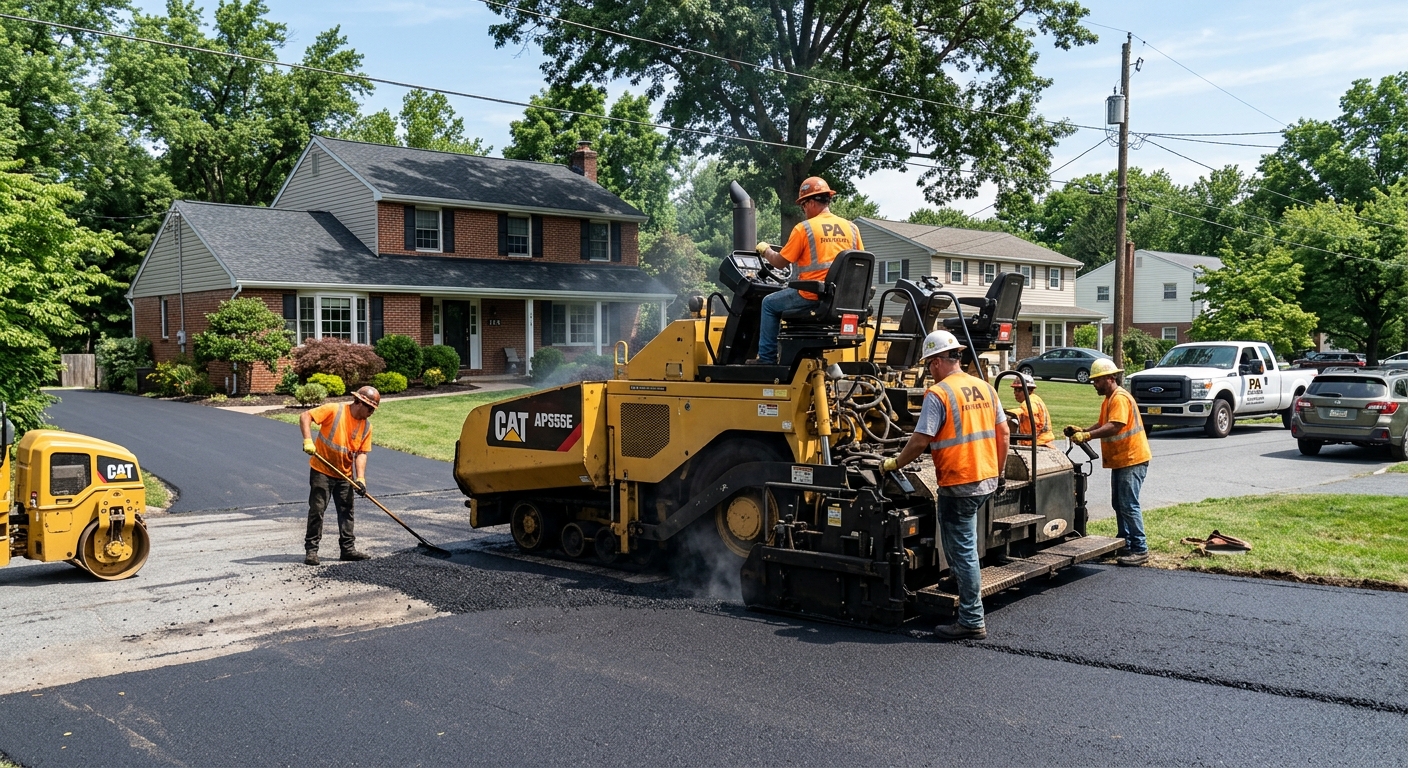
Driveway paving costs in Palmyra — 2026
Palmyra sits in a mostly owner-occupied, single-family home neighborhood—roughly 45% of homes are detached, and the homeownership rate stands at just over half. That means most driveways here are privately maintained and, for houses built before 1980, now facing decisions about replacement or more regular upkeep. With residential driveways, especially under Palmyra’s freeze-thaw heavy climate, what you pay is shaped most by things you will never see: what’s done under the asphalt or concrete, not just what’s on top. Base preparation, subgrade depth, stone thickness, and drainage handling create nearly all of the difference between a rock-solid, decades-long job and a patchy mess that heaves and cracks after two winters.
This is even more true in Palmyra because of the local soil—a limestone karst subgrade, especially near North Lebanon Township—which means the stone base under your driveway matters more. If someone gives you a surprisingly low bid, it usually means they’re skipping steps you can’t see: less excavation, thinner or softer stone, or poor drainage handling. Here’s what different paving options typically cost around Palmyra for 2026:
| Service |
Best for |
Lifespan |
Price range |
| Asphalt — full replacement with new base |
failed base, structural cracking |
20–30 yrs |
$3,300–$8,500 |
| Asphalt overlay / resurfacing |
sound base, surface cracking only |
8–15 yrs |
$1,400–$4,300 |
| Sealcoating — single application |
preventive maintenance on sound asphalt |
2–4 yrs |
$200–$650 |
| Concrete — new installation |
long service life, low maintenance |
30–50 yrs |
$4,700–$11,500 |
| Crack filling and patching |
isolated cracks under a quarter inch |
1–3 yrs |
$200–$800 |
| Gravel driveway |
rural, budget, long runs |
5–10 yrs with upkeep |
$900–$3,500 |
Estimates for a typical Palmyra driveway. Square footage and base condition drive these figures more than material choice.
Asphalt or concrete for a Palmyra driveway?
For Palmyra homeowners, the real deciding factor between asphalt and concrete is how these materials handle south-central Pennsylvania’s relentless freeze-thaw swings and winter road salt. Asphalt is flexible—it moves when the ground shifts, letting it survive when limestone soils or deep frost heave the base up and down. It’s less expensive up front but does need routine sealcoating every few years. Concrete, on the other hand, is rigid and offers a very long service life in theory, but it’s more vulnerable to salt damage. Every winter, driveways in Palmyra end up coated in salt runoff from plows and tires, and most spalling or scaling in concrete here is from salt attack, not surface cracking.
If you never used salt or chloride de-icers, concrete could last three or four decades—many owners intend to avoid salt but don’t manage it once the first ice storm hits. Asphalt tolerates that reality much better. For typical Palmyra homes, asphalt replacement ($3,300–$8,500) is the market standard. Concrete demands a higher up-front investment ($4,700–$11,500) and stricter care habits; otherwise, expect premature repairs from scaling.
Pavers can work well for patios or decorative zones—they’re strong, easy to repair, but come at a premium and require a stable base. Gravel remains the most flexible and forgiving for long driveways or rural runs in Palmyra’s outskirts—just expect to top-dress every few years.
| Option |
Installed cost |
Maintenance |
Freeze-thaw performance |
Lifespan |
| Asphalt — new install |
$3,300–$8,500 |
sealcoat every 3–4 yrs |
excellent, flexes |
20–30 yrs |
| Asphalt — overlay |
$1,400–$4,300 |
same |
good if base is sound |
+8–15 yrs |
| Concrete |
$4,700–$11,500 |
low, avoid de-icing salt |
fair, spalls with salt |
30–50 yrs |
| Pavers |
$7,600–$11,500 |
individual units replaceable |
good, settles gradually |
25–50 yrs |
| Gravel |
$900–$3,500 |
top-dress every 2–3 yrs |
excellent drainage |
indefinite with upkeep |
Permits and approvals for paving in Palmyra
If you’re resurfacing your existing asphalt driveway in Palmyra—just restoring the top layer, not expanding—it’s not likely you’ll need a building permit based on county practice. However, if you’re paving a new driveway or altering the footprint (making it wider, adding a pad, or rerouting), you generally do need a zoning and building permit through the Lebanon County Planning Department. The exception is the driveway approach: where your driveway meets a public road. For state-maintained highways, PennDOT District 8 issues Highway Occupancy driveway approach permits—most people overlook this step and apply to the wrong office, so check your street’s status before starting.
Expanding an impervious surface (like turning gravel into asphalt or concrete) can trigger stormwater requirements, and it’s on the homeowner to avoid new runoff onto a neighbor’s land. Violating this isn’t just a permit issue; it’s a direct liability risk regardless of paperwork.
Contractors must hold a valid Home Improvement Contractor (HIC) registration for jobs over $500—verify them at hic.attorneygeneral.gov. Workers’ compensation is required for all employers in Pennsylvania, and you can check a contractor’s compliance at WCAIS (wcais.pa.gov). These steps are your surest protection when hiring for paving in Palmyra.
Widening, extending or adding a parking pad
When you want more than a straightforward driveway replacement—say, adding a second parking spot, extending to reach a detached garage, building a turnaround, or upgrading a gravel access to asphalt—there’s a bigger checklist. Any change to the driveway footprint starts with undisturbed subgrade, meaning the new section needs excavation and an all-new base. The joint where new meets old will forever be a weak seam, often the first place to crack or settle.
Palmyra’s zoning and stormwater rules come into play for all these projects: expanding your impervious area almost always means a permit from the Lebanon County Planning Department, and you may be limited in how much of your lot can be hard-paved. Setbacks—how close you can pave to neighbors or the street—are enforced in most county townships.
If your extension meets a state or township road, approach permitting applies, handled by PennDOT District 8 or your local township office. Always check before paving to save yourself grief—a call to the right office up front beats fines and rework after the fact.
How paving fraud actually operates
Paving scams show up in Lebanon County every summer. The work is high visibility—from the road, new asphalt looks identical whether it’s top-tier or a “fly-by-night” job. The scam: leftover material from “a job down the street,” today-only discounts, cash up front, out-of-state license plates, unmarked trucks, and the promise of sealcoating or paving for half the going rate, but with no written contract. Because rural or suburban areas like Jackson Township have more distance between neighbors and thinner contractor markets, these operators know they can vanish before the homeowner sees a problem.
Key tactics: no written scope (just a handshake or scribbled number), refusal to show HIC registration, and ultra-thin sealant sprayed on with no prep. The damage doesn’t show until the first or second freeze-thaw cycle, when cracks, settling, or base failure appear and the "contractor" is long gone.
Palmyra and all of Pennsylvania require a written contract for any job over $500, and you have a legal right to cancel within three business days under the Home Improvement Consumer Protection Act. If anyone tries to rush that window or says they’ll “waive your deductible,” they’re breaking state law. Demand a clear scope in writing, never pay in full before work begins, and always check HIC registration and insurance first.
Five-minute checks that stop almost every scam: verify HIC at hic.attorneygeneral.gov, confirm workers’ comp at WCAIS, get a written quote listing every step, and never agree to “today only” deals. If they can’t or won’t provide paperwork, walk away.
Base preparation: the part you pay for and never see
Few jobs are more about what’s underground than driveway paving in Palmyra. A properly built driveway starts with stable soil (the subgrade), covered by a layer of compacted aggregate stone, then finished with asphalt or concrete on top. Each layer supports the one above it—if any is skipped or done poorly, the driveway fails early, even if the top looks perfect on day one.
Our region’s limestone karst subgrade is infamous for sinkholes and soft spots, making it critical that the compacted stone base is thicker than what you’d get away with elsewhere. On top of that, south-central Pennsylvania’s 30-inch frost depth and freeze-thaw cycling mean that water trapped in the base will expand, heaving the entire slab up in winter. That’s why a crushed-stone base (not just sand or soil) and careful grading to move water away from the slab matter more here than almost anywhere.
When you see a quote that’s drastically lower, this is usually where the cost was cut—not enough excavation, cheap or thin aggregate, or skipping compaction testing. The trick is that shortcuts under the surface don’t become visible until several years (and freeze-thaw cycles) later. Honest contractors specify how many inches of base (for this soil, 8–10 inches of compacted crushed limestone is standard), how the base is compacted (in 2–3 inch lifts, never just all at once), and what stone is used. Make these requirements part of your contract—if it’s not in writing, it won’t be done once the dump truck leaves. Solid base prep, not just a pretty finish, is what makes a Palmyra driveway survive a decade of winters.
Overlay, patch or full replacement?
There’s a simple rule for Palmyra driveways: the base tells the story. You can check a lot yourself before calling anyone out. If you see alligator cracking—a network of cracks that look like a map or the skin of an alligator—especially over wide areas, the base has failed. If cracks are isolated and under a quarter inch wide, that’s just surface aging, and patching or sealcoating makes sense. Depressions or birdbaths suggest the subgrade shifted, likely from water or frost. Crumbling edges are from lack of support, often where the base was never extended to the edge or has eroded away. Potholes mean water has gotten into and through the base; patching might buy time, but the root problem will worsen. Faded but otherwise sound asphalt just needs maintenance.
Never accept an overlay quote unless the contractor has confirmed the base is stable—otherwise, new asphalt will fail rapidly. Patches and overlays have their place, but sometimes replacement is the honest answer.
| What you see |
Likely cause |
Right fix |
Cost |
| Isolated cracks under 1/4 inch |
surface aging |
crack fill and seal |
$200–$650 |
| Alligator cracking over a wide area |
base failure |
full replacement |
$3,300–$8,500 |
| Depressions holding water |
subgrade movement |
excavate and rebuild that area |
$3,300–$5,200 |
| Crumbling edges |
no edge support |
edge repair, consider curbing |
$400–$1,500 |
| Potholes |
water into the base |
full-depth patch, then assess |
$250–$900 |
| Faded but sound surface |
oxidation only |
sealcoat |
$200–$650 |
Frequently asked questions — driveway paving in Palmyra
What kind of soil is under Palmyra driveways?
Palmyra driveways, especially north toward North Lebanon Township, are built over limestone karst—a subgrade that’s notorious for being both stable and unpredictable. Limestone soils drain fairly well but can develop soft spots or even sinkholes if water isn’t managed right. That means a thicker, well-compacted aggregate base is critical for any driveway job in Palmyra. Contractors who know Lebanon County’s quirks will recommend at least 8–10 inches of stone underneath new asphalt or concrete. Skipping this step can turn a full-replacement job that should last decades ($3,300–$8,500) into a chronic repair headache far sooner.
How long does a driveway installation take?
In a typical Palmyra neighborhood, a straightforward asphalt replacement—digging out old material, prepping and compacting the base, and paving—runs two to three days for most single-family driveways. Add a few days when changing the footprint or pouring concrete, which needs longer to cure (usually five to seven days before parking on it). If weather delays come into play, which is common in our wet spring/fall seasons, you may get pushed back. Overlay or resurfacing jobs ($1,400–$4,300) can often be finished within a single day, but always allow extra drying or setting time for best results.
What are the signs of a failing driveway base?
Signs of a failing base underneath your Palmyra driveway usually show up as alligator cracking (a web of small, interconnected cracks), depressions that hold water or never fully dry, potholes that return after patching, and sections where the pavement feels spongy underfoot. Edge crumbling is another key sign, since it means the stone base didn’t reach far enough or has worn away. When you see these symptoms, repairs like overlays or sealcoating ($200–$650) won’t hold up—the problem is underneath. At that point, only full-depth reconstruction fixes it for good.
How thick should asphalt be for a residential driveway in Palmyra?
With Palmyra’s freeze-thaw climate and limestone subgrade, the industry norm is a minimum of 3 inches compacted asphalt on top of an 8–10 inch compacted crushed-stone base for residential driveways. Some contractors might offer thinner installs to cut costs, but in south-central Pennsylvania—including Lebanon County—less than this almost guarantees premature cracking or settling. For overlays, expect 1.5–2 inches added on top if the base is sound. Skimping here just means you’ll be calling for repair or replacement ($3,300–$8,500) well before you should.
Why are paving quotes in Palmyra so different from each other?
The biggest reason paving quotes vary in Palmyra is what happens below the surface—the prep and materials you won’t see. Some contractors cut corners: skipping old base removal, using thinner stone, or not compacting in layers. Others include full excavation, proper stone, and proof of compaction. That’s why you’ll see a big range, from a “cheap” job that looks fine this year but falls apart fast, to one built to last 20+ years. For example, a typical full replacement runs $5,200, but you may see bids as low as $3,300 or over $8,500—ask for base thickness, stone type and proof of compaction in your contract.
When can I seal a brand new asphalt driveway?
In Palmyra’s climate, you need to wait at least 90 days (and ideally a full season) before sealcoating new asphalt. This pause lets the fresh pavement cure fully and its natural oils come to the surface—otherwise, premature sealing can trap moisture and cause peeling or soft spots. Plan to apply the first sealcoat in late summer or early fall, weather permitting. One coat every 3–4 years afterwards, at $200–$650 each time, keeps a new driveway looking sharp and extends its life considerably.
How much does driveway paving cost in Palmyra?
For a standard Palmyra driveway, full asphalt replacement with a fresh stone base usually falls between $3,300–$8,500, with most jobs landing around $5,200. Resurfacing an existing base is less, in the $1,400–$4,300 range. Concrete is a higher up-front investment at $4,700–$11,500, but can last longer if maintained. Small repairs—crack-filling or sealcoating—run $200–$800. The biggest variable is square footage and how much base work is needed.
Can I pave over my existing driveway?
In some Palmyra cases, yes—you can overlay new asphalt over old if the base is stable and cracks are only superficial. That’s usually an option on drives less than 20 years old with no major depressions or widespread cracking. A proper inspection means probing down to the base in several spots. If the old drive has alligator cracks, soft areas, or holds water, overlaying will just trap those problems and you’ll be paying for full replacement ($3,300–$8,500) within a few years anyway. The right contractor will be upfront about when it’s worth doing and when you’re just buying time.
Do I need an approach permit where my driveway meets the road?
Yes, if your Palmyra driveway connects to a state highway, you’ll need a Highway Occupancy Permit from PennDOT District 8. For township or local roads, the township itself issues the approach permit. Resurfacing work that doesn’t affect the driveway entrance usually skips this step, but any project that rebuilds, widens, or redirects where you join the road triggers the permit process. Skipping this can lead to stop-work orders or fines, so check your street’s classification before paving. Permits add a bit of time and cost but streamline resale or future property improvements ($1,400–$4,300 for most overlays with approach work included).