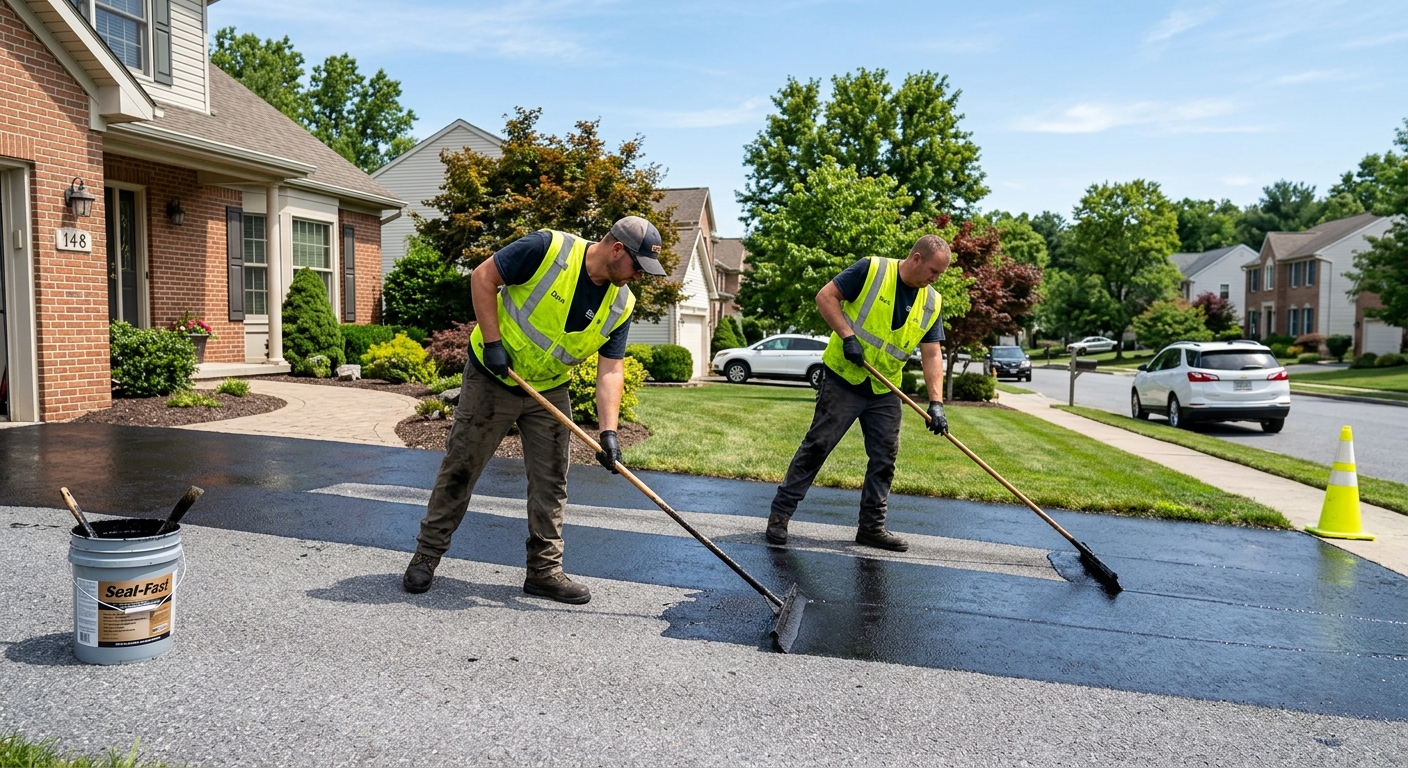
Driveway paving costs in Plymouth — 2026
With 68.3% homeownership and more than half of Plymouth dwellings being single-family homes (U.S. Census Bureau, ACS 2024), driveway paving is a routine but substantial investment for local households. Most homes were built before 1980, pulling in a steady flow of re-paving work as original surfaces age out. In southeastern Pennsylvania’s moderate freeze-thaw climate, what you see on the surface never tells the whole story—nearly all cost differences between quotes come down to what’s hidden below the asphalt or concrete. If you compare two bids for the “same” driveway in Plymouth, the cheaper one is almost always cutting corners on excavation, stone, or compaction, not just markups on materials.
Local subgrade is often silty clay or glacial till, both of which need a thicker aggregate base to withstand rutting and heaving in a climate that cycles above and below freezing through the winter. Asphalt overlays may seem affordable, but if the underlying base is weak or holds water, you’ll be replacing it years sooner. Concrete is a bigger upfront outlay, but can pay off with decades of durability for those seeking a low-maintenance surface. For those simply buying curb appeal or prepping to sell, sealcoating is a fresh look at a modest cost—but it’s not structural protection.
| Service |
Best for |
Lifespan |
Price range |
| Asphalt — full replacement with new base |
failed base, structural cracking |
20–30 yrs |
$3,800–$9,800 |
| Asphalt overlay / resurfacing |
sound base, surface cracking only |
8–15 yrs |
$1,650–$4,900 |
| Sealcoating — single application |
preventive maintenance on sound asphalt |
2–4 yrs |
$225–$750 |
| Concrete — new installation |
long service life, low maintenance |
30–50 yrs |
$5,400–$13,000 |
| Crack filling and patching |
isolated cracks under a quarter inch |
1–3 yrs |
$200–$800 |
| Gravel driveway |
rural, budget, long runs |
5–10 yrs with upkeep |
$900–$3,500 |
Estimates for a typical Plymouth driveway. Square footage and base condition drive these figures more than material choice.
Sealcoating: what it does and what it doesn't
Sealcoating is one of those routine home maintenance tasks in Plymouth that is often oversold and misunderstood. It does deliver a sharp black finish, restores some of the initial look, and puts down a protective layer to slow your driveway’s aging from the sun, oxygen, road salt, fuel or oil spills. Preventing oxidation keeps your asphalt binder pliable, delaying brittle cracking on driveways that are otherwise in decent shape.
What sealcoating cannot do is stop existing structural problems. If you’ve got depressions that puddle or the edges are crumbling away, sealcoating won’t fix them. It also doesn’t add an ounce of structural strength. The durability gained is limited to the surface. If the driveway’s base has failed, sealcoating is at best cosmetic and may hide problems until they worsen.
Applying sealcoat too often is common—and harmful. Extra layers build up and turn brittle, eventually cracking or flaking off, especially after several quick, cheap spray-on jobs. On newly paved asphalt, sealing too soon can trap uncured volatiles, leading to soft spots and peeling layers. A sound routine in Plymouth is every 2–4 years at most, and only after a full curing period for fresh asphalt. Crack filling, not sealcoating, is what actually prevents water penetration and freeze-thaw damage. Done right, it’s a rubberized filler, not just a squirt of cold-patch.
A thorough sealcoat application involves prep, edge cutting, and hand-brushing the first coat—expect $225–$750 for a real job. Prices much below this typically mean a thin, quickly sprayed emulsion that may look fine for weeks but will disappear at the first freeze or rain. If you’re quoted a bargain, ask what’s being skipped, and remember that no surface film can rescue a failing base.
Door-knocking crews and leftover material
Paving scams hit the same streets in Plymouth as anywhere else in Montgomery County, taking advantage of work that’s highly visible but where the real defect will sometimes hide for years. The typical pitch is some version of, “We’ve got leftover material from a job nearby and can do yours cheap today.” That may be paired with a demand for cash up front, a verbal price with no paperwork, or an unmarked truck parked out front. Today-only pricing and out-of-area phone numbers are tip-offs that a crew is looking to leave without a trace.
Oil-based spray sold as “sealcoating” is a perennial: it turns your driveway black for a few weeks, then rapidly breaks down. These traveling crews rely on the homeowner’s urgency and the promise of quick savings. Competition in the Philadelphia metro suburbs is heavy, but the same density that drives those offers also means most reputable contractors aren’t knocking unannounced—they have more work than hours in the day.
Pennsylvania consumer law is built for situations like this. The Home Improvement Consumer Protection Act requires a written contract for any driveway work over $500, and gives you three business days to cancel. No exceptions for “special deals” or “leftover loads.” You are also entitled to an itemized scope of work and cannot legally waive your homeowner’s insurance deductible.
A five-minute screen before hiring: verify HIC registration at hic.attorneygeneral.gov, check their workers’ compensation status at WCAIS (wcais.pa.gov), and demand every promise in writing—this blocks nearly every bad actor cold.
The paving season in southeastern Pennsylvania
The paving season in Plymouth and the greater Montgomery County area is very much set by the calendar, not just by preference. For hot-mix asphalt, you need a window where both air and surface temperatures are reliably warm enough—the winter design temp here is 14 °F, and the plants that supply asphalt along the I‑276 and US 202 corridors close for the winter months. If you’re being quoted a project in deep winter, you’re either looking at cold patch (temporary at best) or a crew that’s ignoring the basics.
Even concrete installs, though less temperature-sensitive than asphalt, can’t be poured and finished reliably below freezing. Both materials set better in the spring and fall shoulder seasons when the temperature swings are moderate—crews have more schedule flexibility then, and prices are steadier than in backlogged midsummer.
Summer peak means crews and plants run flat-out. If you’re scheduling in July or August, expect to book weeks out and pay a premium. Low-cost or urgent paving work offered in late November or December in Plymouth is a red flag—the surface may look right for a season but could be riddled with unnoticeable flaws. If your contractor works when the local plants are closed, they are not laying material that will endure a Pennsylvania freeze-thaw cycle.
What to put in a Plymouth paving contract
Price alone tells you little about driveway quality in Plymouth. In this climate and with our local clay till subgrade, a contract must spell out actual specs—otherwise, the lower price usually means the contractor is shaving depth or skipping compaction. Phrases like “about three inches of asphalt” or “stone as needed” are nearly meaningless because after the crew leaves and your driveway is rolled, you can’t see what’s underground (and you can’t measure loosely compacted lifts).
What counts here, where freeze-thaw cycles work water and clay deep into the drive, is written depth and base details, not just total thickness. The right way is specifying compacted, and for each layer—not “laid” thickness, which is always more before the compactor. If someone says, “We’ll put down three inches,” ask: compacted or uncompacted? How thick is the stone base, and what was used? Anything unmeasured is open to shortcutting.
- Total excavation depth (inches, from current surface)
- Aggregate base thickness, in compacted inches (minimum 6–8” here on silty clay; more for poor drainage)
- Aggregate type (e.g., 2A modified stone)
- Base compaction method (vibratory roller, in lifts)
- Binder course asphalt thickness, compacted
- Surface course asphalt thickness, compacted
- Asphalt mix designation (e.g., 9.5mm or 19mm, per PennDOT specs if possible)
- Edge treatment (tapered edge, backfill, or concrete restraint)
- Drainage and slope design
- Timeline for return to vehicle use
Permits and approvals for paving in Plymouth
In most of Plymouth, replacing or resurfacing your driveway inside its existing footprint usually doesn’t call for a municipal building permit, especially if you’re not altering the curb, apron, or sidewalk. But the one spot that trips up many homeowners is the driveway approach—where your driveway connects to the township road. In Montgomery Township, for example, this means a road occupancy permit from the Montgomery Township Public Works Department.
If you plan to widen the driveway, change the apron at the street, or install new drainage that affects curbs and sidewalks, expect at least one permit, and sometimes more if stormwater runoff is involved. Expanding your impervious surface can also trigger reviews for stormwater impact or minimum green space—be mindful that township staff have an eye for water redirection. And no matter the permit, you are liable if runoff is directed onto a neighbor's property.
Always verify your paving contractor has a Pennsylvania Home Improvement Contractor (HIC) registration through the Attorney General’s HIC database at hic.attorneygeneral.gov, and check proof of workers’ compensation status in the WCAIS system. You are entitled to this verification before signing—don’t rely on word of mouth or truck logos alone.
Drainage: the failure nobody plans for
Every failed driveway in Plymouth that I’ve torn out has one thing in common—water was allowed to stick around. Drainage isn’t a finish detail; it’s core to whether your new pavement lasts a few years or a few decades. Here, a minimum slope of 2% (about a quarter inch per foot) is best to keep water moving. Long driveways get cross-slope or crowning to send water to edges rather than pooling in the drive. If the drive slopes toward your house or garage, you’re set up for water in the foundation and frost heaving under the slab.
Where grade can’t be corrected, trench or channel drains installed at the garage threshold or apron are sometimes the only solution. This region’s clay and glacial till base means poor natural drainage—so stone base must be thicker than in sandy soils, and drain lines need an outlet (“daylighted”) lower than the end of the drive or into a dry well built to handle runoff. If your site is flat or you’re boxed in by neighbors, never gamble with surface water—give it somewhere to go.
Freeze-thaw cycles turn ponded water into expanding ice that jacks up pavement, splits the base, and chews holes along the edge—once that happens, even the best topcoat can’t save it. And remember: sending runoff onto a neighbor’s property, whether by design or accident, is a liability risk that no permit can shield you from.
Frequently asked questions — driveway paving in Plymouth
How much does it cost to widen a driveway?
Widening a driveway in Plymouth costs much the same as new installation work, since it involves excavation, grading, base stone, and adding new surface. For asphalt, you’re typically looking at $3,800–$9,800 for full replacement including widening, with the upper end including work on the approach or curb. If your existing drive is sound and you’re just widening an apron or adding a lane, an overlay for the addition may run $1,650–$4,900. But don’t widen just for the sake of it: added impervious surface can trigger stormwater review, and wider drives require more ongoing maintenance. It’s worth discussing with your contractor whether your current layout and run-off patterns support a wider drive without inviting drainage and permit headaches.
How often should I sealcoat my driveway in Plymouth?
In Plymouth’s climate, with humid summers and frequent freeze-thaw cycles, sealcoating is generally appropriate every 2–4 years. More frequent applications are not only unnecessary, but may actually harm your asphalt by trapping moisture or building up brittle layers that later crack and peel. Wait at least one full year after a fresh paving before the first sealcoat. On an average-sized drive, professional sealcoating costs $225–$750. Focus more on spot crack filling as issues appear, because sealing alone won’t stop water from penetrating structural cracks. When the drive is older but still structurally sound, that’s when sealcoating gives the most meaningful value—delaying UV aging and oil stains, but not “fixing” underlying problems.
Does Plymouth have local asphalt plants?
Yes, for Plymouth homeowners, asphalt is supplied from established plants along the I‑276 and US 202 corridors, keeping truck haul distances short. This is one reason why pricing in Montgomery County is more stable and competitive than some rural counties, and why crews can move quickly for both small and large jobs. Local supply means you’re not being charged for long-distance hauling, and ensures that the mix stays within the correct temperature window—critical in a climate with a 14 °F winter design temperature. For a full replacement, expect $3,800–$9,800. If your contract mentions “leftover material,” be wary: real contractors buy from these local plants at the job’s start, not from what’s left on another.
How long before I can drive on a new asphalt driveway?
After a new asphalt driveway is installed in Plymouth, you should keep vehicles off for at least 3–5 days during summer and 5–7 days if the weather is cool or overcast. Full curing—where asphalt binder hardens and volatiles leave—takes months, but staying off it initially prevents ruts or marking. If you need access sooner, discuss whether steel plates or a temporary ramp can be placed without damaging the surface. For overlays, the wait might be shorter, but confirm it in writing. A typical driveway replacement runs $3,800–$9,800, so it’s worth the short inconvenience to protect your investment.
Is an overlay worth it or should I start over?
An overlay or resurfacing is worth considering in Plymouth if your driveway’s base is stable—meaning no structural cracks, soft spots, or persistent drainage issues. At $1,650–$4,900, it’s less money than a full replacement, and can restore the look and function for 8–15 years. But if you see deep alligator cracking, depressions that return after patching, or edges breaking away, those are signs the base is failing. In that case, an overlay is just covering up expensive problems that will come through in short order. With Montgomery County’s clay subgrade and freeze-thaw swings, investing in a full base rebuild pays off over the long run. Never let price alone push you into an overlay—evaluate the real condition first.
How much does driveway paving cost in Plymouth?
The total cost for driveway paving in Plymouth depends on size, thickness, and prep, but most homeowners pay $3,800–$9,800 for full asphalt replacement with new base. Overlay ranges from $1,650–$4,900 if the subbase is stable, and concrete drives are higher at $5,400–$13,000. What drives price isn’t the surface—it’s excavation, stone base, edge work, and drainage. Montgomery County’s local supply chain helps with cost stability, but never be tempted by prices far below this range. They almost always reflect shortcuts on base work that will show up in a few seasons.
How do I verify a paving contractor in Pennsylvania?
For Plymouth residents, start by checking their Home Improvement Contractor (HIC) registration at the official Pennsylvania Attorney General site: hic.attorneygeneral.gov. This is state-mandated for any residential driveway job over $500—almost all real jobs in this market. Second, verify their workers’ compensation status in the WCAIS system (wcais.pa.gov). These two checks take minutes and weed out most uninsured or unregistered contractors. Always insist on a written contract as required by the Home Improvement Consumer Protection Act, and never pay more than one third up front. For a typical job, you’ll see prices in the $3,800–$9,800 range for a full replacement. Documentation protects you if something goes wrong.
How deep should the aggregate base be here?
In Plymouth, with our glacial till and silty clay soils, you need a compacted stone base at least 6–8 inches thick for best results—sometimes more on flat or poorly draining sites. The silty clay holds water, which magnifies freeze-thaw action and can undermine the pavement if your base is thin. A “standard” 4-inch base used in other parts of the country will rut here after a couple of severe winters. This base depth supports a 3 to 4-inch compacted asphalt mat, bringing your replacement cost into the $3,800–$9,800 band for most layouts. Any spec less than 6 inches is likely too shallow for local soil and climate.
What are the signs of a failing driveway base?
In Plymouth, signs that your driveway base is failing—not just the topcoat—include widespread “alligator” cracking, depressions that reappear after patching, soft spots underfoot, heaving or buckling along edges, and sections that hold standing water after rain. You may notice early weeds poking through, or gravel migrating upward into the asphalt. All of these point to water infiltrating the base and frost working it apart. These failures are not cosmetic and can’t be fixed with sealcoating or a simple overlay. If your driveway fits this description, it’s time to consider a full replacement at $3,800–$9,800, because anything else is a short-term patch and not a cure for base failure.