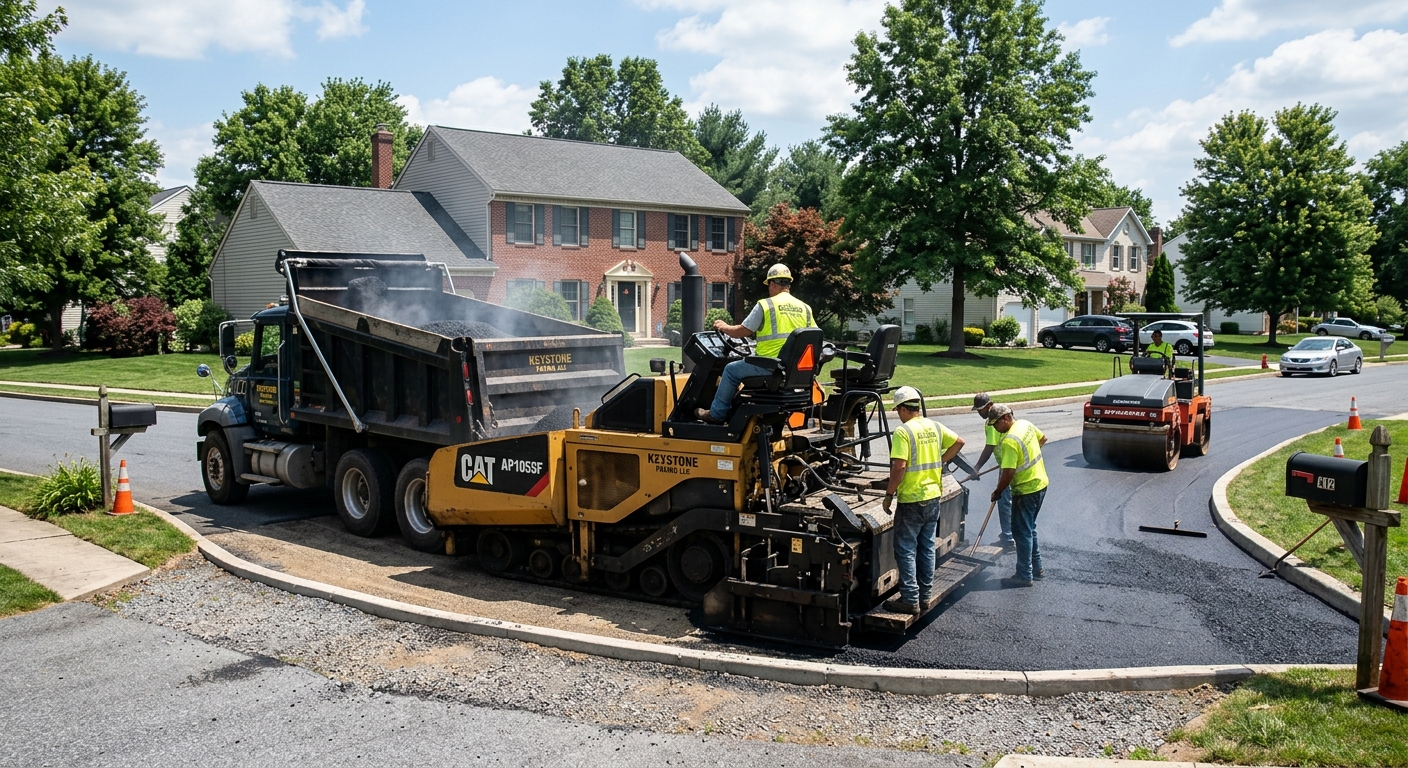
Driveway paving costs in Manchester — 2026
Manchester households face driveway decisions more often than you might expect: 88.3% of households here are owner-occupied, and the majority of the housing stock—71.2%—is single-family homes (U.S. Census Bureau, ACS 2024). For most, a driveway is a practical necessity and a major outlay. What you pay depends far less on the blacktop you see than on what’s beneath it.
Our region’s pronounced freeze-thaw cycle and York County’s shale subgrade mean the unseen base is what drives both cost and longevity. A cheap job may fail early if the base isn’t rebuilt when needed, while a higher quote often reflects hauling more stone or correcting drainage. Manchester driveways frequently need extra base work for this reason, and that’s where the real difference lies from one estimate to the next. Material choice matters, but neglecting what’s below the surface risks spending the same sum more than once.
| Service |
Best for |
Lifespan |
Price range |
| Asphalt — full replacement with new base |
failed base, structural cracking |
20–30 yrs |
$3,800–$9,700 |
| Asphalt overlay / resurfacing |
sound base, surface cracking only |
8–15 yrs |
$1,600–$4,800 |
| Sealcoating — single application |
preventive maintenance on sound asphalt |
2–4 yrs |
$225–$750 |
| Concrete — new installation |
long service life, low maintenance |
30–50 yrs |
$5,400–$13,000 |
| Crack filling and patching |
isolated cracks under a quarter inch |
1–3 yrs |
$200–$800 |
| Gravel driveway |
rural, budget, long runs |
5–10 yrs with upkeep |
$900–$3,500 |
Estimates for a typical Manchester driveway. Square footage and base condition drive these figures more than material choice.
Comparing materials in south-central Pennsylvania
Choosing between asphalt and concrete in Manchester is mostly a question of how each handles the local climate. South-central Pennsylvania’s freeze-thaw cycles are punishing—with winter design lows down to 12 °F. Asphalt survives by flexing with the ground as it moves. When properly installed, it will shed surface cracks instead of shattering, which is critical given the cycling we see every winter.
Concrete lasts longer—30 to 50 years when left intact—but the catch is de-icing salt. York County gets moderate snowfall and most homeowners do use salt. Salts penetrate concrete, causing it to scale, spall, and fail not by cracking but by the top surface crumbling away. Unless you are willing and able to give up chloride-based de-icers, this is a real risk that limits concrete’s effective lifespan here. Paver driveways avoid this particular problem—they’re expensive but let you replace small sections over time. Gravel remains a viable choice for rural properties and long runs; it’s the lowest maintenance option, but means a rutty surface and regular top-ups.
| Option |
Installed cost |
Maintenance |
Freeze-thaw performance |
Lifespan |
| Asphalt — new install |
$3,800–$9,700 |
sealcoat every 3–4 yrs |
excellent, flexes |
20–30 yrs |
| Asphalt — overlay |
$1,600–$4,800 |
same |
good if base is sound |
+8–15 yrs |
| Concrete |
$5,400–$13,000 |
low, avoid de-icing salt |
fair, spalls with salt |
30–50 yrs |
| Pavers |
$8,600–$13,000 |
individual units replaceable |
good, settles gradually |
25–50 yrs |
| Gravel |
$900–$3,500 |
top-dress every 2–3 yrs |
excellent drainage |
indefinite with upkeep |
Why you can't pave in February
Paving in Manchester is tied directly to the weather—and it’s absolutely cut off in winter. Asphalt must be laid while it’s hot and compacted long before it cools, or it will not bond and water will get in. With our average winter lows under 12 °F and regular freeze-thaw cycles, local asphalt plants stop production entirely during the coldest months. There simply is no fresh product available, and even if there were, crews can’t compact it before it hardens. Concrete is also off-limits in the cold: it needs above-freezing temps to cure properly and resist early surface damage.
Starting as early as March (weather depending), crews begin work for the season—if the frost is out and plants are up and running. The shoulder months—spring and early fall—are when experienced contractors have room in the schedule and the weather plays along. By high summer, demand peaks. If you get an offer to pave in late November or early winter here, take it as a warning—either they’re cutting corners or they’ll rush the job and you’ll pay the price within the first year or two. Book with that reality in mind, and don’t trust any “deal” that happens outside actual paving season in Yorkshire County.
Caring for a new Manchester driveway
How you treat a new driveway in Manchester has real impact on its lifespan—especially with our frequent freeze-thaw cycling. Crack filling is the most important step: sealing even small surface cracks before winter keeps water from reaching and destroying the base. This single act extends service life more than any other. Second, always support the edges with soil or gravel so the pavement isn’t undermined, and don’t drive or park off the edges.
Drainage matters just as much. Make sure water flows off the driveway and doesn’t pool, as standing water speeds up the freeze-thaw damage cycle. Keep heavy point loads—think dumpsters, jacks, or heavy trucks—off new pavement for as long as you can, but at least four weeks for asphalt. Don’t turn steering wheels while stationary on new asphalt in its first summer, or you’ll gouge ruts into the surface.
For de-icing: salt is the enemy of concrete and should be avoided. Sand, calcium magnesium acetate, or potassium chloride are safer for pavement but cost more. For asphalt, salt’s main risk is making water seep and refreeze, so moderation is key. Good care is worth more than any coating a contractor can sell you, especially in a Manchester winter.
How paving fraud actually operates
Manchester and the broader York County market see their share of paving fraud—because driveways are obvious from the street, and poor prep or thin asphalt is invisible to the homeowner until years later. The most common scams start with a knock on the door: someone claims they have “leftover material from a job nearby,” offers a today-only rate, and wants payment up front—often cash. The truck will be unmarked or run out-of-state tags. They will either hand you a verbal quote or claim they’ll “write it up later.” The most dangerous: selling a thin layer of oil-based spray as real sealcoating. These tactics flourish where job verification is tricky—suburban Manchester isn’t as exposed as a rural township, but checking details still protects you.
You have strong legal protection here. In Pennsylvania, any contract over $500 must be in writing under the Home Improvement Consumer Protection Act, and you have a three-business-day right to cancel—no reason needed. Never pay in full before the job is done (a fair deposit is normal). These laws exist for exactly this reason: visible work, invisible defects, and out-of-town operators preying on owner-occupied neighborhoods.
Want a five-minute check? Confirm their PA Home Improvement Contractor registration at hic.attorneygeneral.gov, and their workers’ comp coverage at wcais.pa.gov. Require a written scope of work and read the cancellation language. No legitimate York County paver will balk at that.
How to tell if the base is gone
If you’re staring at a worn or cracking driveway in Manchester, these simple clues can tell you whether you need a costly rebuild or can get by with maintenance. Alligator cracking—meaning tight, scale-like crack patterns over a wide area—means the base has failed and patching is a waste. Surface cracks that run straight and don’t branch are usually just age; these can be crack-filled and sealed. Depressions where water sits point to subgrade or drainage problems, and those sections must be rebuilt, not just resurfaced. Crumbling edges mean the driveway was never given enough lateral support—sometimes curbing is the only lasting fix. Potholes mean water has actually made it to (and through) the base, and while a full-depth patch can give you a few years, that’s the point you start budgeting for a replacement.
Any contractor who skips this sort of on-site diagnosis and jumps right to an overlay quote is asking you to risk burning money. If the base is shot, putting new blacktop over it just delays the inevitable and does nothing about movement below the surface.
| What you see |
Likely cause |
Right fix |
Cost |
| Isolated cracks under 1/4 inch |
surface aging |
crack fill and seal |
$225–$750 |
| Alligator cracking over a wide area |
base failure |
full replacement |
$3,800–$9,700 |
| Depressions holding water |
subgrade movement |
excavate and rebuild that area |
$3,800–$5,900 |
| Crumbling edges |
no edge support |
edge repair, consider curbing |
$400–$1,500 |
| Potholes |
water into the base |
full-depth patch, then assess |
$250–$900 |
| Faded but sound surface |
oxidation only |
sealcoat |
$225–$750 |
Driveway permits, approaches and stormwater rules
In most of Manchester and York County, simply repaving your driveway within the same footprint does not require a building permit—though always check if you live in York City, where driveway reconstruction or expansion does require one. The most common pain point is the driveway approach: where your drive meets the public street. On state roads, curb cut permitting comes from PennDOT District 8; on township roads, township authorities handle it. Many homeowners expect this to be covered by their general town permit, but it’s a separate process entirely.
Expanding your driveway or changing grade can impact stormwater drainage. If you add impervious surface or route water toward a neighbor or the road, you may trigger runoff requirements and could be liable for resulting problems even if you hold all permits. With shale subgrades and Manchester’s snowmelt cycles, drainage planning is non-negotiable.
Before hiring, verify that your contractor is registered as a Home Improvement Contractor at hic.attorneygeneral.gov, and make sure they have workers’ compensation insurance—it’s easy to check at wcais.pa.gov. Both are required in Pennsylvania for contracts over $500, and there’s no substitute for this due diligence.
Frequently asked questions — driveway paving in Manchester
What causes driveway cracks in Manchester?
Manchester sees pronounced freeze-thaw cycling each year, and this is the number one cause of driveway cracks. Water enters small surface cracks, freezes and expands, and ruptures the pavement in winter. Over time, repeated cycles widen cracks and cause new ones. The typical shale subgrade in York County sometimes moves under these cycles as well, worsening the problem if the base wasn't built thick enough during installation. In addition, snowplows, salt, and UV radiation can degrade the surface, especially on older or poorly sealed driveways. Catching cracks early and sealing them quickly is critical here—a simple crack fill and seal usually costs $225–$750 and extends the life of your driveway in Manchester.
Can I pave over my existing driveway?
Overlaying new asphalt on an existing driveway, called resurfacing, is common in Manchester—but only when the base is solid and there are no signs of subsurface movement. If you see wide alligator cracking or deep depressions, an overlay is money down the drain, as it won’t last without base correction. However, if your driveway just has some surface cracks or is faded but still sturdy, a resurfacing job can add 8–15 more years for $1,600–$4,800, less than half the cost of full replacement. It is worth having a reputable local contractor probe the base first, rather than simply trusting that what you see is all there is.
Can I cancel a paving contract I signed at my door?
Yes—for any contract signed for driveway work in Manchester, if the agreement is over $500 and made at your home, Pennsylvania’s Home Improvement Consumer Protection Act gives you a three-business-day right to cancel. This applies no matter what the contractor says and regardless of their schedule or claims of “limited time only” pricing. The law is designed for exactly these door-to-door sales situations. Written notice is best, and must be delivered within that three-day window. Don’t be pressured to pay a deposit until the period passes. On a typical job, like a full asphalt replacement from $3,800–$9,700, that window is crucial. Always review the contract cancellation language before signing.
Are door-to-door pavers a problem in Manchester?
They are, and with Manchester’s mix of suburban and township homes, it’s not uncommon for crews from out of the area to pitch “leftover asphalt” or today-only deals. The law here—requiring written contracts over $500 and a three-day cancellation period—helps, but only if you know to ask and verify. If a crew won’t give details you can check or dodges the official Home Improvement Contractor registry, that’s a flag. Hiring the cheapest offer without verifying registration could mean paying $1,600–$4,800 for an overlay that fails in its first winter. Book only with proven, registered Manchester contractors.
Does sealcoating fix cracks?
No—sealcoating protects but does not fill or repair cracks. In Manchester, with regular freeze-thaw cycles, any crack left unaddressed will let water in, undermine the base, and force early driveway replacement. True crack repair involves cleaning out the joint, filling it with hot or cold-applied crack sealant, and only then applying a sealcoat as surface protection. For a single pass of sealcoating, expect $225–$750 for an average Manchester drive, but don’t expect that to fix structural cracks. Crack filling is a separate, critical step.
How far ahead should I book a paver in Manchester?
Most Manchester contractors book prime season jobs two to four months out—sometimes longer if it’s a larger or full-replacement job. Local demand spikes in summer, so booking early in spring or even during winter is wise if you want work completed before fall. Many crews stop work entirely in winter due to plant closures and temperature limits. If you wait for peak season you might pay premium prices, and possibly wait into the following year for $3,800–$9,700 full replacement schedules. Lead time is your friend—book early to get the best slot and pricing.
What does sealcoating cost in Manchester?
A typical single application of sealcoating for a Manchester driveway ranges from $225–$750, depending on driveway size and any prep work required (cleaning, edging, minor crack filling). York County’s mix of wide and mid-length suburban drives puts most homes in the $400–$500 range. This is preventive—sealcoating does not fix structural problems, but it does extend surface life by protecting against sun, water, and chemical damage from de-icing salts. For best results with our winters, sealcoating every 3–4 years is recommended.
What does an asphalt overlay cost in Manchester?
For a driveway with a sound base, an asphalt overlay or resurfacing in Manchester runs $1,600–$4,800 for typical mid-sized drives. Size, layout, and base condition all affect this number. If contractors do not verify base strength, don’t commit—the cheapest overlay can end up failing within a season or two if used over a compromised base, especially here with regular freeze-thaw. Before hiring, request a core or dig-down evaluation of the drive’s layers.
What slope does a driveway need for drainage?
Proper drainage is essential for every Manchester driveway, given our freeze-thaw cycles and potential for drainage-related base failure. Code here matches national standards: the driveway should slope away from buildings at a minimum of 2% (about a quarter inch per foot) for at least the first ten feet. For the remainder, maintain enough slope (usually at least 1%) to send water to the street or swale, never onto your neighbor’s property. The cost to correct poor drainage during paving—sometimes $3,800–$9,700 for excavation and rebuilding base—far outweighs the minimal price improvement for a perfectly level but poorly draining surface.